Most buyers who ask me about a new build vs resale villa in Montenegro expect one percentage: new costs this much more. After seven years on the bay, I can say that the evidence available in November 2026 does not support one honest figure for detached villas in Budva, Kotor and Tivat. What it does support is a method: match the properties, separate the tax treatment, and price the work an older house will need. This guide sets out that method with dated figures, three worked budgets and the legal checks behind each route.
A new-build villa in Montenegro is not automatically more expensive than a resale villa. In Budva, Kotor and Tivat, location, sea views, plot size and condition can outweigh building age. Buyers should compare like-for-like asking prices, resale transfer tax, renovation costs and developer VAT treatment before calculating the true price difference.

How Much More Does a New-Build Villa Cost?
No defensible universal or city-specific villa premium for new-build over resale can be stated from the sources reviewed on 13 November 2026. The datasets that exist either mix villas with other property types, mix asking prices with other measures, or describe apartments rather than detached houses. A percentage lifted from any of them would describe the wrong population.
The official benchmark is a useful anchor, but it is not a villa price. MONSTAT, the national statistics office, reported in its 20 August 2026 release that second-quarter 2026 average contracted prices for new dwellings were €2,557 per square metre (€/m²) nationally and €2,838/m² for the coastal region. That series covers first-time sales of dwellings in new residential buildings. It is not a resale series and not a dedicated villa price index, so the €2,838/m² coastal figure should not be applied to new-build villas.
The table below shows what the villa evidence actually contains. The only municipality-level villa figures I hold are unsegmented medians from a Fijaka listing snapshot dated 9 November 2026. They are asking prices for all villas in each dataset, whatever their age or condition.
| Municipality | All-villa median asking price (€, 9 November 2026) | All-villa median asking price (€/m², 9 November 2026) | Villas in dataset | New-build villa median (€/m²) | Resale villa median (€/m²) | Calculated new-build premium |
|---|---|---|---|---|---|---|
| Budva | 1,200,000 | 3,550 | 199 | Not established | Not established | Not established |
| Kotor | 1,050,000 | 3,790 | 135 | Not established | Not established | Not established |
| Tivat | 1,225,000 | 4,620 | 102 | Not established | Not established | Not established |
“Not established” means that separate new-build and resale villa medians, with their own sample sizes, were not available from the sample reviewed. The villa-wide figures are context only. They are not new-build prices, resale prices, achieved sale prices or valuations.
The premium formula is simple: (new-build €/m² ÷ resale €/m² − 1) × 100. As pure arithmetic, if matched new-build villas had a median of €4,000/m² and matched resale villas €3,600/m², the result would be (4,000 ÷ 3,600 − 1) × 100 = 11.1%. Those two inputs are invented for illustration and are not market observations.
A descriptive sample difference is not the same as a like-for-like premium. A sample difference simply subtracts one group median from another. A matched premium compares houses of similar size, plot, position, view and condition. Where waterfront resale stone houses sit in one group and hillside new builds in the other, the sample difference can be negative even when a new build costs more than an equivalent resale.
Other datasets pull in different directions, and the table below separates them by what they measure.
| Source | Population measured | Price type | Period | Usable as a villa new-build premium? |
|---|---|---|---|---|
| MONSTAT | First-time sales of new dwellings in new residential buildings | Average contracted price | Q2 2026 (released 20 August 2026) | No: not villas, not resale |
| Fijaka villa listings | All villas, unsegmented by age | Median asking price | 9 November 2026 | No: no new-build/resale split |
| Premium villa catalogue (Sotheby’s) | Curated higher-end villas | Median asking price | Reviewed 13 November 2026 | No: selection bias |
| Objekta comparison | Apartments, new-build and resale | €/m² | Date not established from the material reviewed | No: apartments only |
| Fijaka classified flats | Flats, new-build versus resale | Asking price | November 2026 | No: flats only |
The premium catalogue showed higher median asking prices, roughly €1,295,000 in Budva, €1,995,000 in Kotor and €2,080,000 in Tivat when reviewed on 13 November 2026. A curated catalogue lists fewer, more expensive houses than a broad listing platform, so its medians sit higher by design. I have not blended it with the broader platform into an average, because the two populations are different.
The apartment evidence shows why presumptions fail. Objekta’s comparison put Tivat apartments at €3,994/m² new-build against €3,949/m² resale, a gap of about 1.1%. In Kotor it showed €3,000/m² new-build against €3,933/m² resale, which makes new-build roughly 23.7% cheaper. Separately, Fijaka reported a 27% new-build asking-price premium for classified flats in a November 2026 snapshot. Three apartment results, three different stories, and none of them is a villa premium. They simply show that location and stock mix can reverse a presumed premium.
How to Compare Villa Prices Fairly
A fair comparison needs a written procedure that someone else could repeat. The steps below are the one I would use for a new build vs resale villa Montenegro comparison, and they are also the reason I distrust headline averages.
- Fix the property type. Include only detached villas. Exclude apartments, townhouses, semi-detached houses and mixed-use buildings, because their €/m² behaves differently.
- Split by construction status. Keep completed new builds, off-plan villas, recently built resales (for example under ten years old) and older homes in separate groups. An off-plan villa has no finished condition to inspect, so it should never be pooled with completed houses.
- Keep the geography tight. Compare within one municipality, and within one neighbourhood wherever possible. A Bečići villa and a hillside villa above Budva share a municipality but not a market.
- Match size and specification. A workable band is 200–350 m² of internal area, with similar bedroom counts, plot size, sea view, pool, parking, finish quality and legal status.
- Normalise area, but keep the plot. Convert internal area to €/m² for comparison, yet record plot size and total asking price beside it. A 300 m² house on 400 m² of land and one on 1,500 m² are not equivalent, whatever the €/m² says.
- Clean the sample. Remove duplicate advertisements for the same house, exclude listings with no price or “price on request”, and exclude incomplete shells. Report how many listings were removed and why.
- Treat outliers openly. Use medians rather than means, and note extreme listings instead of silently deleting them.
- Apply a minimum sample. A group with fewer than five meaningful comparable properties is insufficient for a general percentage claim. Describe the individual houses instead.
- Record the observation period. State the snapshot date, and say clearly that these are asking prices. Achieved sale prices are usually negotiated below or around them, and the sample does not show by how much.
This is where most first-time buyers slip up: they compare a municipality-wide median with one house they like. The median hides plot size, sea views, access roads and condition, and any one of those can outweigh the age of the building. A reproducible method also exposes weak claims, since a source that cannot state its sample size, exclusions and date has not earned a place in your budget.
Budva: New-Build and Resale Villa Costs
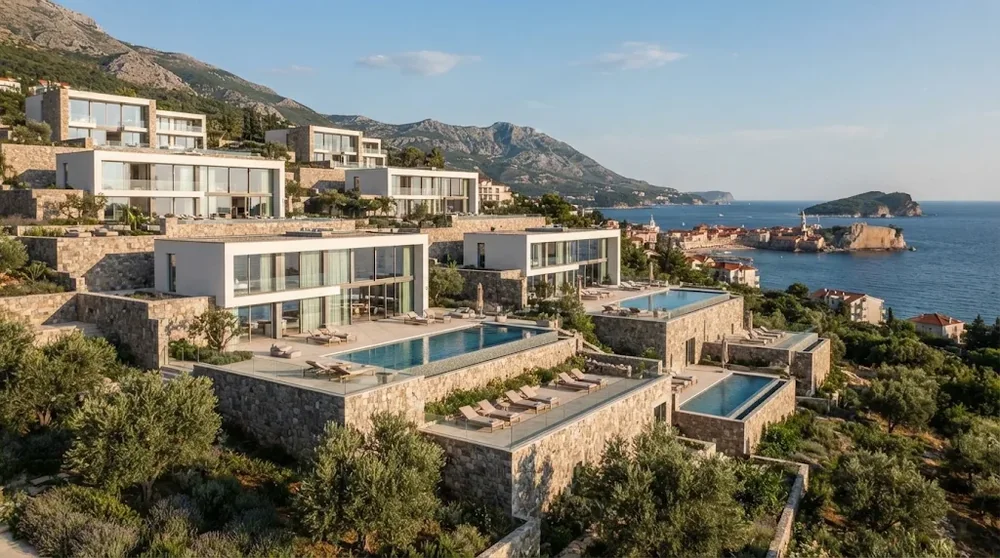
Drive up the hill road above Bečići in the late afternoon and the villas seem to stack up the slope like seats in an amphitheatre. Each terrace has its own slice of sea, and its own gradient to climb with the shopping. That variety is the real story of Budva, and it is why one municipal figure explains so little.
In the Fijaka listing snapshot dated 9 November 2026, Budva showed 199 villas, a median asking price of €1,200,000 and a median of €3,550/m². These figures cover all villas in that dataset. They are not a new-build figure, a resale figure or a record of completed sales, and I have not created a Budva new-build versus resale split, because none was established from the available sample.
| Area or factor | Evidence in this article | What changes the comparison |
|---|---|---|
| Budva villa-wide | €1,200,000 and €3,550/m², 199 listings, 9 November 2026 (asking) | Mixes all ages, sizes and conditions |
| Bečići | Neighbourhood median not established from the available sample | Distance to the beach and resort amenities; plot size is often limited |
| Reževići | Neighbourhood median not established from the available sample | Steeper ground, sea-view orientation and access road quality |
| Blizikuće | Neighbourhood median not established from the available sample | Hillside, generally car-dependent; larger plots are possible, and views vary terrace by terrace |
| Road gradient and parking | Not quantified | Winter access, turning space, number of covered spaces |
| Finish and renovation state | Not quantified | Turnkey finish versus works still to be done |
Within one hillside, the sea view usually matters more than the construction year. A villa with an uninterrupted view over the bay can ask more than a newer house whose view is a neighbour’s roof. Before comparing prices, I stand on the terrace and check whether the view is protected by the plot or could be built across next year. That last point is my assessment, not a measured fact.
Access is the quiet cost driver. A steep, narrow approach road affects delivery of materials, emergency access, winter driving and daily life, and a developer-built villa with a proper turning area and parking can be easier to live with than an older house reached by a lane. Pool specifications matter too: a pool built to a modern standard, with a working filtration plant and sound waterproofing, is a different asset from an older pool that needs relining.
I looked for two or three traceable comparable Budva listings that I could classify correctly, but I did not verify such a set for this article, so I have not quoted any. No Budva construction-age premium is established, and any local claim of one should be tested against matched properties, using the procedure above.
Kotor: New Villas Versus Stone Houses
The Bay of Kotor was built by sea captains and stonemasons, and the houses along the water at Dobrota still show it: heavy limestone walls, shuttered windows, and gardens that run down to the quay. When I restored my own stone house here seven years ago, I learned that these buildings are valued as much for where they stand as for what they are. This house has a story — and so does its paperwork, and the two have to be read together.
The Fijaka snapshot of 9 November 2026 recorded 135 villas in Kotor, a median asking price of €1,050,000 and a median of €3,790/m². As with Budva, these are villa-wide asking prices, not a new-build or resale split.
| Area or factor | Evidence in this article | Why the comparison is difficult |
|---|---|---|
| Kotor villa-wide | €1,050,000 and €3,790/m², 135 listings, 9 November 2026 (asking) | Mixes stone houses, modern villas and hillside homes |
| Dobrota | Neighbourhood median not established from the available sample | Bay-side frontage is scarce, so position can outweigh age |
| Prčanj | Neighbourhood median not established from the available sample | Historic stone houses on the water, with protected surroundings and restricted plots |
| Kavač | Neighbourhood median not established from the available sample | Elevated position, bay views, lower walkability |
| Heritage constraints | Not quantified | Approvals, permitted materials and works in protected areas |
An older stone house in a prime position can exceed the price of a contemporary hillside home because the waterfront cannot be built again. A newer villa above the road may offer more internal space, a pool and better insulation, yet it cannot replicate a terrace on the water. That is why simple age-based comparisons mislead in Kotor: scarce waterfront position can outweigh construction age.
My own opinion, drawn from restoring a stone house rather than from market data: the visible walls are rarely the expensive part. Water behind the masonry, old roof timbers and poor drainage are the items that change a budget, and they are hard to judge on a first viewing.
Heritage settings add constraints. The bay lies within a UNESCO-listed region, and works on historic or protected buildings may need approvals and sympathetic materials. Contractor availability is a practical issue too: skilled stonemasons and people who understand lime-based mortar are in demand, so scheduling can matter as much as price. I cannot give a verified cost per square metre for any of this, and I will not invent one. A realistic restoration estimate comes from a surveyor’s report and written contractor quotations, not from a listing.
Structural renovation of old masonry is a different category of work from refreshing a modern interior, and I return to that distinction below.

Tivat: Contemporary Villas and Resale Alternatives
Tivat feels different from its neighbours. The old naval yard became a marina, and much of the surrounding housing was built or refreshed to match, so the town reads as newer than Kotor or the Budva hillside. That reputation can distort comparisons, because the polished corner near the marina is one market and the rest of the municipality is another.
The Fijaka snapshot of 9 November 2026 showed 102 villas in Tivat, a median asking price of €1,225,000 and a median of €4,620/m². I use this as a benchmark only. The €/m² figure is the highest of the three municipalities, but whether that reflects marina proximity, smaller houses or stock mix is not established from the available sample.
| Area or factor | Evidence in this article | What to separate |
|---|---|---|
| Tivat villa-wide | €1,225,000 and €4,620/m², 102 listings, 9 November 2026 (asking) | Premium and ordinary stock sit in one median |
| Donja Lastva | Neighbourhood median not established from the available sample | Bay-side position, marina proximity and older houses |
| Seljanovo | Neighbourhood median not established from the available sample | Flatter ground and everyday access; test the airport proximity on site |
| Krašići | Neighbourhood median not established from the available sample | Smaller settlement with its own character; check each plot’s views and access |
| Luštica Peninsula | Not established; boundaries must be checked | The peninsula is not identical to Tivat municipality |
Municipal boundaries need care. The Luštica Peninsula is a geographic area, not a municipality, and a listing described as “Luštica” may lie inside or outside Tivat. Only villas in the cadastral municipality of Tivat belong in the Tivat figure above, and the cadastral extract, not the advertisement headline, settles which municipality a house is in.
Premium managed developments and ordinary detached houses are different products. A managed or marina-oriented development often offers turnkey finishes, shared services and consistent construction standards. An ordinary detached villa on its own plot offers privacy and plot control but leaves maintenance to you. I do not assume that the managed option is cheaper or dearer per square metre: the sample does not establish it, and service charges change the running cost.
Water views, finish level and proximity to the marina all move prices, and in Tivat they can matter more than whether the villa is new or resale. If you are choosing between a contemporary villa and a resale alternative, compare them on the same street, view and specification first, and only then look at the construction year.

Purchase Taxes: New Build Versus Resale
The tax route is the first place where a cheaper-looking resale can lose ground. I describe the rules as published in guidance in November 2026, and they should be verified against current legislation, and with the Montenegrin Tax Administration, before you sign anything.
New build: Value Added Tax (VAT)
A qualifying first transfer of a newly built property that is subject to 21% Value Added Tax (VAT) generally does not incur a separate Real Estate Transfer Tax. Developer-quoted prices are generally VAT-inclusive, but that should be confirmed in writing. Never add 21% to a price that is already stated as VAT-inclusive. Developer status alone is not proof of VAT treatment, so ask the seller to state in the contract whether VAT applies and how the price is made up.
Resale: progressive transfer tax
A resale purchase is generally subject to the Real Estate Transfer Tax. As of November 2026, published guidance describes a progressive calculation: 3% up to €150,000; €4,500 plus 5% of the amount over €150,000 up to €500,000; and €22,000 plus 6% of the amount over €500,000. The 5% and 6% rates are marginal. They apply only to the slice of price inside each band, not to the whole purchase price.
| Purchase price (€) | Tax on first €150,000 at 3% (€) | Tax on slice €150,000–500,000 at 5% (€) | Tax on slice above €500,000 at 6% (€) | Total transfer tax (€) | Effective rate |
|---|---|---|---|---|---|
| 500,000 | 4,500 | 17,500 | 0 | 22,000 | 4.4% |
| 750,000 | 4,500 | 17,500 | 15,000 | 37,000 | 4.9% |
| 1,000,000 | 4,500 | 17,500 | 30,000 | 52,000 | 5.2% |
These are tax illustrations only. They assume that the stated purchase price is the accepted taxable market-value base, and they are not total transaction costs. The tax base can differ from the contract price if the authority assesses market value differently, and that uncertainty is worth discussing with a tax adviser before you commit. In practice the buyer often bears the transfer tax, but the contract should state who pays it.
Other transaction costs
Notarial fees, registration at the cadastre (Uprava za nekretnine), independent legal review, and any agency commission that you have agreed in writing are separate lines. I have not published figures for these, because current notarial and registration charges require a current quotation and my sample does not establish an average. This is where most first-time buyers slip up: they price the tax and forget everything around it, then discover at the notary that the budget has no room for the paperwork.
Three Villa Budgets: Total Cost Comparison
The table below compares a new-build villa with a resale villa at three hypothetical budget points. Every figure is an editorial scenario, not a market observation, an achieved transaction price or an average. The resale tax uses the progressive calculation above on the stated asking price as the tax base.
| Line (€, illustrative) | Case A: new-build | Case A: resale | Case B: new-build | Case B: resale | Case C: new-build | Case C: resale |
|---|---|---|---|---|---|---|
| Asking price (new-build VAT-inclusive) | 500,000 | 380,000 | 750,000 | 640,000 | 1,000,000 | 1,150,000 |
| Qualifying tax or transfer tax | 0 separate | 16,000 | 0 separate | 29,000 | 0 separate | 61,000 |
| Documented transaction expenses (assumed 1% of price) | 5,000 | 3,800 | 7,500 | 6,400 | 10,000 | 11,500 |
| Refurbishment allowance | 5,000 | 40,000 | 10,000 | 80,000 | 15,000 | 120,000 |
| Contingency (15% new, 20% resale of allowance) | 750 | 8,000 | 1,500 | 16,000 | 2,250 | 24,000 |
| Illustrative total | 510,750 | 447,800 | 769,000 | 771,400 | 1,027,250 | 1,366,500 |
| Resale minus new-build (€) | −62,950 | +2,400 | +339,250 | |||
| Difference as % of new-build total | −12.3% | +0.3% | +33.0% | |||
Assumptions behind the table
The 1% transaction allowance is a placeholder for notary, registration, legal review and survey costs and is not a verified fee. The refurbishment lines are editorial scenarios that require individual quotations, with no market-observed cost behind them. New-build allowances stand for snagging and minor landscaping, resale allowances for refurbishment of an older house, and furnishing and any new pool construction are excluded. The tax arithmetic follows the brackets shown above.
Case A is a plausible resale-saving case: a resale asking price well below the new-build, even after tax, works and contingency, is cheaper in this scenario by about 12.3%. Case B is near-parity, with the resale discount almost entirely absorbed by tax and works, leaving the two within roughly 0.3%. Case C is an older-property-premium case, in which a historic or waterfront resale priced above a hillside new build ends up about 33.0% dearer once tax and works are added.
These scenarios are reproducible: change any input and the totals follow. They are not evidence that resale is cheaper, equal or dearer in the market. Their purpose is to show that the asking-price gap is only the starting point of the comparison, and that tax treatment, works and contingency can reverse it either way.
Renovation Costs and Hidden Property Defects
On paper this looks fine, but in reality a resale villa with a low asking price may need more work than its photographs suggest. A low asking price is not the same as a low completed cost. I treat renovation in three tiers, because the cost behaviour of each is different.
- Cosmetic refurbishment: repainting, new floor finishes, kitchens, bathrooms and furnishing. This is the most predictable tier and the easiest to quote.
- Medium renovation: replacing windows, adding insulation, upgrading electrical and plumbing installations, installing or replacing cooling and heating systems, and renewing waterproofing on terraces. The scope depends on what is found behind the finishes.
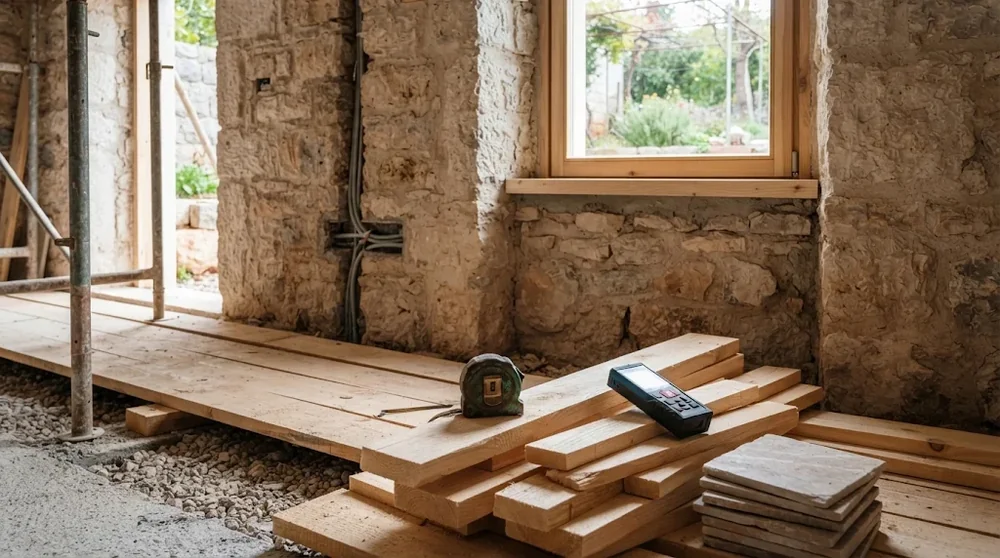
- Structural restoration: repairing roofs and roof timbers, consolidating masonry, treating rising damp, correcting foundation movement, rebuilding retaining walls and renewing drainage. This tier carries the greatest uncertainty.
Roofs deserve an early look: tiles that appear sound can hide failed membranes, rotted battens or sagging timbers. Masonry should be checked for cracks, loose rendering and weak mortar, and damp for tide-marks, salts and mould, which usually point to a drainage or waterproofing failure rather than a paint problem. Foundations and retaining walls matter on sloping plots, where water pressure behind a wall can move it. Pools need the shell, waterproofing and plant inspected, since a leaking pool is one of the costlier surprises on a hillside.
Montenegro’s coast is seismically active, and the 1979 earthquake damaged many buildings in Kotor and Budva. A surveyor should therefore comment on structural integrity and any past alterations, such as added storeys or removed walls, instead of relying on a visual impression.
A lesson from my own restoration: build the schedule around the work you cannot see. The decisions that cost me the most time were about drainage and the base of the walls, not about finishes.
Specialist stonework is a separate category from ordinary resurfacing. Repointing with lime mortar, repairing dressed stone and restoring a traditional roof need different skills and materials from a modern render job, and cheap shortcuts, such as cement over old stone, can trap moisture. I will not give a fabricated cost per square metre for any tier. Current local contractor quotations, based on an independent survey, are the only reliable basis.
For planning, an illustrative assumption of a contingency of 15–25% on agreed works, plus a schedule buffer for delays and permits, is sensible for older houses. These are hypothetical planning allowances, not observed norms. Project uncertainty is real: the final cost can be lower or higher than the first quotation, and an inspection before purchase narrows that range but cannot remove it.
Legal Checks Before Buying Either Villa
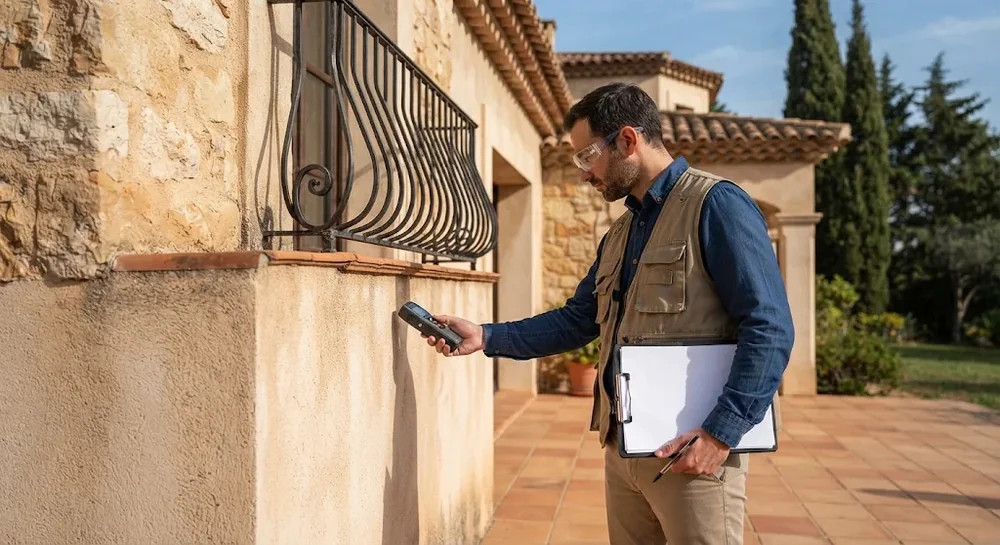
The first document I ask for is the current extract from the cadastre, the list nepokretnosti, issued by the Uprava za nekretnine, the real estate administration. Everything else is read against it. A new villa and an old one need the same core checks, and a developer-built or off-plan purchase needs more.
- Obtain a current list nepokretnosti. Check that it is recent and covers the parcel and the building.
- Confirm the registered owner. The seller named in the contract must match the registered owner, or hold documented authority to sell.
- Match parcel and structure. Compare the parcel number, building description and recorded floor areas with the physical property, and note any difference between cadastral and measured area.
- Check encumbrances. Look for mortgages, pledges, easements, disputes or restrictions recorded against the property.
- Verify legal access. A house reached by a lane needs a recorded right of way if the lane crosses someone else’s land.
- Request building approvals and completion documents. Ask for the construction permit and evidence that the building was completed under it.
- Identify extensions and alterations. Added floors, enclosed terraces, pools and outbuildings may fall outside the permit.
- Separate registration from legalisation. A building can be registered in the cadastre without completed legalisation (legalizacija). Distinguish three states: registered only, legalisation pending, and legalisation completed.
- For developer-built or off-plan villas, check the developer and the land. Confirm the developer’s identity, ownership of the land, valid permits, the contractual specification, payment milestones, warranty terms and the completion arrangements.
- Commission independent reviews. A qualified local lawyer should review the documents, and a building surveyor should inspect the house, before any reservation payment.
The legal framework for unlawfully built structures has been changing. A June 2026 government notice, published on the official government portal, described registration and legalisation requirements for unlawfully constructed buildings and referred to an August 2026 submission deadline. As of 13 November 2026 that date has passed, so I treat it as a historical fact and not as a current instruction. Verify the legal framework that applies today with a lawyer, and do not assume that mere registration confirms completed legalisation or that any outcome is assured.
If you are unsure which documents your particular villa needs, a short one-to-one conversation before you sign can save a great deal of trouble later.
Before you pay a reservation fee, make sure the cadastral extract, the permit history and the contract terms have been read by someone independent of the seller. A reservation payment can be hard to recover if the paperwork later disappoints. A developer’s offer should be tested in the same way: a polished brochure does not replace a signed specification and a clear delivery date.
Running Costs, Rental Use and Resale Value
The purchase price is one year of cost, while running costs continue for as long as you own the house. The table compares the main categories qualitatively, because actual amounts depend on the municipality, assessed value, property characteristics and how often the villa is occupied.
| Cost item | What drives it | Newer villa | Older or stone villa |
|---|---|---|---|
| Annual property tax | Municipal rate applied to assessed value | Depends on assessed value; may be higher for larger, newer houses | Depends on assessed value and recorded area |
| Maintenance | Age, materials, exposure | Usually lower in early years | Often higher, with recurring masonry and roof attention |
| Insurance | Value, location, construction | Requires a quotation | Requires a quotation; older fabric may be assessed differently |
| Pool and landscaping | Size, plant, planting | Seasonal servicing and water treatment | Similar, plus older plant and terrace repairs |
| Utilities and cooling | Insulation, systems, occupancy | Often better insulated | Thick stone buffers heat but may need heating and damp control |
| Management and reserve fund | Absence, rental use, shared services | Service charges in managed developments | Owner-arranged care; a renovation reserve is prudent |
Property tax is set by municipalities under national law and depends on assessed value, so it should be checked with the local authority for the specific house. Seasonal demand on the coast is strongly weighted to summer. Rental use in Budva, Kotor and Tivat therefore needs to be planned around a short, busy season and a quiet winter, and I do not forecast occupancy, yield or appreciation. Rental income and future capital appreciation are uncertain for any villa, new or old.
Resale appeal differs by type. A standard contemporary villa with parking and a pool tends to suit a wide group of buyers who want to move in. An isolated hillside home may appeal to fewer buyers, because access and winter use matter. A heritage property has a smaller, more specialised audience, who value character and are prepared to maintain it. None of this implies that modern villas always outperform older ones, and the sample does not show that either does.
My opinion, offered as opinion: I would rather own a house I can afford to maintain every year than one that wins on paper in year one and drains the budget in year five.
Think of running costs as scenarios and not predictions. If you plan to let the villa, compare a low-occupancy and a moderate-occupancy case, subtract management and upkeep, and treat anything above that as uncertain. The point is not to prove an investment return but to see whether the house can pay its own bills in a poor summer.
Which Villa Type Suits Your Budget?
The matrix below reflects my own assessment of fit, not a measured market advantage. Preference and performance are different things, and I have kept them apart.
| Your priority | New-build villa | Older resale villa | Heritage stone house |
|---|---|---|---|
| Turnkey use | Usually a good fit, subject to snagging | Depends on condition | Rarely turnkey |
| Restoration character | Limited | Possible | Strongest fit |
| Family lifestyle (space, pool, parking) | Often strong | Varies by plot | Space and parking can be limited |
| Management convenience | Easier, especially in managed schemes | Moderate | More hands-on |
| Upfront liquidity | More cash committed to price; less to works | Lower price but works may follow | Price and works both uncertain |
| Maintenance tolerance | Low to moderate | Moderate to high | High but rewarding for some owners |
| Possible resale | Broad audience | Depends on location and condition | Narrower, character-led audience |
For location, Budva suits buyers who want a broad choice of coastal and hillside houses and accept the busier summer season. Kotor suits buyers who value historic character around the bay and can live with approvals and maintenance. Tivat suits those who want contemporary housing near established marina-oriented amenities. None is universally better, and the right answer depends on your budget, year-round access and tolerance for work.
I would not pick between these on the strength of an average. A better route is to set your budget, preferred neighbourhood, internal area and renovation tolerance, then compare three or four specific villas on the same terms, with the full tax, works and contingency lines shown.
To match your budget, preferred neighbourhood and appetite for renovation to actual houses, a dated like-for-like shortlist is a more useful starting point than any municipal average.
Send your budget, location, size and renovation tolerance and I can prepare a dated villa shortlist, an itemised purchase-cost estimate and a legal-check list for the houses on it. That is general information tailored to your brief, not a promise of savings or investment performance, and the legal and tax steps still need your own lawyer and surveyor.
Frequently Asked Questions
Are new-build villas always more expensive than resale villas in Montenegro?
No. New-build villas may command higher prices for modern finishes, energy performance and turnkey condition, but an older waterfront property can cost more than a new hillside villa. Published November 2026 figures do not establish a reliable villa-specific premium across Budva, Kotor and Tivat. Compare similar locations, plot sizes, condition and final purchase costs before calculating a percentage difference.
How much does a villa cost in Budva, Kotor or Tivat?
In a Fijaka listing snapshot dated 9 November 2026, median advertised villa prices were €1.20 million in Budva, €1.05 million in Kotor and €1.225 million in Tivat. These are asking-price medians covering different property sizes and conditions, not completed sale prices or separate new-build and resale averages. Individual prices vary substantially by neighbourhood and waterfront access.
Is buying a resale villa and renovating it cheaper than buying new?
It can be, but only when the resale discount exceeds renovation, transaction and contingency costs. An older villa may need structural repairs, waterproofing, electrical upgrades or extensive work on a pool and retaining walls. A historic stone house may also require specialist restoration. Obtain an independent survey and itemised contractor quotations before comparing its completed cost with a new villa.
Do I pay transfer tax when buying a new-build villa in Montenegro?
A qualifying first sale of newly built property subject to Montenegro’s 21% VAT generally does not attract separate real estate transfer tax. The VAT is normally included in the developer’s quoted price, but this must be confirmed. Resale purchases are generally subject to progressive transfer tax, with marginal rates from 3% to 6%. Verify the transaction’s treatment under the legislation applicable in November 2026.
What should I check before buying an older villa in Montenegro?
Obtain the current cadastral extract, verify ownership and registered encumbrances, and compare the recorded building with its physical dimensions. Check construction permits, legalisation status, rights of access, extensions, structural condition and moisture problems. A registered building is not automatically fully legalised. Use an independent local lawyer and building surveyor before committing money or accepting contractual deadlines.
Is Budva, Kotor or Tivat better for buying a villa?
Budva offers a broad mix of coastal and hillside properties, Kotor includes historic stone homes around the bay, and Tivat has contemporary villas near established marina-oriented developments. None is universally better. Compare your budget, year-round access, maintenance requirements, intended occupancy and resale priorities, then assess actual villas within matching neighbourhood and property categories rather than relying on municipality-wide averages.
What the Evidence Leaves You With
I started this article expecting to give you a percentage, and the honest finding is that November 2026 data does not provide one for villas. The villa-wide medians in Budva, Kotor and Tivat are real asking-price figures, but they mix ages, sizes and conditions. The apartment evidence shows the premium can be small, absent or reversed, and it should not be carried over to detached houses.
What I can give you is a way to decide. Compare matched villas, keep new-build VAT-inclusive prices separate from resale transfer tax, and add works and contingency before you judge any discount. In my three hypothetical budgets the resale route came out cheaper in one case, level in another and dearer in a third, and that spread is the real lesson.
My years restoring a stone house in Kotor taught me to respect what is hidden behind a wall and in a file. Whichever route you choose, put the cadastral extract, the permits and a surveyor’s report ahead of the viewing and the reservation fee.
Disclaimer: This article provides general information about the Montenegrin property market as of November 2026. Market figures are asking-price or statistical observations, the worked budgets are hypothetical illustrations, and legal and tax explanations are general and may change. Nothing here is individual legal, tax, financial or investment advice, and no outcome, saving, rental return or successful legalisation is guaranteed. Consult a qualified local lawyer, tax adviser and building surveyor before buying.