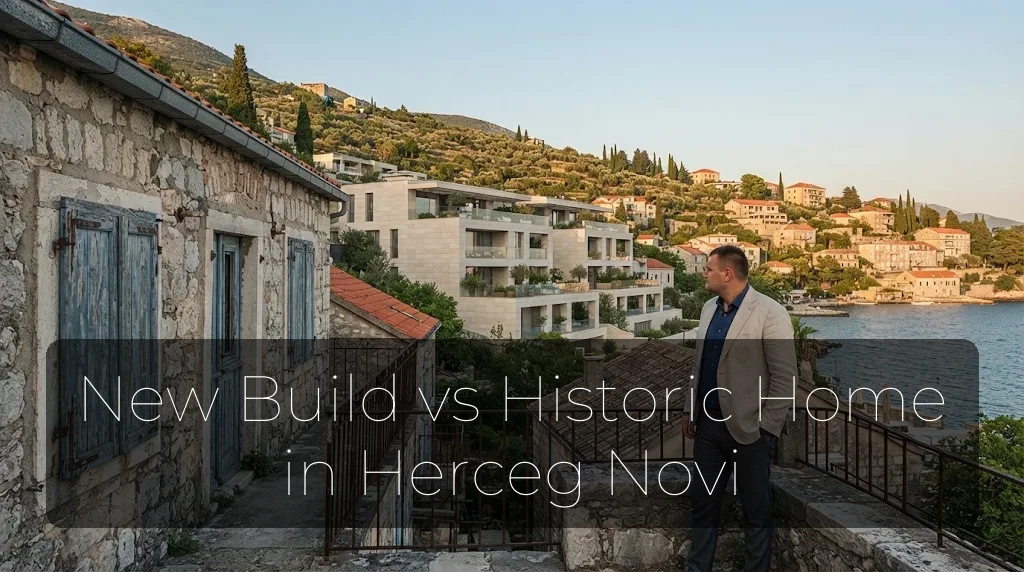
Herceg Novi climbs out of the Bay of Kotor in terraces, and almost every home here is defined as much by its steps as by its walls. Anyone weighing a new build vs historic home in Herceg Novi is really choosing a daily routine: how you reach the front door, how the rooms feel in January and who looks after the roof. I moved to Kotor about seven years ago after restoring an old stone house of my own, so I have a soft spot for old walls, and I try to be fair to the new ones.
A modern new-build in Herceg Novi generally offers easier access, contemporary insulation, parking and managed facilities, while a historic resale home offers architectural character, established streets and a closer connection to local life. The practical differences emerge in daily stair climbing, winter comfort, maintenance responsibilities, noise and renovation work. Neither option is automatically better.

New Build vs Historic Home: Lifestyle at a Glance
The fundamental difference is who carries the burden of upkeep and access. A managed modern apartment tends to move that burden onto a building company, a management agreement and a monthly charge, whereas a historic resale home leaves most of it with the owner, in exchange for character and independence. The table below sets out the contrast in conditional terms, because individual buildings break every rule.
| Lifestyle criterion | Modern new-build development | Historic resale house |
|---|---|---|
| Architecture | Contemporary layouts, larger windows and open-plan living are common. | Thick stone walls, smaller openings, vaulted or timber-beamed rooms and older detailing may be present. |
| Stairs and lifts | A lift is possible but not universal; check each building. | Internal and external stairs are common, and a lift is unlikely. |
| Parking | Dedicated spaces or a garage may be included, sometimes at extra cost. | Parking is often on the street or at a distance from the door. |
| Insulation | Modern insulation and glazing may be installed, but quality varies with the builder. | Stone offers thermal mass rather than insulation; performance depends on roof, windows and previous works. |
| Heating and cooling | Individual air-conditioning units or central systems are typical. | Often retrofitted; may rely on split units, stoves or electric heaters. |
| Privacy | Shared corridors, balconies and amenities can mean more neighbours within earshot. | Closer streets and shared walls can reduce privacy in dense lanes; freestanding houses offer more. |
| Outdoor space | Balconies and shared landscaped areas are typical. | Terraces, courtyards or small gardens may exist, sometimes with uncertain legal status. |
| Maintenance | Common areas are maintained collectively; the interior remains the owner’s task. | The owner is usually responsible for roof, façade, drainage and structure. |
| Service charges | Regular management charges are likely in managed buildings. | Often none, but the owner should budget for irregular repair bills. |
| Accessibility | Easier where there is a lift and level approach. | Frequently limited by gradients, steps and narrow lanes. |
| Renovation flexibility | Limited by shared structure and building rules. | Greater scope, but constrained by masonry, access and possible conservation rules. |
| Neighbourhood atmosphere | Often a mix of residents and seasonal owners. | Often established streets with longer-standing local households. |
Completed new build, off-plan purchase and older apartment
A completed new build is a finished unit you can inspect, test and measure. An off-plan purchase is a promise based on drawings and a specification, so the lifestyle you are buying is still partly imagined. Those are different risks, and this article concentrates on the completed building.
Likewise, a genuinely historic stone house is a different thing from an ordinary older apartment in a concrete block. A 1970s flat on a main road has more in common with a modest new build than with a house in the lanes of the Old Town.
The property matters more than the category
Micro-location and building condition usually matter more than construction date. A well-sited stone house with a sound roof can be more comfortable than a poorly built new apartment facing north, and the reverse is equally true.
What Everyday Life Feels Like in Herceg Novi
Herceg Novi is a hillside coastal town, and its daily rhythm is set by gradients. Streets, stairways and vehicle access decide whether a home feels easy or demanding, long before insulation or interior design come into it.
Map distance versus walking effort
Two addresses equally close to the water on a map can involve very different daily effort. One may be a level, ten-minute stroll to a café on the seafront. The other may be a similar distance as the crow flies but include a long flight of steps, and the return leg is uphill with shopping in your hands.
The seafront promenade known as Pet Danica is a useful local reference. It follows the coast through several districts, so check which section serves a given address and how you would actually reach it from the front door before assuming a flat walk.
Shopping, luggage, rubbish and deliveries
Consider the ordinary tasks. Collecting groceries from a shop at the bottom of the hill, wheeling a suitcase up from the nearest place a taxi can stop, carrying rubbish to the bins and receiving a parcel all behave differently depending on the street. In a historic lane, a courier may leave the delivery at the nearest vehicle access point and call you to collect it. In a managed complex, the same parcel may go through a reception or a ground-floor door.
Parking is another divider. In the older streets, the car may be a few minutes’ walk from the house, so the real question is the route from the parked car, not the property’s own boundary. A new build with a dedicated space may remove that effort entirely, though you should confirm that the space is included in the contract and registered correctly.
Neighbours, privacy and atmosphere
The social texture also differs. In older neighbourhoods, long-standing households tend to know one another, and a newcomer may be noticed and welcomed in equal measure. Walls are often close, and sound travels across lanes and courtyards. In a development, there may be more anonymity, a larger share of seasonal owners and fewer people around in winter, which some buyers find peaceful and others find empty.
Construction disturbance deserves a mention as well. Living beside an active building site, or a neighbour’s renovation, can disrupt either type of home for months.
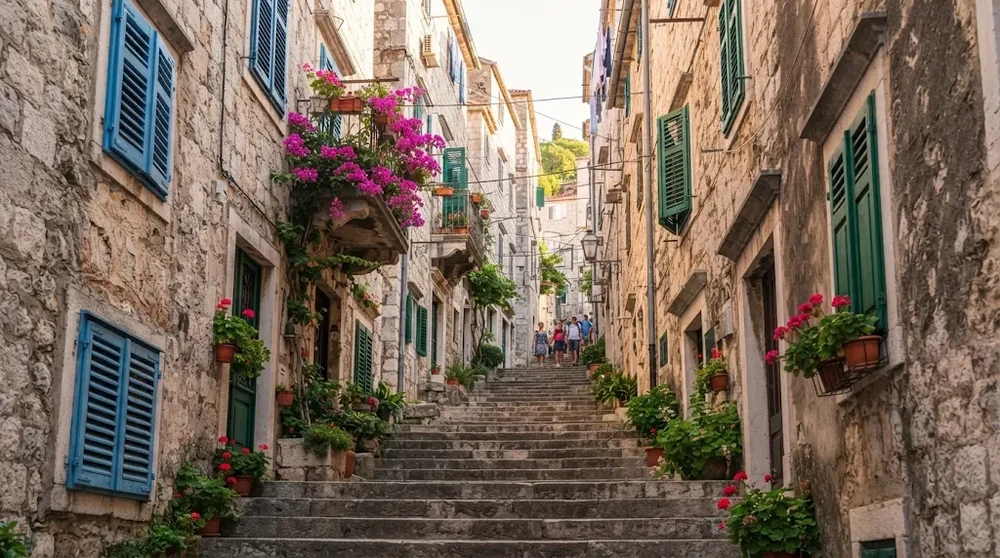
Herceg Novi Neighbourhoods: Old Streets and New Developments
Neighbourhood choice shapes daily life more than almost any other single decision. Every area below contains mixed housing stock and street-level exceptions, so treat the table as a broad tendency, not a verdict, and verify local claims on foot.
| Area | Typical built environment | Slope and access | Atmosphere and waterfront | May suit buyers who value |
|---|---|---|---|---|
| Old Town (Stari Grad) | Historic stone buildings, squares, narrow lanes and steps. | Steep stairways and limited vehicle access are common; varies by street. | Close to cafés, squares and the sea; lively in season. | Historic character, walking life and tolerance for stairs. |
| Savina | Established residential area with older houses and greenery around the monastery district. | Hillside gradients; check the approach road and steps. | Quieter and more residential, with views possible from higher plots. | Calm surroundings and established streets. |
| Topla | Mixed older houses and apartment buildings. | Varies; some parts are close to the coast, others climb. | Local neighbourhood feel; waterfront access depends on the street. | A mix of housing types and everyday services. |
| Igalo | Mixed stock, including apartment buildings and villas. | Generally flatter near the shore; check inland streets. | Long seafront walking routes and a spa-town atmosphere. | Easier walking and a manageable gradient. |
| Meljine | Mix of older houses and newer apartments along the coastal road. | Position above or below the main road changes noise and access. | Residential, with sea access that depends on the exact plot. | A quieter residential setting near the town. |
| Kumbor | Villas, apartment buildings and larger developments; Portonovi sits here as one example of a managed waterfront scheme. | Varies by plot; confirm road access and parking. | More resort-style in parts, more village-like in others. | Space, views and a managed environment, if a development is chosen. |
| Đenovići | Mix of village houses and newer buildings. | Hillside and road-dependent access. | More spread out and village-like, with fewer walking amenities. | Space, quiet and willingness to drive. |
Why street-level checks matter
Portonovi is one example of a managed waterfront development, not a synonym for new-build housing generally. Most modern apartments in Herceg Novi are in far more modest buildings with their own particular management quality.
Check whether year-round shops, public transport and parking exist within a realistic walk of the specific address, because services thin out noticeably in winter in some areas. Also note whether the property sits above or below the major road: the difference can decide traffic noise, sea views and the effort of reaching the front door.
Winter Comfort: Stone Walls, Insulation and Sea Air
Winter is where marketing labels meet reality. Herceg Novi has mild but wet winters, and a house that feels delightful in July can feel quite different in January. It would be wrong to say all new buildings perform well or that all old houses are damp, so compare conditions rather than building types.
Thermal mass versus insulation
- Thermal mass: thick stone walls absorb and release heat slowly, which can moderate swings in temperature, but stone alone is not insulation, and a cold, unheated stone house may stay cold for days.
- Insulation: a modern building with properly installed insulation and good windows can hold heat more efficiently, but poor workmanship, thermal bridges and thin walls can undermine this.
- Cold surfaces and condensation: in either type, cold surfaces meeting humid indoor air create condensation, which can lead to mould if ventilation is poor.
- Ventilation: cross-ventilation helps both building types, but sealed modern apartments left empty for months can trap moisture, while old houses with blocked air paths suffer similarly.
- Roof and drainage: a leaking roof or poor drainage around a stone house can drive moisture into walls; in new builds, flat roofs, terraces and waterproofing details are the usual weak points.
- Sea air: salt-laden air corrodes metal fittings, balcony railings, window hardware and external units, so material quality matters in both.
- Sunlight: a north-facing or shaded home loses winter warmth whatever its construction, so the position on the hillside matters.
- Heating and cooling: check what actually heats the home and what it costs to run; air conditioning is common, but its efficiency, capacity and noise vary.
What to inspect on a cold or rainy day
These are observations, not engineering conclusions, and a structural engineer or surveyor should assess anything that worries you.
- A damp or musty odour in closed rooms or cupboards.
- Staining, bubbling paint or salt deposits on walls, especially at the base or under windows.
- Cold corners, particularly on external walls and behind furniture.
- Condensation on window glass and frames.
- Water marks on ceilings or around the roof edge.
- How quickly heating warms a room, and whether it feels even.
- Whether the direct winter sun reaches the main living space.
- The condition of gutters, downpipes and the drainage around the base of the building.
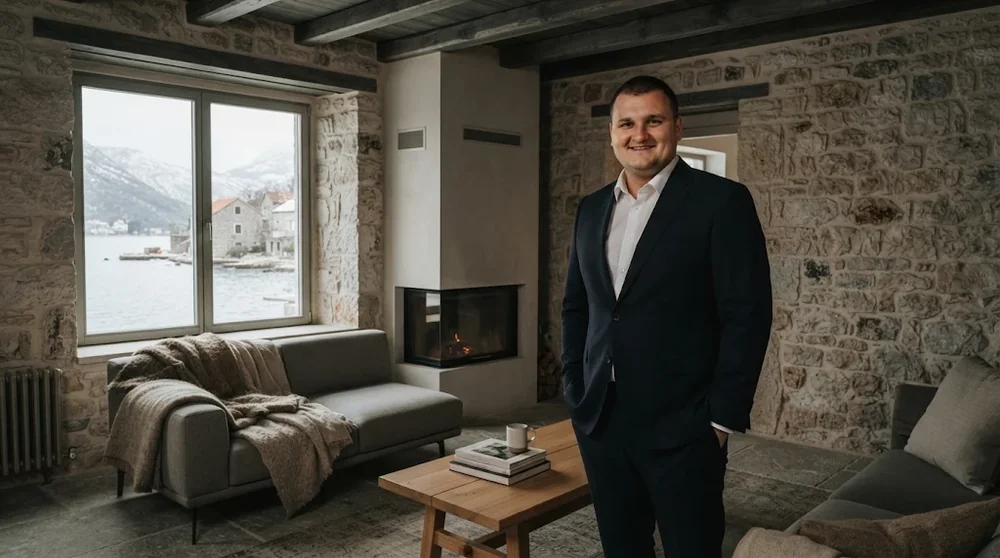
Renovating a Historic Stone House in Herceg Novi
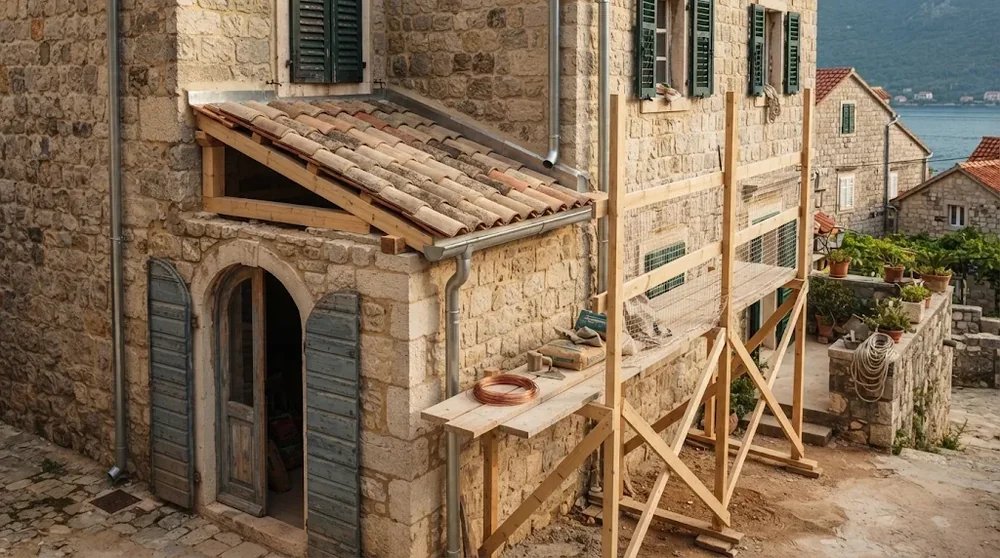
Old coastal houses reward patient owners, but they punish optimism. Renovating a historic stone house is mostly a matter of managing water, movement and access, and the finish you see in a viewing is the least important part of the job.
Masonry, materials and moisture
Traditional stone masonry was built with lime-based mortars and renders that allow walls to breathe. Where repair is technically appropriate, lime-compatible materials generally suit old stone better than hard cement-based ones, which can trap moisture and push damage into the stone itself. This is a technical judgement for each wall, and a suitably experienced professional should make it.
Moisture can arrive through several pathways: a failing roof, blocked gutters, rising damp, leaking pipes, poor drainage or ground water pressing against a retaining wall. Treating a symptom, such as a stained wall, without finding the source simply hides the problem.
Roof, timber, structure and services
The roof is often the first priority. Tiles, battens, membranes and timber rafters all need assessing, and timber elements may suffer from rot or insects after years of leaks. Structural movement, cracks and settlement should be examined by an engineer, particularly in a hillside setting where retaining walls and terraces carry load. Water and electrical installations in older houses are often outdated or improvised, and replacing them means opening walls.
Restoring my own stone house left me with a firm opinion: the difficulty is rarely the stone, and almost always the water. That is a personal view, not a rule, but it is why I look at roofs and drainage before kitchens.
Access, logistics and the limits of cosmetic work
In narrow lanes, every bag of cement, load of tiles and cubic metre of debris may have to be carried by hand, which affects both the price and the timetable. Ask contractors specifically how they would move materials and waste in and out.
Cosmetic refurbishment, such as painting, new floors and a fitted kitchen, is a different category from structural reconstruction. Once you touch walls, floors or the roofline, permits and professional design may be needed. Some buildings in historic areas may also be subject to heritage or conservation controls, although not every old house is legally protected. Confirm the position for the specific building with the competent authorities before planning work.
Modern Developments: Convenience and Hidden Responsibilities
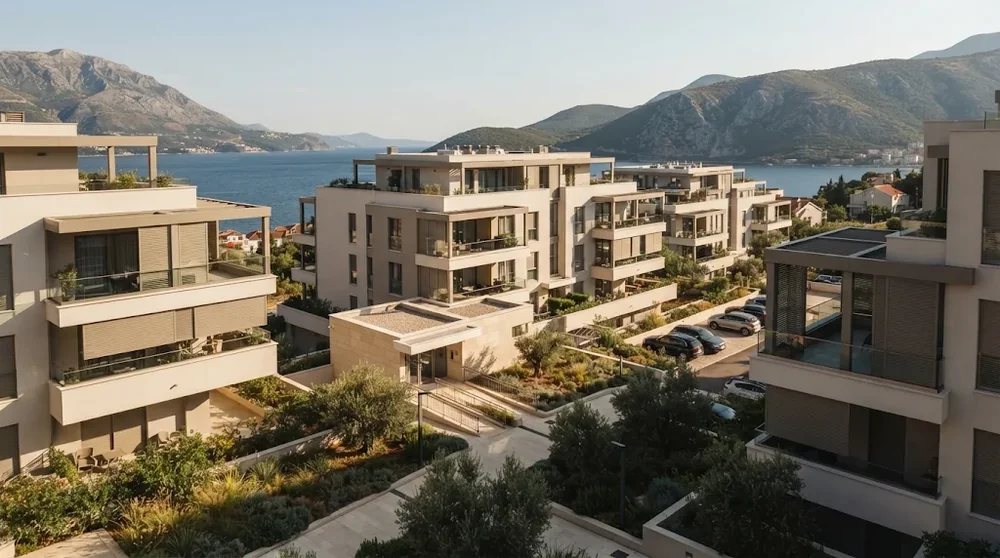
Modern developments offer real advantages, but the word “new” is not a synonym for “maintenance-free”. The features below are possible rather than universal, and the contract and the building will tell you which apply.
What a modern development may offer
- A lift, which can change daily life for anyone carrying shopping or with limited mobility.
- Dedicated parking or a garage space.
- Reception, security, cleaning and landscaped common areas in full-service schemes.
- Modern services such as contemporary wiring, plumbing and heating or cooling systems.
- Managed amenities such as a pool, a gym or communal terraces.
An independent modern apartment block and a full-service development are very different propositions. The first may have a simple owners’ arrangement and basic cleaning, while the second may involve a professional management company, a detailed fee structure and a range of facilities that must be funded.
The responsibilities that arrive with the keys
- Management agreements and service charges: ask what is covered, how the fee is calculated and how it can change.
- Reserve funds: find out whether a maintenance reserve exists and how large it is relative to the building’s needs.
- Lifts and pools: servicing, inspection and repairs are recurring costs shared among owners.
- Workmanship defects: water ingress, cracked finishes, failing waterproofing on terraces and poorly fitted windows can appear in the first seasons.
- Common areas: check the condition of corridors, stairwells, roofs and car parks in a completed building, not only the apartment itself.
- Absentee ownership: if you are away for months, confirm who handles emergencies, leaks, key access and repairs.
Do not assume warranty coverage. Any protection for defects must rest on a contractual or legal basis, so ask for the relevant wording in writing and have a Montenegro-qualified lawyer read it.
Comparing the Real Cost of Each Lifestyle
Cost is where lifestyle comparisons often go wrong, because the purchase price is only part of the story. A transparent framework looks at acquisition costs, annual running costs and future capital works for each type of home.
Asking prices, transactions and official statistics
An advertised price is what a seller hopes to achieve, while an achieved transaction price is what was actually agreed. The two can differ, and neither is the same as a first-sale price for a newly built unit. According to MONSTAT‘s preliminary Q2 2026 release of 20 August 2026, first-sale new residential dwellings averaged €2,557/m² nationwide and €2,838/m² in Montenegro’s coastal region. The coastal figure was €2,575/m² in Q1 2026.
These are first-sale new-dwelling averages for a region, not Herceg Novi figures and not historic-house prices. They should not be used to value a stone house, and price per square metre alone can mislead, because a small, well-placed home and a large home with an expensive roof problem do not compare on that measure.
A cost-category framework
| Cost category | Typical consideration for a new build | Typical consideration for a historic resale | What to verify |
|---|---|---|---|
| Purchase price | Price per unit, possibly stage-linked for off-plan. | Negotiated price; condition strongly affects value. | Asking versus achieved prices, from a qualified adviser. |
| Acquisition taxes and charges | Tax treatment may differ for a first sale. | Tax treatment of resale transactions. | Current category and rate with a lawyer or tax adviser, as of November 2026. |
| Notary, legal and agent fees | Contract review and registration. | Contract review, cadastral checks and registration. | Written fee quotes before committing. |
| Technical checks | Snagging inspection at handover. | Structural, roof and moisture survey. | Independent engineer or surveyor. |
| Renovation or fit-out | Furnishing, kitchen and possible upgrades. | Repairs, restoration and a contingency for hidden work. | Written contractor estimates. |
| Utilities | Electricity for heating and cooling; building services. | Heating costs may differ with insulation and system. | Previous bills for the same property. |
| Service charges | Management fees, lift and pool servicing. | Usually none unless in a shared building. | Current charge, history and planned increases. |
| Insurance | Contents and possibly building cover through the management. | Building and contents cover, which may be harder to arrange for old structures. | Quotes and exclusions. |
| Repairs and capital works | Common-area works shared among owners. | Roof, façade, drainage and structure borne by the owner. | Planned works and reserve funds. |
Renovation contingencies
Any historic house should carry a contingency for work that only becomes visible once walls and roofs are opened. I will not suggest a percentage, because the right figure depends on the building and on a proper survey. Ask a professional to state the assumptions behind any estimate and what is excluded.
Documents and Building Checks Before Choosing
This section is a lifestyle-related checklist, not a full conveyancing guide. A home that suits your routine is worth little if its legal or technical status is uncertain. This house has a story, and so does its paperwork, and the paperwork should be read before the romance takes over.
The first document I ask for is a current list nepokretnosti, the property register extract issued through the Real Estate Administration (Uprava za nekretnine). It records ownership, registered area and encumbrances such as mortgages or restrictions, and it is the starting point for every property in Herceg Novi.
Before you sign anything on an older home, a short professional opinion on its registered and legal status is cheaper than discovering a problem afterwards.
Cadastral registration, legalisation and lawful use are three separate matters, and this is where most first-time buyers slip up: a terrace or extension may be visible on the ground but absent from the register, or registered without having been legalised. As of November 2026, the legalisation rules for unauthorised buildings should be checked against the current consolidated official legislation, because some earlier summaries of deadlines are outdated. I am not your lawyer, and the outcome for any particular building depends on its specific facts.
A due diligence checklist
- Obtain a current list nepokretnosti and confirm the owner, the registered area and any encumbrances.
- Compare the building on site with the records, looking for extensions, enclosed terraces and altered layouts.
- Ask for evidence of permits, legalisation or alteration approvals for anything that differs from the register.
- For an older house, check with the competent authorities whether conservation requirements apply to the property or its street.
- Commission an engineer or surveyor where structural movement, roof problems or moisture are suspected.
- For a new build, review the building permit, the registration status of the unit, the written specification and any completion or use documentation.
- Read the management commitments, common-facility arrangements and charges before signing.
- Have a Montenegro-qualified independent lawyer review the contract, because a notarial transaction does not replace full technical and legal due diligence.
Before you pay a reservation fee, make sure you understand what happens to it if the checks reveal a problem.
Which Home Suits Your Way of Life?
Buyer groups are not uniform, and no age or household type automatically wants one kind of building. The matrix below shows where each option may fit, followed by the condition that should decide it.
| Household profile | Where a modern development may fit | Where a historic resale may fit | Deciding lifestyle condition |
|---|---|---|---|
| Full-time residents | Reliable heating, parking and managed upkeep can simplify a daily routine. | A well-restored house in an established street can offer community and character. | How the home performs in November, and how reachable it is every day. |
| Families with children | Lifts, parking and shared outdoor space may ease the school run and shopping. | A house with a courtyard or garden may give children space, if it is safe and accessible. | School and healthcare access, stairs with pushchairs and safety of terraces. |
| Retirees | A lift and level approach may support independence for longer. | A single-level old house on a gentle street may still work well. | Mobility now and in future, and who handles repairs. |
| Remote workers | Modern wiring and building-wide internet may be available. | A quiet room with character is possible if connectivity is arranged. | Tested internet speed, workspace and noise. |
| Seasonal second-home users | Managed buildings may cope better with long absences. | An old house may need more checking and maintenance while empty. | Who looks after the home when you are away. |
Questions that cut across every profile
Mobility, services, internet, parking, weather comfort and independence matter in every case. So does your capacity to manage a property: a historic house suits someone who enjoys, or can delegate, ongoing supervision of repairs, while a managed development suits someone who wants to hand over most of it. Privacy and the atmosphere of the neighbourhood also belong in the decision, because the same building feels different depending on who lives around it.
How to Test a Herceg Novi Home Before Buying
A viewing shows a home at its best, usually on a dry day with the owner or agent present. Testing it properly means seeing it as you will live in it. Please note that nothing here implies a particular property has been inspected by me; these are steps for you to take with suitable professionals.
- Walk the real route. Start from the nearest practical parking point and walk to the door at the time of day you would normally do it, noting gradients and surfaces.
- Climb the stairs with realistic baggage. Carry shopping bags or a suitcase, and try the route in both directions.
- Check the parking. Confirm whether a space is included and registered, how easy it is to reach in busy weeks and where visitors would leave their cars.
- Visit in both seasons. High summer shows crowds, heat and noise, while winter shows damp, light and how quiet the area becomes. A second seasonal visit, ideally on a wet day, is valuable where possible.
- Inspect damp and sunlight. Look for the signs listed earlier, and note when the sun reaches the main rooms.
- Listen for noise. Stand in the home with the windows open and closed, and note traffic, neighbours, building work and nightlife.
- Test the systems. Run the heating and ventilation, check water pressure and electrics, and test mobile and internet speeds in the rooms you would use.
- Ask for the numbers and the paperwork. Request recurring charges, planned works, and the legal and technical findings, and review them with your lawyer and engineer before paying any reservation fee.
A short viewing cannot reveal every defect, and even a careful survey has limits. Seasonal testing matters because summer hides damp and winter hides the pleasures of heat and sea breezes, so each season reveals something the other conceals.
Final Thoughts: Choose the Daily Routine
The useful question is not whether a new build or an old house is better, but how the home feels in November as well as in July. A modern development may suit someone who values accessible facilities and delegated management, while an old stone house may suit someone who enjoys traditional streets, independent upkeep and careful restoration. The daily route, the property’s condition and the maintenance you are prepared to take on matter more than the marketing label.
I would encourage you to view contrasting homes in Herceg Novi, in different streets and at different times of year, before narrowing your search. A new apartment and an old house seen on the same weekend usually clarify your priorities faster than any brochure.
If you are still unsure about the budget, the area or the type of home that would match your routine, a short questionnaire can turn those preferences into a practical shortlist.
Whatever shortlist you build, test it on foot and check its paperwork before you commit.
Frequently Asked Questions
Is a new-build apartment better than an old stone house in Herceg Novi?
A new-build apartment may be more convenient if you want a lift, parking, modern heating and shared maintenance services. An old stone house can offer distinctive architecture, established neighbours and a more independent lifestyle. The better choice depends on the exact location, winter comfort, condition, running costs and your willingness to manage repairs.
What is everyday life like in Herceg Novi Old Town?
Living in Herceg Novi Old Town means being close to historic squares, cafés, pedestrian streets and the character of an established coastal community. However, steep staircases, limited vehicle access and parking arrangements can complicate shopping, deliveries and daily mobility. The experience varies considerably between individual streets, building entrances and elevations.
Are historic stone houses in Montenegro difficult to maintain?
Historic stone houses can require specialist maintenance, particularly where roofs, drainage, masonry joints, timber, ventilation or previous alterations are defective. Coastal humidity and salt exposure make material selection and regular inspection important. A properly restored house may be comfortable, but buyers should commission an independent technical survey and budget for unexpected work rather than assume age determines condition.
Which part of Herceg Novi is best for year-round living?
There is no single best neighbourhood for everyone. Old Town and Savina appeal to buyers seeking established surroundings, while parts of Igalo and other waterfront areas may offer more manageable walking routes. Topla, Meljine, Kumbor and Đenovići provide different combinations of housing, access and services. Test winter sunlight, parking, transport and the actual walking route before deciding.
What should I check before buying a historic house in Herceg Novi?
Start with a current cadastral extract and confirm ownership, registered area, encumbrances and any extensions or alterations. Have an independent professional inspect the structure, roof, moisture, drainage and utilities. Check whether legalisation or conservation approvals are relevant to the specific building. Obtain written renovation estimates before committing to a deposit or final purchase agreement.
Key Takeaways from the Bay
I settled in the Bay of Kotor because the coast rewards people who pay attention to small things: the angle of the winter sun, the age of a roof, the number of steps between the car and the kitchen. Those same details separate a home that feels easy from one that feels like a chore, whichever type of building it is.
A modern development generally trades independence for convenience and shared responsibility, while a historic stone house trades convenience for character and control. Both can be excellent, and both can disappoint if the street, the paperwork or the walls are wrong. My own restoration made me cautious about romance and respectful of good building, and I would rather you buy slowly than fall for the first beautiful façade.
This article is educational information based on general observations and on sources available as of November 2026, including the MONSTAT Q2 2026 release. It is not legal, tax, financial or technical advice, and it does not promise any price, yield, legalisation outcome or completion date. Please consult an independent Montenegro-qualified lawyer for legal and tax questions and a suitable engineer or surveyor for structural and moisture assessments.