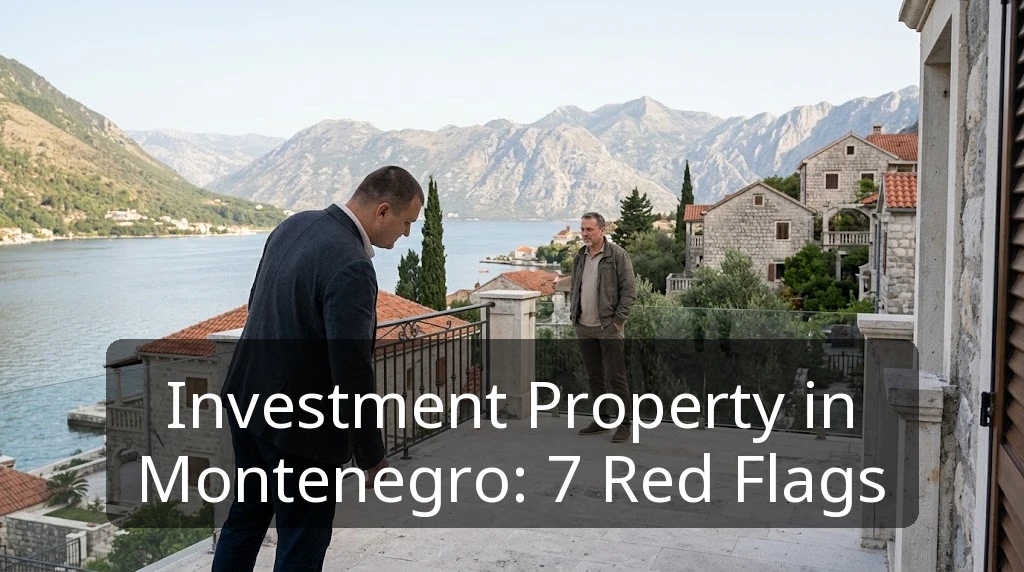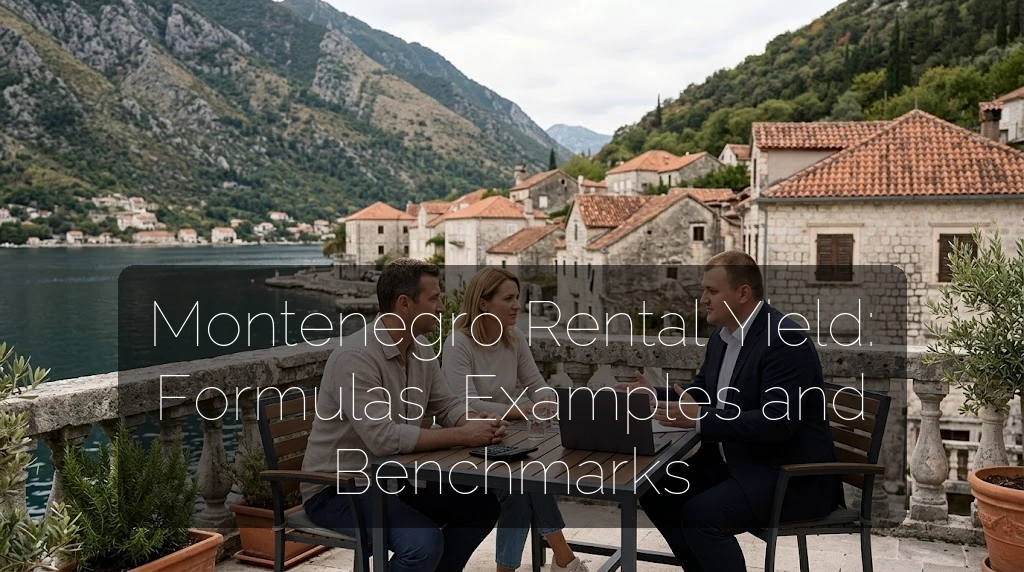

On many lanes above the Bay of Kotor, two apartments share a stone façade and a staircase, yet one looks across the water and the other at a retaining wall, and their asking prices often differ by more than the floor plans explain. At the shortlist stage, the useful question is not which home is lovelier but which lets a fixed budget work hardest once income, your own use, running costs, legal status and an eventual sale are all counted.
Sea view property in Montenegro may attract higher holiday rents and stronger buyer interest, but a higher purchase price can reduce rental yield. Inland property can offer lower entry costs or year-round tenants. Compare similar homes by total acquisition cost, annual net income, access, legal status and resale evidence; no nationwide sea-view premium is established.
Sea View, Waterfront and Inland: Compare Like with Like
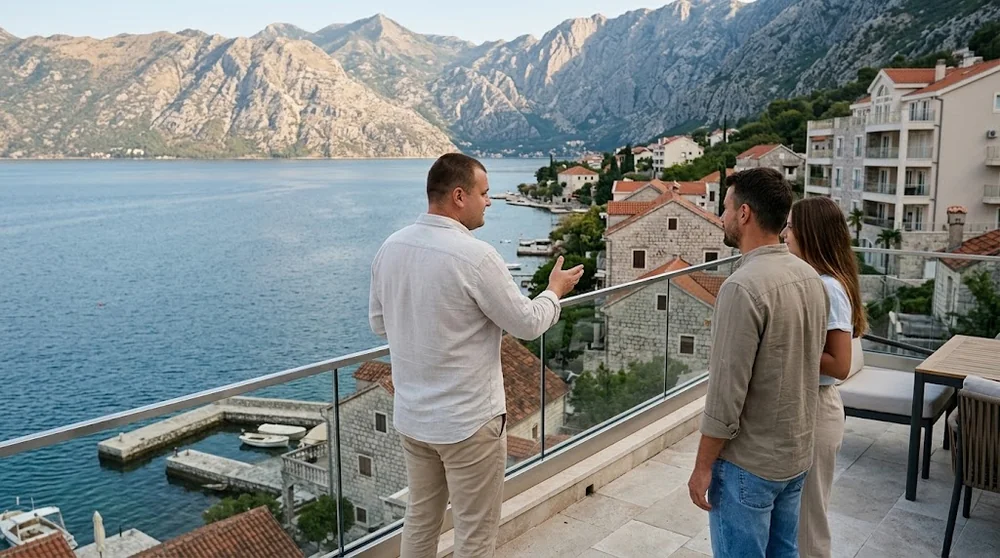
Most “sea view versus inland” comparisons go wrong in their first sentence. A sea view is an attribute of a particular property, while inland is a geographic category. Comparing a sea-view apartment with an inland house mixes two different questions: the value of the outlook and the value of the location. The coast is full of homes with no view at all, and plenty of hillside homes overlook the sea from a long, steep road away from it.
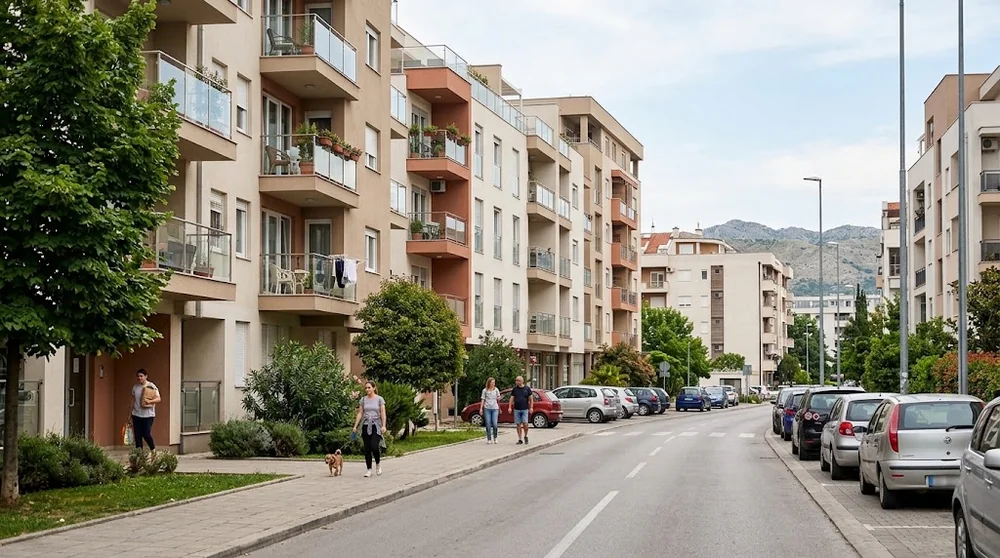
I use five working categories. Waterfront property sits directly on or beside the shore, usually with a promenade or the maritime zone between it and the water. A coastal hillside property with a view looks over the sea from higher ground, often at the cost of steps or a winding drive. A coastal property without a view shares the town’s amenities and tourist market but faces inland, a courtyard or neighbouring buildings. Inland urban property means homes in cities such as Podgorica, where demand is largely residential. Rural inland property covers villages, mountain houses and farmsteads, where demand depends heavily on the individual setting.
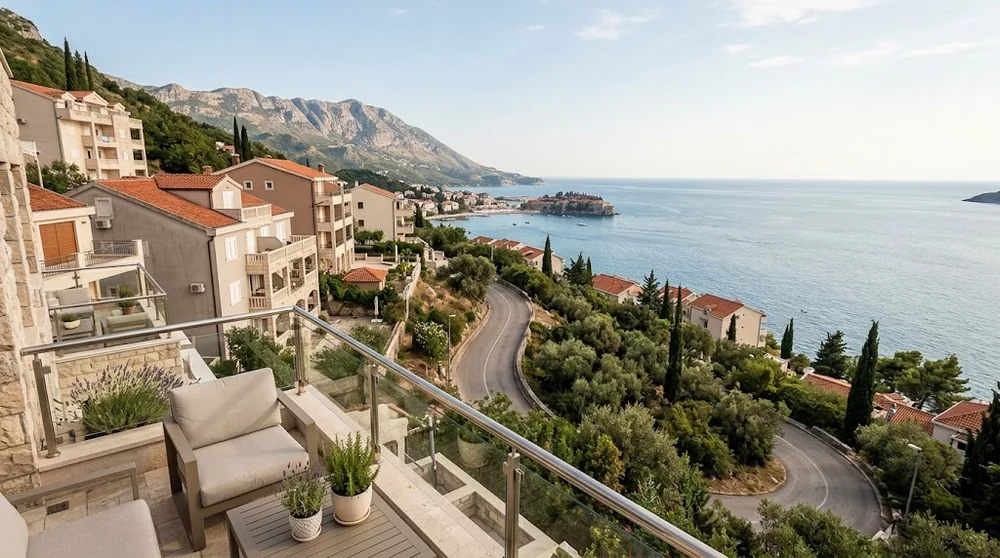
Views themselves need description rather than a single label. A partial view shows a slice of sea between buildings or from one room. A direct view faces the water squarely from the main living space. A panoramic view takes in a wide sweep of bay or open sea. These are descriptive categories I use with buyers, not formal valuation standards, and two agents may grade the same window differently.
| Category | Main acquisition cost drivers | Typical demand | Access | Maintenance profile | Exit evidence to seek |
|---|---|---|---|---|---|
| Waterfront | Scarcity, frontage, building age, maritime-zone constraints | Holiday guests, lifestyle buyers | Often level but congested in summer; parking scarce | Often heavy salt and humidity exposure, depending on distance from the water, elevation and building design; check maintenance records | Achieved sales of comparable frontage units |
| Coastal hillside with a view | View quality, floor, terrace size, newness | Holiday guests, some long-stay tenants | Steep roads or steps; car often essential | Wind, waterproofing, retaining walls, drainage | Sales in the same building or micro-location with similar views |
| Coastal without a view | Walking distance to beach and town, condition, parking | Holiday guests, year-round local tenants | Can be easier than hillside, depending on street gradient and parking | Coastal humidity, ordinary building wear | Sales of similar units nearby |
| Inland urban | Neighbourhood, newness, parking, energy efficiency | Year-round residential tenants | City roads and public services | Heating, cooling, common-area upkeep | Recent city sales of similar size and age |
| Rural inland | Land, condition, road, utilities, renovation scope | Seasonal holiday guests, owner use | Varies widely; winter access can be difficult | Roofing, heating, septic systems, road upkeep | Very thin; individual transactions |
Once a shortlist is sorted into these categories, a fair comparison becomes possible: a hillside apartment with a direct view against a no-view apartment in the same coastal area, or a coastal flat against a Podgorica flat, but never a blurred mixture of both.
What Montenegro Price Data Can Actually Tell You
The most authoritative public price series comes from MONSTAT, the Statistical Office of Montenegro. Its quarterly release on new dwellings records average prices per square metre from first-sale contracts for newly built flats, grouped by statistical region. The figures for the second quarter of 2026 (April to June 2026) are shown below; MONSTAT labels them preliminary, and I checked them in October 2026.
| Statistical area | Average price (€/m²) | Period measured | Scope |
|---|---|---|---|
| Coastal region | 2,838 | Q2 2026 | First-sale new-build contracts |
| Podgorica | 2,510 | Q2 2026 | First-sale new-build contracts |
| Central region (reported separately from Podgorica) | 2,131 | Q2 2026 | First-sale new-build contracts |
| Northern region | 2,145 | Q2 2026 | First-sale new-build contracts |
The MONSTAT Q2 2026 coastal mean of €2,838/m² is about 13% higher than the Podgorica mean of €2,510/m², but that gap is not a sea-view premium. It blends differences in municipality, building type, specification, developer pricing and the mix of units sold that quarter. Some coastal units sold will have had views and many will not. The figures say nothing about resale flats, old stone houses or villas, and because they are preliminary, MONSTAT may revise them.
Sample composition matters too. The northern region’s mean is slightly above the central region’s in this quarter, which may reflect which projects happened to complete and sell rather than any lasting ranking. A single quarter is a snapshot. Podgorica is reported as its own category and is not part of the central-region figure, so the two should never be averaged together or swapped.
Three kinds of price evidence should be kept apart. Official regional means are measured, dated and broad. Asking-price samples from listing portals show what sellers hope for, are not verified sales, and depend entirely on how the sample was gathered. Individual valuations are professional opinions about one property on one date. I do not quote city price ranges here because I have no dated, described sample of transactions to support them.
Editorial note on the source: the narrative text of the underlying MONSTAT PDF contains a national figure for enterprise sales that is inconsistent with its own tables. Until MONSTAT clarifies it, I have left that number out and used only the regional figures above.
How to Measure a Sea-View Premium
Because no independently verified nationwide percentage isolates a sea-view premium in Montenegro, the only defensible approach is to measure it yourself for the specific homes on your shortlist. The method is simple to describe and demanding to carry out well.
Comparable selection
A useful comparison removes as many differences as possible before looking at price, so that what remains is closer to the value of the view.
- Match the building or micro-location. Start with units in the same building or development; if none exist, use the same street or slope with similar walking distance to the shore.
- Normalise usable floor area. Convert both prices to euros per square metre of usable internal area, and treat terraces separately rather than adding them at full value.
- Account for parking and storage. Remove the value of a garage space or storeroom included in one sale but not the other.
- Align condition and age. A renovated unit with new glazing and waterproofing is not comparable with one needing work, view or no view.
- Align floor and orientation. Higher floors and south-west aspects often carry their own appeal, light and heat gain, regardless of the sea.
- Record the actual view. Note which rooms see the water, whether the view is partial, direct or panoramic, and what lies in between.
- Calculate and label the gap. Apply the formula below and record the dates and sources of both prices.
The formula in plain text is: observed asking-price gap = (view-property €/m² ÷ comparator €/m² − 1) × 100. As a purely illustrative example, a view flat asking €3,300/m² against a matched no-view flat asking €2,900/m² gives (3,300 ÷ 2,900 − 1) × 100 = 13.8%. That result is an observed asking-price gap, not a measured premium.
Residual uncertainty
Even after careful matching, the remaining difference cannot automatically be attributed entirely to the view. One seller may be more ambitious, one unit may have a larger terrace or quieter neighbours, and one may sit in a building with better management. Asking prices also move during negotiation. Only achieved sale prices of genuinely matched units can narrow the estimate, and even then a small sample leaves a wide margin of error.
Treat a calculated sea-view premium as a range with a written list of confounders beside it. If you cannot name what might explain the gap other than the view, you have not looked hard enough.
Rental Demand: Coast, Podgorica and Rural Inland
Montenegro has at least three distinct rental markets, and they behave so differently that a single “coastal versus inland” figure would mislead more than it informs.
Coastal short lets
The coast lives by the tourist season. Budva and Bečići offer long beaches, a lively summer scene and a large stock of competing apartments, which brings both demand and noise. The Bay of Kotor draws heritage visitors and people who value water views and old towns, but steep lanes, scarce parking and cruise-day crowds affect guest experience. Tivat benefits from its airport and marina setting. The Luštica peninsula is a broad, partly rural landscape of villages and scattered houses, and it should not be confused with any single managed resort development there; rental rules, service charges and management arrangements inside a resort can differ completely from those of a village house a few kilometres away. Bar and Herceg Novi have more year-round residential life, with Bar’s port and rail link and Herceg Novi’s stepped old town shaping who stays and for how long. I deliberately do not rank these towns, because I have no verified, comparable rental dataset that would justify a ranking.
One official figure frames the concentration of demand. According to MONSTAT’s announcement dated 5 March 2026 on individual (private) accommodation for 2025, private accommodation recorded 10,179,395 tourist overnight stays, of which 94.8% (roughly 9.65 million) were in seaside resorts. That percentage describes how recorded private tourist nights were distributed across resort types. It does not measure occupancy, nightly rates, profitability, unrecorded stays or long-term residential tenancies, and it says nothing about whether a particular apartment with a view outperforms its neighbour.
Podgorica long lets
Podgorica, the capital, has a residential rental market driven by public administration, business, students and families. Demand is spread across the year, so income depends less on a summer peak and more on tenant stability, heating and cooling efficiency, parking and proximity to work and schools. Rents per night are irrelevant here; what matters is the monthly rent actually collected over twelve months and the gaps between tenancies. A sea view has no role in this market, which is exactly why Podgorica needs its own assessment rather than a comparison with coastal holiday rates.
Rural holiday accommodation
Rural inland homes, from mountain villages to lakeside cottages, can attract hikers, skiers and families seeking quiet. Demand is usually seasonal, more dependent on online reviews and the owner’s hospitality, and vulnerable to road conditions and the distance from airports. Management is harder to outsource, and winter services such as snow clearance and heating supplies need planning.
Across all three markets, practical details shape income as much as location. Owner-use weeks taken in July or August remove the most valuable nights from a coastal let. Steep access deters older guests and long-term tenants. Lack of parking costs bookings on the coast and tenants in the city. Noise from bars or roads reduces reviews. Winter services, from open cafés to reliable heating, decide whether a property can earn anything outside the season.
When Higher Rent Fails to Cover the Premium
Buyers often reason that a view will “pay for itself” through higher rent. The way to test that claim is to compare the extra income with the extra capital. The model below uses two comparable coastal apartments, one without a view and one with a sea view. Every input is an illustrative assumption, not observed market performance or a forecast. The first apartment is a coastal no-view home, not an inland property.
| Item (illustrative assumption) | Coastal, no view | Coastal, sea view |
|---|---|---|
| Purchase price | 200,000 | 250,000 |
| Real estate transfer tax (taxable resale, no exemption, market value = price) | 7,000 | 9,500 |
| Legal, notary, translation and registration | 3,000 | 3,000 |
| Technical survey | 1,000 | 1,000 |
| Furnishing and equipment | 9,000 | 11,500 |
| Total invested capital | 220,000 | 275,000 |
| Annual collected rent, after vacancy and owner use | 15,000 | 18,000 |
| Management, cleaning and booking fees | 2,400 | 2,900 |
| Utilities and internet | 1,200 | 1,400 |
| Building service charge and insurance | 900 | 1,300 |
| Property tax and local charges | 300 | 400 |
| Maintenance and replacement reserve | 1,200 | 2,000 |
| Total operating costs and reserves | 6,000 | 8,000 |
| Annual income before personal income tax and financing | 9,000 | 10,000 |
| Pre-personal-tax yield on total invested capital | 4.09% | 3.64% |
| Stress test: collected rent 20% lower | 12,000 | 14,400 |
| Stress-test income, cost totals held fixed | 6,000 | 6,400 |
| Stress-test pre-personal-tax yield | 2.73% | 2.33% |
The decisive figure is incremental. In this hypothetical model the sea view requires €55,000 of extra capital but adds only €1,000 of annual income, an incremental return of about 1.82%. If you set an illustrative 4% pre-personal-tax hurdle on that extra capital, the extra €55,000 would need to earn €2,200 more per year. Holding the cost totals fixed, the sea-view flat would need to collect €19,200 a year, 28% more than the no-view flat, rather than the assumed 20% more.
Two different decision tests are easy to confuse here. The first, above, is your own hurdle rate on the incremental capital: does the extra €55,000 earn at least 4%? The second asks whether the sea-view flat simply matches the no-view flat’s overall yield of 4.09%. To equalise the two yields on €275,000 of capital, the sea-view flat would need €11,250 of annual income before personal tax and financing, which with the stated €8,000 of costs means €19,250 of collected rent. The figures are close in this example, but they answer different questions, and with other inputs they can diverge widely.
Both rent figures apply the same convention: they are already reduced for empty periods and the owner’s own weeks. That consistency matters. If you plan to keep the sea-view apartment free for four weeks in August, the most valuable weeks of the year, its collected rent must be cut accordingly. The cost breakdown avoids double counting: the reserve covers future replacements, while repairs that arise in a given year are assumed to be drawn from it.
Note what this basis excludes. Mortgage interest and loan costs are left out; current lending conditions are published by the Central Bank of Montenegro, and your own loan offer is what counts. The tourist tax payable per guest night, where applicable, is excluded too. These yields are therefore pre-personal-tax yields on total capital, not fully after-tax returns.
A fully after-tax net rental yield needs one more step, and I would build it in this order. Start with collected rent. Deduct the actual operating costs paid that year and any tourist tax you remit rather than pass to guests. Deduct personal income tax on rental income, calculated under the treatment that applies to your registration (private letting, registered short-let provider or company) and your tax residency, as confirmed by an accountant for the tax year in question. Divide the result by total invested capital. Keep the replacement reserve visible as a separate line: it is an economic cost you should set aside each year, but it is not necessarily cash spent that year, and tax rules may not treat it as a deductible expense.
Under the stress test, with collected rent 20% lower and cost totals held fixed as a deliberate simplification, the income gap shrinks to €400 a year against the same €2,200 hurdle. In reality some costs, such as management fees, would fall with revenue, so treat this as a rough sensitivity check rather than a full fixed-and-variable model.
View obstruction is a separate risk. If a new building were to cut the outlook, both the achievable rate and the resale value could drift towards the no-view level while the extra capital stays spent. I do not assign a probability to that; it depends on the specific parcels and planning documents examined in the checklist further on.
A genuinely inland option, such as a Podgorica flat, cannot simply be slotted into this table. It needs its own verified monthly rents, tenancy gaps, heating and cooling costs and purchase costs before any yield comparison is meaningful.
Ownership Costs Behind the View
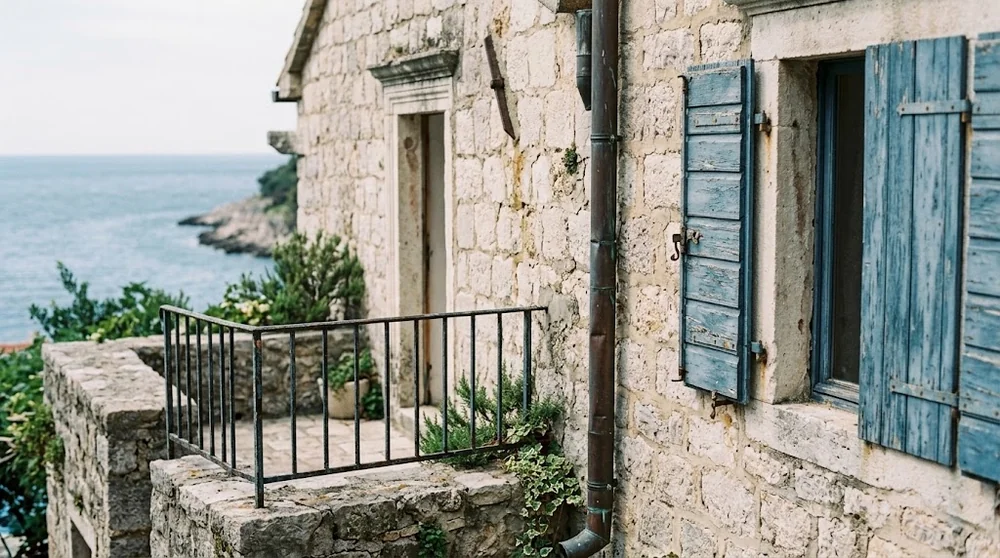
An exposed, sea-facing property may carry maintenance costs that a sheltered flat does not, and they recur every winter rather than once at purchase. Having restored an old stone house of my own in Kotor, I look at the materials before I look at the panorama. On the coast, the elements that earn the view can also wear the building, so treat the list below as inspection priorities rather than certainties.
- Coastal corrosion: salt air attacks railings, balustrade fixings, window hardware and air-conditioning condensers; galvanised or stainless fittings and regular repainting matter.
- Waterproofing: flat roofs and terraces above living rooms need intact membranes, correct falls and sound upstands where tiles meet walls.
- Glazing: large sea-facing windows bring heat gain, wind loading and seal wear; check frame quality and whether double glazing has failed.
- Shutters: timber shutters need oiling or painting and hinge repairs; aluminium shutters need clean tracks and sound motors.
- Cooling: south-facing glass can make summer cooling a significant utility cost.
- Drainage: hillside plots must shed heavy autumn rain away from foundations and terraces.
- Retaining walls: stone or concrete walls holding back a slope can be costly to repair and may be shared with neighbours.
- Winter damp: closed holiday homes on the coast often suffer condensation and mould without ventilation and dehumidifiers.
- Service charges and shared facilities: pools, lifts, gardens and security raise annual charges, especially in resort developments.
Inland property carries a different but equally real list. Heating can be a major recurring cost in Podgorica’s colder months and in mountain villages, depending on insulation, glazing and heating system, so ask for past utility bills. Roofs face snow load and frost. Rural homes may rely on septic systems, private wells and unpaved roads that the owner maintains. Old farmhouses can require structural renovation whose cost exceeds the purchase price.
Recurring costs and replacement reserves should be budgeted separately. Recurring costs are annual: utilities, cleaning, insurance, service charges and minor repairs. Reserves fund replacements on a longer cycle, such as a new terrace membrane, replacement windows or a boiler. A sea-facing flat often needs a larger reserve, which is why the model above assumes €2,000 rather than €1,200.
Acquisition tax needs careful handling. As of October 2026, I have checked the government-published 2026 consolidated text of Montenegro’s Law on Real Estate Transfer Tax, which supports the bands in force since January 2024: 3% up to €150,000; €4,500 plus 5% of the excess above €150,000 up to €500,000; and €22,000 plus 6% of the excess above €500,000. Table 3 applies them to taxable resale transactions with no exemption and with taxable market values equal to the purchase prices, which gives €7,000 and €9,500. The tax authority can assess a market value different from the contract price, and exemptions exist, so a Montenegrin lawyer should confirm the position for your specific purchase. Where the acquisition is subject to VAT, typically the first sale of a new-build by a VAT-registered developer, the law excludes it from real estate transfer tax, so the two taxes should not be applied to the same transaction.
Resale Value: Demand Is Not an Exit Guarantee
A view may well attract more viewings. That is buyer interest, and it is only the first of five separate things. The others are time to sell, the discount negotiated from the asking price, the achieved sale price and the net proceeds after costs and taxes. Strong buyer interest does not guarantee a faster sale, a higher achieved price or better net proceeds. I have no verified transaction evidence showing that sea-view homes in Montenegro sell faster, so I will not claim it.
The hypothetical pair from Table 3 shows why the exit must be modelled. Assume a five-year hold, the base-case annual income in every year, selling costs of 3% of the sale price for agency and legal fees, and furniture sold with the property. Any seller tax, such as tax on a capital gain, is excluded here and must be verified with an accountant for the year of sale.
In a flat-price scenario, both flats sell after five years at their original nominal purchase price. The no-view flat sells for €200,000, leaving €194,000 after selling costs; adding five years of income (€45,000) and deducting the €220,000 originally invested gives a pre-tax gain of €19,000. The sea-view flat sells for €250,000, leaving €242,500; adding €50,000 of income and deducting €275,000 gives €17,500. Selling at the original purchase price does not return the original investment, because transfer tax, fees and furnishing were spent at the start. On sale proceeds alone, the no-view flat is €26,000 short of its capital and the sea-view flat €32,500 short.
In a downside scenario, both sell 10% below their purchase price. The no-view flat fetches €180,000, nets €174,600, and with €45,000 of income ends €400 below the capital invested. The sea-view flat fetches €225,000, nets €218,250, and with €50,000 of income ends €6,750 below. Larger capital magnifies a price fall in euro terms.
These figures are nominal, ignore inflation and financing, and are not a forecast of Montenegrin prices. Their purpose is to show that a sea view’s exit case rests on achieved comparable sales, legal clarity, maintained condition and competing supply at the time you sell, not on advertised appreciation.
Applying these scenarios to a real listing usually raises specific questions about its title documents, its likely resale competition or a residence permit linked to ownership. Those are often quicker to settle in conversation than by email.
Have a listing in front of you? Message Vladislav on WhatsApp and he can usually tell you within one call which documents to request first.
Whatever the listing, the exit case is only as strong as the checks done before you commit. That is where the next stage begins.
Check the View and Paperwork Before Reserving
This house has a story — and so does its paperwork. A view is only as secure as the parcels in front of it, and a home is only as sellable as its legal status. Before you pay a reservation fee, make sure the following checks are complete or at least commissioned.
- Inspect the view from the actual rooms. Stand in the living room and on the terrace of the unit you are buying, not a show flat or the rooftop, and photograph the outlook at different times of day.
- Identify the intervening parcels. Map every plot and building between the property and the water, including empty land, gardens and low houses that could be replaced.
- Obtain a current list nepokretnosti. The first document I ask for is a fresh real estate certificate from the Real Estate Administration (cadastre), which shows the registered owner, parcel, building, unit and any encumbrances or restrictions recorded against it.
- Compare registered and physical areas. Measure the unit and terrace and compare them with the registered figures; enclosed balconies and added rooms are common discrepancies.
- Review planning conditions and neighbouring permissions. Ask a qualified planner or architect to check the current planning documents and urbanističko-tehnički uslovi (UTU) for nearby parcels, which set what may be built there, and any building permits already issued.
- Verify legalisation status and restrictions. Confirm whether the building was built with a permit, whether any note of unlawful construction appears in the title, whether a legalisation application exists, and whether a final decision has been issued.
- Establish lawful road access. A track used for years is not the same as registered access over a public road or a recorded right of way.
- Investigate Morsko dobro boundaries. For waterfront and near-shore plots, check whether any part lies within the public maritime domain, known as Morsko dobro, where private ownership and building rights are restricted.
- Obtain technical findings and repair estimates. Commission a survey of structure, waterproofing, drainage and services, and get written estimates for any defects before agreeing a price.
On paper this looks fine, but in reality a clean title extract proves ownership, not a view. A list nepokretnosti does not protect a sea view, because the neighbouring parcel’s development rights are governed by planning documents, not by your title. An empty plot below a terrace may simply be waiting for its permit.
Legalisation deserves its own warning. Montenegro’s rules for regularising informally built structures have changed over time, and historical notices or deadlines found online do not settle the position in October 2026. No buyer should assume that an irregular building can be legalised or sold without problems. Have a Montenegrin lawyer confirm the current procedure, any applicable deadlines and the consequences for financing and registration.
Price the view, the paperwork and the maintenance together. A beautiful outlook over an unprotected plot, on a terrace needing a new membrane, in a building with an unresolved legalisation note, is three discounts in one listing, not one premium.
Choose a Property That Fits Your Investment
This is where most first-time buyers slip up: they choose the property first and the limits afterwards. Write your limits down before viewing, then let each shortlisted home pass or fail against them.
- Income-led buyers should rank homes by incremental income per euro of extra capital, compare a coastal no-view flat and a Podgorica long let alongside any sea-view option, and reject homes that fail the stress test.
- Lifestyle-led buyers can pay for a view deliberately, but should treat the extra cost as a budgeted preference and still check obstruction risk, access and resale evidence.
- Renovation buyers should price structure, waterproofing and legal regularisation before the view, and keep a contingency for surprises in stone and timber.
- Every buyer needs written limits for total capital, minimum annual cash flow, owner-use weeks, acceptable access and the level of unresolved legal uncertainty they will tolerate.
An illustrative decision, not a real client case: a buyer with a €280,000 ceiling finds a hillside apartment with a panoramic view of the bay. The total capital comes to €292,000 once tax and furnishing are added, the realistic collected rent fails the 4% incremental hurdle, and the parcel below has a pending building permit. The correct decision is to walk away, however lovely the evening light.
Many shortlists stall because the buyer has not yet matched budget, preferred location and investment goal. Setting those three down in a structured way makes every later comparison faster and fairer.
Still shaping your criteria? Take the short property-matching quiz to set out your budget, location and goal before you compare homes.
Once those limits are on paper, the remaining questions tend to be the same handful that buyers ask me most often.
Frequently Asked Questions
Are sea view properties in Montenegro always worth more?
No. A sea view can support a higher asking price, but its contribution depends on the actual outlook, access, building quality and competing homes. A poorly maintained hillside apartment may be worth less than a well-positioned home without a view. Compare similar properties rather than treating waterfront, panoramic views and coastal location as interchangeable or automatically more valuable.
How can I check whether a sea view could be blocked?
Inspect the view from the actual living room and terrace, then identify the land and buildings between the property and the water. Ask a qualified local professional to review current planning documents, neighbouring permissions and permitted development. An empty plot, a seller’s assurance or a cadastral extract alone does not establish protection against future obstruction.
Do sea view properties generate higher rental income?
A sea view may support higher holiday rates, but annual income also depends on occupancy, beach access, parking, condition and guest reviews. Higher revenue does not automatically produce a higher yield, because the purchase price and costs may rise more. Compare twelve-month collected income and expenses, including periods reserved for your own use.
How much extra should I pay for a sea view in Montenegro?
There is no verified nationwide percentage that should determine your offer. Start with comparable homes in the same building or micro-location, then adjust for floor, condition, parking and access. Test whether the additional total capital is justified by realistic incremental income or a clearly budgeted lifestyle preference, allowing for obstruction risk.
Can inland property produce a better rental yield than coastal property?
Yes, an inland property can produce a better yield if its lower total cost outweighs the difference in annual rent and expenses. Podgorica’s residential rental market needs a different assessment from rural holiday accommodation. Neither an inland address nor a coastal view establishes performance; use property-specific rental evidence and consistent vacancy and cost assumptions.
Does a sea view make a property easier to resell?
A good sea view may broaden buyer interest, but it does not guarantee a quick sale or a higher net return. Legal status, asking price, access, maintenance and competing supply all influence the exit. Assess achieved comparable sales where available, and calculate proceeds after selling costs and applicable taxes rather than relying on advertised appreciation.
Fazit
A sea view in Montenegro is a genuine pleasure and, in the right building, a real source of demand. It is not a financial rule. The official MONSTAT data, preliminary for Q2 2026 as of October 2026, describe regional new-build averages, not the value of an outlook, and tourist-night statistics confirm where holidaymakers stay, not how a single flat performs.
The hypothetical model shows that a view can raise income while lowering yield on total capital, that an incremental hurdle and a matched yield are different tests, and that selling at the original price still leaves the buying costs unrecovered. The sound approach is to compare like with like, measure the gap yourself, test the incremental income after tax as well as before it, and price the view, the paperwork and the maintenance together.
When I settled in the Bay of Kotor, it was the stone and the water that drew me, but it was the paperwork that decided whether my own house was worth restoring. The same order of priorities serves any buyer: fall for the view if you like, then let the documents and the numbers decide.
Disclaimer: this article, reviewed in October 2026, is general information and not financial, tax or legal advice. All model figures are illustrative assumptions; no rental income, occupancy, appreciation, sale price or sale date is promised. Tax bands and legal procedures must be confirmed against current law. Before committing to a purchase, consult an independent Montenegrin lawyer, a qualified accountant and a technical specialist as appropriate.