
If you hope to get Montenegrin residence through a property, the number to remember is EUR 150,000, not EUR 200,000. Since 17 January 2026, new non-EU applicants must show a municipal transfer-tax decision with a tax base of at least that amount. The higher figure was a November 2025 proposal that never reached the adopted law. I checked this against the Official Gazette on 23 October 2026.
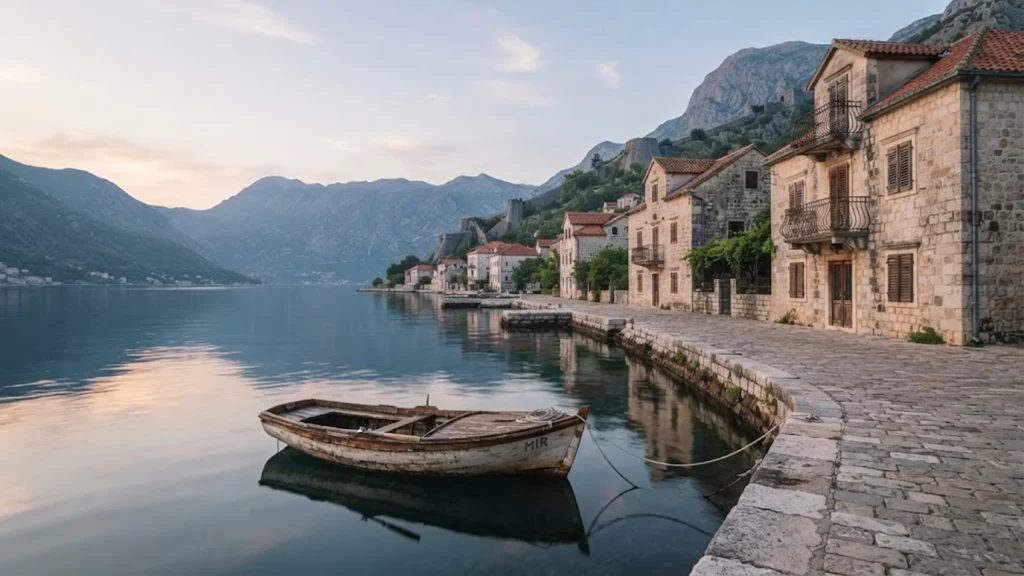
An old stone house in the Bay of Kotor often has a long chain of owners behind it: brothers who split it, a cousin abroad, a grandmother’s name still in the register. This house has a story, and so does its paperwork. Residence by property now has its own paperwork, and one number in it has caused real confusion: is it EUR 150,000 or EUR 200,000?
The short answer, with the source

The adopted law says EUR 150,000. The Law on Amendments and Supplements to the Law on Foreigners was published in Sluzbeni list CG 3/2026 on 9 January 2026 and entered into force on 17 January 2026. In Article 24, amending Article 56 of the Law on Foreigners, the applicant must add proof of the property’s value issued by the local tax authority: the decision on real-estate transfer tax, whose tax base is not less than EUR 150,000.
The EUR 200,000 figure comes from the Government’s amendments in November 2025, as reported by regional media. It was a proposal, and it is not in the text Parliament adopted on 31 December 2025. Some articles still repeat it.
My own opinion, clearly labelled: when two figures circulate, the Gazette is the only place to settle it, and I would not rely on a summary, including mine, without opening Article 24 yourself. The PDF text I read was machine-extracted and in places garbled, so I paraphrase rather than quote.
On paper this looks fine, but in reality…
On paper this looks fine: you buy a flat for more than EUR 150,000, so you qualify. In reality the law does not ask for the price in the contract. It asks for the tax base written into the municipal transfer-tax decision. I could not verify how municipal offices arrive at that base in practice, or whether a price above EUR 150,000 always produces a base above it. That is the first thing to ask before you pay a reservation fee.
The first document I ask for is therefore the tax decision itself (rješenje o porezu na promet nepokretnosti), together with the cadastre extract. If the base is below EUR 150,000, a new application on the property basis will not work.
Before and after the amendment

| Before 17 January 2026 | From 17 January 2026 | |
|---|---|---|
| Legal basis | Temporary residence for use and disposal of real estate owned in Montenegro | Same basis, plus a value proof |
| Value threshold | None in the statute | Tax base of at least EUR 150,000 |
| Document | Proof of ownership | Ownership plus municipal transfer-tax decision |
| Extension of a new-regime permit | Old rules | Proof that taxes were paid during the permit |
Who is exempt and who keeps the old rules
- Exempt from the value proof: citizens of EU member states and their family members, and citizens of Iceland, Liechtenstein, Norway and Switzerland.
- Applications started before 17 January 2026: finished under the old law (Article 217a).
- Extensions of permits held before that date: under Article 217b, requests filed after entry into force are completed under the old law. As I read it, the EUR 150,000 test is not applied to them. It is unclear whether the new tax-paid proof is still requested, so ask the Ministry of Interior.
Anyone from the UK or the US needing residence is a non-EU applicant under this law, so the value proof applies to you for a new application.
This is where most first-time buyers slip up
This is where most first-time buyers slip up: they treat property as a guaranteed ticket to residence. It is a conditional route. Bylaws are due within 12 months of the law coming into force (Article 216v), around January 2027, and media say they will cover which property types and what area qualify. I could not confirm that from the text. Until they appear, the old bylaws apply where they do not conflict with the law.
Two more points I could not verify: whether the later amendment cited as SL CG 33/26 changed anything here, and whether the package Parliament adopted on 15 October 2026 touches property-based residence. I have not read either.
A checklist before you commit
- Confirm your nationality category: exempt or not.
- Ask the municipality for the transfer-tax decision and read the base.
- Check ownership and the cadastre extract.
- Before you pay a reservation fee, make sure the contract does not promise residence as an outcome.
- Keep property tax receipts for any later extension.
- Ask the Ministry of Interior which procedure applies if you already hold a permit.
Questions readers ask
Is it EUR 150,000 or EUR 200,000?
EUR 150,000, as the tax base in the municipal decision. EUR 200,000 was only proposed.
Is it the purchase price?
No. It is the tax base in the transfer-tax decision. How it is calculated in practice is not verified.
Do EU citizens need it?
No, they are exempt, as are Icelandic, Liechtenstein, Norwegian and Swiss citizens.
What about my existing permit?
Under Article 217b the extension is completed under the old law.
Official sources
- Official Gazette of Montenegro: SL CG 3/2026
- Law on Amendments, full text (PDF)
- Ministry of Interior
- Ministry of Finance: real-estate transfer tax
Checked on 23 October 2026. This is general information, not legal, tax or immigration advice. Rules can change; confirm the current position with the Ministry of Interior and a licensed lawyer.