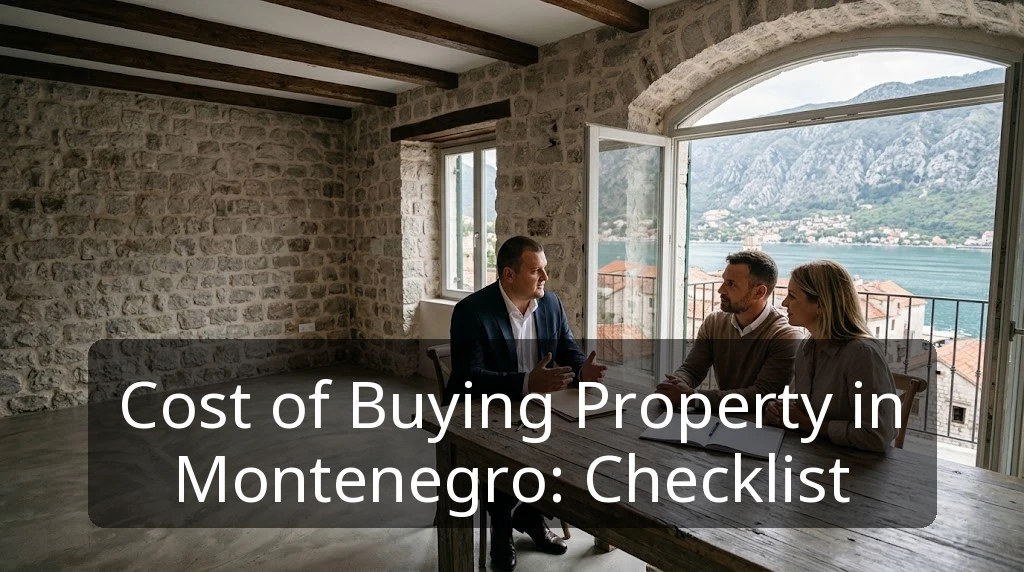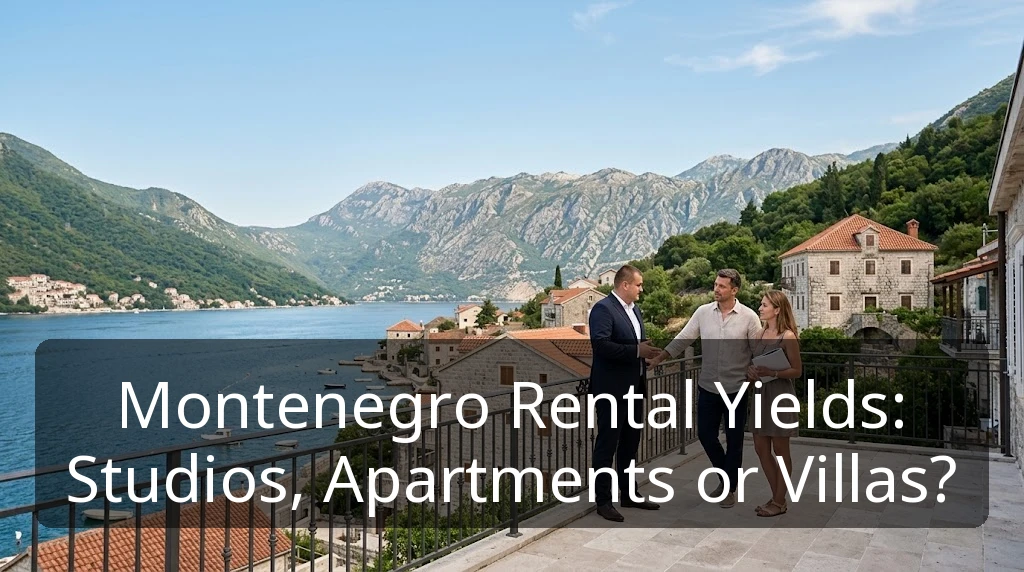
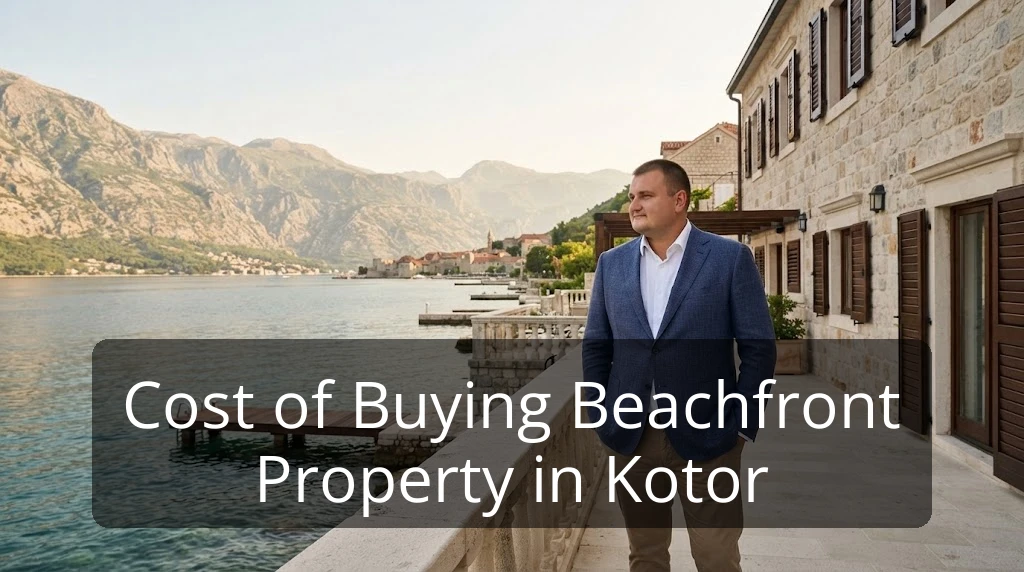
A Kotor waterfront listing quotes one number, but the money that leaves your account is another. Between the asking price and the keys sit transfer tax, notary and legal fees, surveys and, in an old stone house, the repairs the seller’s photographs politely leave out. I have built the full figure for three hypothetical purchases, using the rules as I could verify them in November 2026.
Buying beachfront property in Kotor involves more than the asking price. As of November 2026, resale buyers pay progressive transfer tax of 3–6%, plus notary, legal, registration and possible agency fees. New-build transactions may include 21% VAT instead. Waterfront buyers must also budget for title checks, coastal restrictions, maintenance, insurance and potential renovation before committing to a purchase.

How Much Does Beachfront Property in Kotor Cost?
The total capital needed for a Kotor waterfront home is the purchase price plus taxes, professional fees, surveys, any immediate works and a reserve for holding the property safely. I wrote this guide as of November 2026, and every rule below should be re-confirmed with your own lawyer before you sign anything.
What counts as beachfront in Kotor Bay?
Estate agents use the word loosely, so I use four working definitions of my own. These are not legal terms. Direct waterfront means the plot or building meets the shoreline, or opens onto a quay or promenade at the water’s edge, with documented access. Beachfront means direct waterfront next to a usable beach, which is rare in the inner bay, where much of the shore is stone quay rather than sand. Sea view means you can see the water, often across the coastal road. Walking distance means a few minutes on foot. The price gap between these four categories is large, so confirm which one you are really buying.
Cost categories at a glance
The table separates charges fixed by law from those that depend on your contract or your choices. Figures follow in later sections.
| Cost category | Status | What decides the amount |
|---|---|---|
| Purchase price | Negotiated | Condition, plot, access, legal status |
| Resale transfer tax | Statutory (resale) | Progressive 3%, 5% and 6% on taxable value |
| VAT on new buildings | Statutory (qualifying first sale) | 21%, usually already inside the developer’s price |
| Notary | Statutory tariff | Official Gazette 49/2026, effective 9 April 2026, plus 21% VAT |
| Lawyer | Optional but advisable | Written fee agreement |
| Interpreter and translation | Conditional | Your language, document length |
| Cadastral registration, bank and currency charges | Conditional | Current fee schedules, your bank |
| Survey and inspection | Optional but advisable | Building type and size |
| Agency commission | Contract-dependent | The written agency agreement |
| Initial works and reserves | Your decision | Survey findings |
| Annual ownership costs | Recurring | Municipal tax, insurance, utilities, upkeep |
Ask the seller or agent for a complete list of these items before you pay anything. [CTA: PERSONALISED_KOTOR_COST_BREAKDOWN] If you already have a shortlist of Kotor Bay properties, a personalised all-in cost breakdown for each one turns this table into real numbers for your own decision.
Kotor Waterfront Property Prices by Location
Kotor waterfront prices vary far more by micro-location and building type than by town name, so any single per-square-metre figure should be treated with caution. I separate three kinds of evidence: official statistics, secondary market commentary and the asking prices you see on listings. None of them is a verified average of completed waterfront sales in Kotor.
What the available price evidence actually shows
MONSTAT, Q2 2026, reported an average of €2,838/m² for new dwellings across the whole coastal region, published on 20 August 2026 (MONSTAT). That figure covers the coastal region, mixes several municipalities and excludes existing resale stock, so it is not a Kotor beachfront benchmark. An October 2026 secondary-market guide cites about €3,605/m² for Kotor generally, about €4,500–8,000/m² for coastal apartments and about €6,500–12,000/m² for premium waterfront villas. I treat these as market commentary, not official valuations, and I do not apply them to every village.
For scale, an 80 m² apartment at €4,500–8,000/m² implies €360,000–€640,000, and a 250 m² villa at €6,500–12,000/m² implies €1,625,000–€3,000,000. This arithmetic is an illustration, not a valuation. It also explains why a €1,000,000 waterfront villa in my scenarios would be roughly 150 m² at the lowest quoted villa rate, or a smaller or older house.
Comparing the bay’s settlements
| Location | Typical stock | Access and parking | Main acquisition risks |
|---|---|---|---|
| Kotor Old Town | Apartments in historic stone buildings | Pedestrian streets; parking outside the walls | Heritage controls, building condition, limited direct water access |
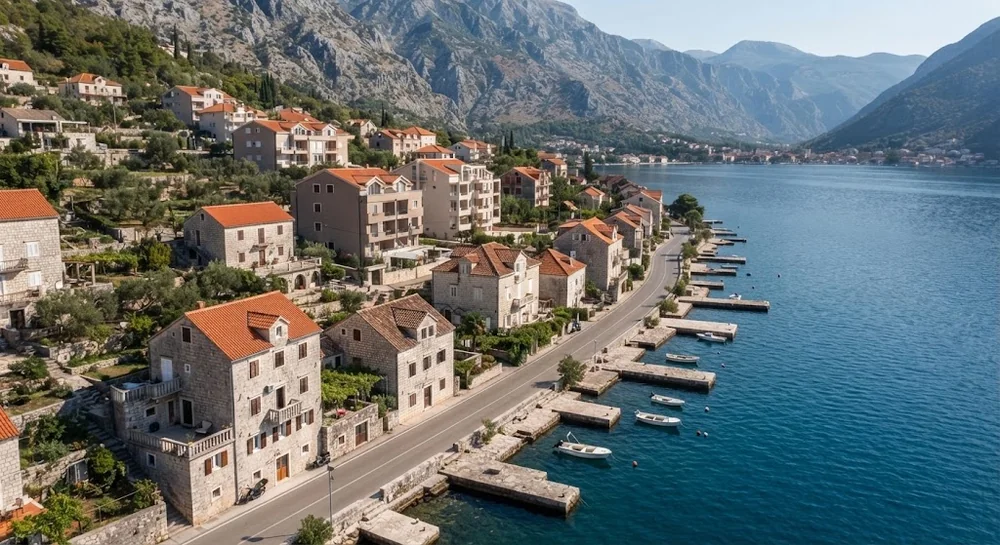
| Dobrota | Long chain of stone houses, apartments and villas | Coastal road; parking varies by plot | Many homes sit across the road from the water; verify the shore parcel |
| Muo | Smaller waterfront houses and apartments | Narrow roads, limited parking | Traffic, flooding exposure, unclear boundaries |
| Prčanj | Historic seafaring houses and some newer villas | Steep lanes; parking is a real constraint | Heritage status, structural condition, retaining walls |
| Stoliv | Small village houses, few listings | Very limited road access | Few comparables, hard construction logistics |
| Perast | Protected historic houses, rare sales | Pedestrian-scale, tight parking | Strict conservation, thin market, difficult valuation |
The table is my own qualitative assessment from reviewing waterfront purchases, not a price list; it deliberately carries no per-square-metre figure for individual villages because I cannot validate one. Apartments in newer buildings behave differently from stone houses: they have predictable service charges and simpler paperwork. A restored stone house on the water offers character and a hard-to-replace location, but the survey, permissions and shoreline questions are heavier. Elsewhere on the coast, Budva and Tivat have different price structures, so avoid transferring their per-square-metre figures to the Bay of Kotor.
Montenegro Property Transfer Tax and VAT
As of November 2026, resale purchases in Montenegro are subject to real estate transfer tax (porez na promet nepokretnosti), which has been progressive since 1 January 2024 under the amended Real Estate Transfer Tax Law. The tax is not a flat 6% of the price. Official texts and tax guidance are published through the Montenegrin government portal, and I recommend asking your lawyer to confirm there have been no amendments since this article’s reference date.
The progressive formula
| Taxable value band (€) | Tax payable (€) |
|---|---|
| Up to 150,000 | 3% of the taxable value |
| 150,000.01 to 500,000 | 4,500 plus 5% of the amount above 150,000 |
| Above 500,000 | 22,000 plus 6% of the amount above 500,000 |
The middle band tops out at €22,000 because 3% of €150,000 is €4,500 and 5% of the next €350,000 is €17,500. The worked examples below assume that the taxable value equals the purchase price.
| Taxable value (€) | Calculation | Transfer tax (€) | Effective rate |
|---|---|---|---|
| 300,000 | 4,500 + 5% × 150,000 | 12,000 | 4.00% |
| 600,000 | 22,000 + 6% × 100,000 | 28,000 | 4.67% |
| 1,000,000 | 22,000 + 6% × 500,000 | 52,000 | 5.20% |
Purchase price versus taxable value
The tax is calculated on the taxable value, which is the market value as determined under the law and not necessarily the figure written in your contract. If the authority assessed a €600,000 property at €700,000, the tax would be 22,000 + 6% × 200,000 = €34,000, which is €6,000 more than the €28,000 on the contract price. That example is hypothetical. Ask your notary and a Montenegrin tax adviser how the valuation is established in practice, and do not assume a low contract price lowers the tax.
When I bought and restored my own stone house, the surprise was not the tax but how many separate payments sat around it. I now lay every payment out on a single sheet for a buyer before anything is signed.
Resale transfer tax versus 21% VAT on new buildings
A qualifying first transfer of a newly constructed building is generally subject to 21% VAT (PDV) instead of the resale transfer tax. The developer’s displayed price is commonly VAT-inclusive, so you should never add another 21% to it automatically. For a VAT-inclusive price of €600,000, the VAT contained in that price is €600,000 × 21 / 121 = about €104,132, and the net price is about €495,868. The precise status of each transaction, including whether the seller is VAT-registered and whether it is a first supply, must be established from the contract and confirmed by your lawyer. Do not double-count VAT and transfer tax.
Filing and payment deadlines
Two obligations are easy to confuse: filing the tax declaration and paying the tax following an assessment. I have not confirmed the day counts for either as of November 2026, so I do not quote them here. Ask your lawyer to state both deadlines in writing, say who is responsible for each, and confirm the consequence of missing them.
Notary, Lawyer and Other Closing Costs
The current notarial tariff is the one published in Official Gazette 49/2026, in force since 9 April 2026. Older tables with fixed price bands, such as a flat €350 for contracts between €80,001 and €120,000, belong to the previous tariff and must not be treated as current. I have not obtained the official gazette text myself, so the notary figures below come from the calculations of agencies that apply the new tariff. They are indicative until your notary provides a written calculation.
How the notary figure is built
The agency calculators I cross-checked apply a base fee of about €480 for values up to €119,999.99, plus about €13 for each started €15,000 above that, plus 21% VAT. Their worked examples agree with each other at €250,000 (a base fee of €597) and at €350,000. A €15 notary charge for preparing the cadastral application and an interpreter’s surcharge of around €15 are also reported. On that basis, an indicative notary bill including VAT and the €15 filing charge would be roughly €800 for €300,000, €1,120 for €600,000 and €1,530 for €1,000,000. Where a preliminary contract is notarised, reports say the tariff may be split between the two documents; confirm that with your notary.
Lawyer, interpreter, bank and commission
| Item | Who normally pays | Nature | How to obtain the figure |
|---|---|---|---|
| Notary (tariff in Official Gazette 49/2026) | Usually the buyer, by agreement | Statutory tariff plus 21% VAT | Written calculation from the notary |
| Legal due diligence and contract review | Buyer | Case-dependent | Fee agreement; published guides cite starting points of about €1,200 and €1,500 |
| Certified interpreter and written translation | Buyer, if needed | Case-dependent | Per-page and hourly quotes; reported written rates are around €15–20 per page |
| Cadastral registration, bank transfer and currency conversion | Buyer | Mixed | Current fee schedules and your bank’s rates |
| Power of attorney (remote purchase) | Buyer | Mixed | Notary or consulate quote |
| Escrow arrangement | By agreement | Optional | Escrow agent’s quote |
| Agency commission | Seller, buyer or both, by contract | Contract-dependent | Written agency agreement |
Legal and interpreter fees are not statutory universal amounts, so I do not give a single number; use quotations. The commission is the most disputed line. Some published guides say the seller pays an agent’s fee of roughly 1.5%, while other calculators model a buyer’s charge of 3–5%. No universal buyer commission exists, and the responsible party is whoever signed the agency agreement. Ask for the fee schedule in writing before viewing, and make sure the purchase contract states that no further commission is owed.
Three Complete Kotor Beachfront Purchase Budgets
These three scenarios are hypothetical. They are not listings or market averages. In each, the taxable value equals the purchase price, so transfer tax is €12,000, €28,000 and €52,000, and price plus tax comes to €312,000, €628,000 and €1,052,000 before other costs.
| Line item (€) | €300,000 apartment | €600,000 premium apartment | €1,000,000 villa | Basis |
|---|---|---|---|---|
| Purchase price | 300,000 | 600,000 | 1,000,000 | Hypothetical |
| Transfer tax | 12,000 | 28,000 | 52,000 | Progressive scale, as of November 2026 |
| Price plus tax | 312,000 | 628,000 | 1,052,000 | Sum |
| Notary incl. 21% VAT and filing | 800 | 1,120 | 1,530 | Indicative; confirm with notary |
| Lawyer | 1,500 | 2,500 | 4,000 | Illustrative allowance |
| Interpreter and translation | 400 | 400 | 400 | Illustrative allowance |
| Registration, bank and currency charges | 300 | 500 | 800 | Placeholder |
| Independent survey | 800 | 1,500 | 3,000 | Illustrative allowance |
| Agency commission | 0 | 0 | 0 | Excluded; contract-dependent |
| Initial improvements | 15,000 | 30,000 | 100,000 | Planning assumption, not a quote |
| Contingency (20% of works) | 3,000 | 6,000 | 20,000 | Planning assumption |
| Total capital required | 333,800 | 670,020 | 1,181,730 | Sum of lines |
The reusable formula is: all-in capital = price + transfer tax (or VAT embedded in a developer’s price) + notary with VAT + lawyer + interpretation and translation + registration and bank charges + survey + commission if contracted + initial works + contingency. Before works and contingency, the extra cost is €15,800 (5.3%) for the first scenario, €34,020 (5.7%) for the second and €61,730 (6.2%) for the third. With works and contingency, it rises to €33,800 (11.3%), €70,020 (11.7%) and €181,730 (18.2%). If a buyer commission of 3% were contracted, it would add a hypothetical €9,000, €18,000 or €30,000. Only the transfer tax and the notary tariff come from rules; every other line is an allowance you should replace with quotations.
A new-build comparison at the same advertised price
Consider a qualifying new-build apartment advertised at €600,000 including VAT. The resale transfer tax of €28,000 would not apply to that first supply, because 21% VAT, about €104,132, is already inside the price. The notary, lawyer, registration and survey lines would still apply. This is why you cannot compare new-build and resale prices without first confirming whether VAT is included and whether the sale is a qualifying first transfer.
[PROPERTY_SELECTION_SHORTCODE: KOTOR_WATERFRONT] If you want to see which Kotor Bay properties fit your all-in budget rather than the asking price alone, you can request a selection filtered by total capital.
Coastal Rights, Cadastre and UNESCO Restrictions
Owning a registered house on the shore does not automatically mean owning the beach, jetty or mooring in front of it. Montenegrin law treats much of the coast as maritime domain, regulated by the Law on Maritime Domain and administered by Morsko dobro. A listing that says waterfront describes a view or a location; it does not establish private ownership of the water’s edge. This is where documents matter more than photographs.
The checks below are the order in which I would run them.
- Cadastral extract. The first document I ask for is the List nepokretnosti issued by Uprava za nekretnine (katastar.me). It should show the registered owner, the share owned, mortgages or other encumbrances, the parcel numbers and whether the building itself is registered. If the seller named in the contract is not the owner named in the extract, stop.
- Parcel map and boundaries. Compare the cadastral map with the physical plot. Establish whether the parcel actually reaches the water or stops at a road, a seawall or a separate coastal strip. In Dobrota in particular, a house can sit across the road from the sea.
- Maritime-domain status. Ask your lawyer whether any part of the plot or the adjoining shore falls under the maritime domain, and whether any concession or consent exists for the jetty, pontoon, slipway or mooring that the seller mentions. A structure that is physically there is not proof that it is lawful.
- Registered access. Confirm legal road access, rights of way and parking, including any easement over a neighbour’s land. Practical access matters twice: for daily use and for bringing building materials to a restoration site.
- Legalisation of the building. Check that the building and any terrace, extension or boathouse are registered and legally constructed. The cost of regularising unauthorised alterations is case-specific and cannot be estimated responsibly from a general guide.
- UNESCO status and planning rules. Kotor and its surroundings form the Natural and Culturo-Historical Region of Kotor, a UNESCO World Heritage property with a protected area and a buffer zone, as listed by the UNESCO World Heritage Centre. I understand that the World Heritage Committee’s decisions in 2025 and 2026 concern development approvals and planning protection in the property. They do not, in my reading, automatically prohibit buying, repairing or renovating an existing building. Whether a particular repair, extension or new build is allowed depends on the site, and I would confirm it with the Municipality of Kotor and the competent heritage and planning authorities before relying on it.
- Purchase legality versus permission to renovate. Being allowed to buy a house is a different question from being allowed to change it. Obtain written confirmation of what works are permitted for the exact property, and the expected timescale, before you reserve it.
This house has a story — and so does its paperwork. In my experience, the buildings with the best stories are the ones where the paperwork needs reading most carefully.
The financial consequence is concrete. Restrictions can delay works, narrow the choice of materials and methods, add specialist fees and, in the worst case, make a planned extension impossible. Price this as a risk to the plan, not as a certainty, and have it assessed by the responsible authorities and your lawyer.
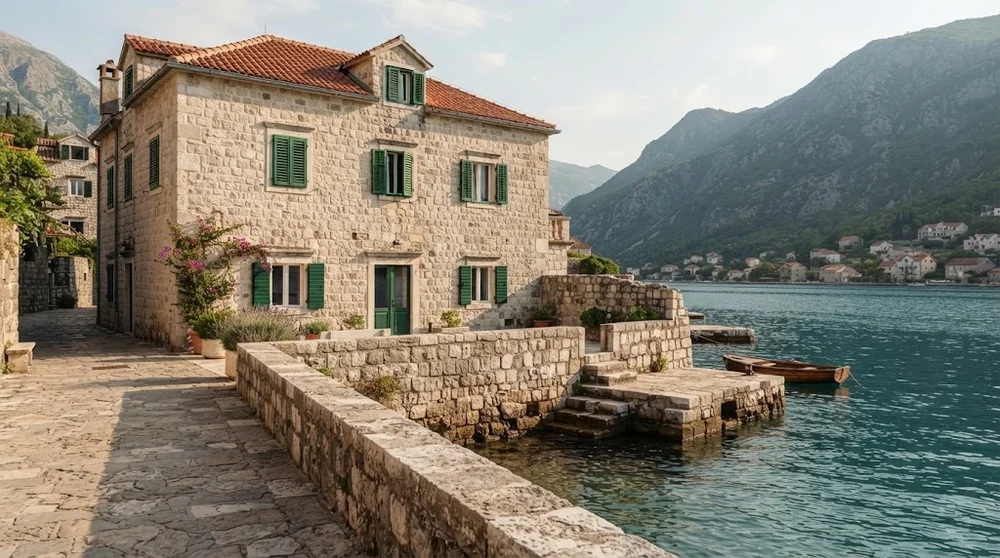
Hidden Renovation Costs of Waterfront Homes
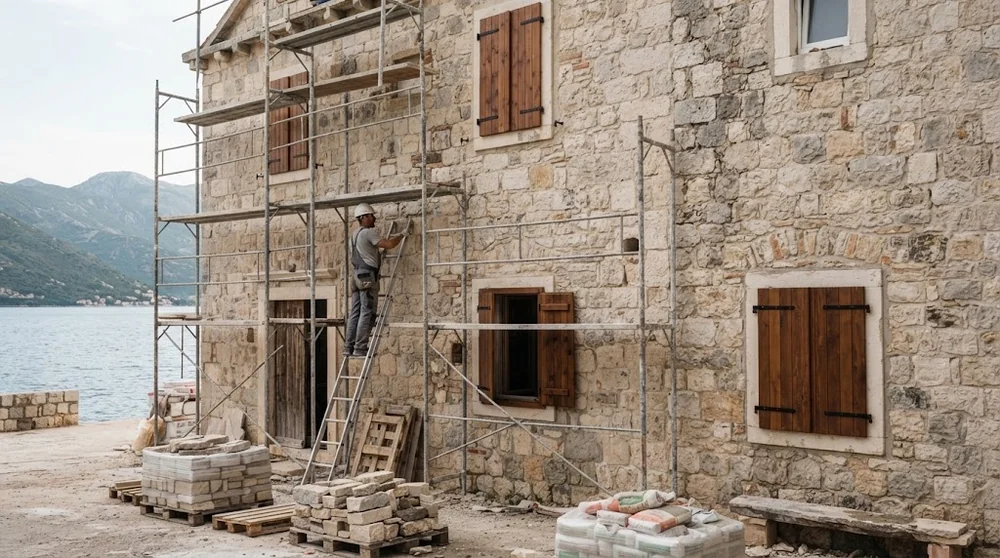
Salt-laden air, rising damp, drainage and limited access make renovation on the Bay of Kotor more expensive and less predictable than inland. Apartments in newer buildings mostly bring service charges and fit-out costs. Historic stone houses bring structural and moisture questions, and detached villas add their own roofs, terraces, retaining walls and sometimes seawalls. Protected historic buildings can require specialist restoration methods and additional approvals, which can raise both cost and time.
A pre-purchase inspection should cover the following points.
- Roof and rainwater: condition of tiles, membranes, gutters and downpipes, and where water goes afterwards.
- Damp: rising damp at wall bases, condensation, salt efflorescence and failed plaster.
- Drainage and wastewater: surface drainage around the building, septic or sewer connection and whether pipes are accessible.
- Stone masonry: failing mortar, cracks, bulging walls and previous cement repairs that trap moisture.
- Salt corrosion: external joinery, shutters, railings, balcony reinforcement and fittings.
- Retaining structures and seawall: cracks, undermining and who is responsible for them.
- Electrics: old wiring, earthing and damp-exposed distribution boards.
- Thermal performance: window quality, roof insulation, and heating and cooling needs.
- Access for works: lane widths, steps, crane or boat delivery, and parking for trades.
Specialist surveys cost more than a general inspection, but they cost far less than discovering a structural issue after completion. For approved restoration methods, I expect lime-based mortars and breathable plasters to be preferred over cement in historic masonry, but the exact specification must come from a qualified conservation professional and the competent authority. I do not quote a euro-per-square-metre renovation rate here because I have no recent documented quotations for the Bay of Kotor, and a figure from another market would mislead you.
Treat contingency as a planning assumption, not a guaranteed percentage. My own habit is about 10% of the works budget for sound, newer buildings and 20% or more for historic stone, which is a personal assessment and not a rule. In the budgets above I used 20%.
Restoring my own stone house taught me to find out where the water goes before choosing any finish. Everything else, from plaster to paint, depends on that answer.
Annual Costs of Owning Kotor Waterfront Property
Annual ownership costs for a Kotor waterfront property depend on the building type, its condition and how you use it. National summaries place annual real estate tax at roughly 0.25–1% of assessed market value, but that range is not a Kotor tax bill. The actual rate, the valuation method, any classification of the property and any exemptions are set by municipal decisions, and you should confirm them with the Municipality of Kotor for the specific property as of November 2026.
Annual budget table
The planning allowances below are mine, not published data. I assumed a property tax rate of 0.5% on an assessed value equal to the purchase price, which is a placeholder inside the national range.
| Annual cost line (€) | Apartment (€300,000) | Villa (€1,000,000) | Basis |
|---|---|---|---|
| Municipal property tax | 1,500 | 5,000 | 0.5% placeholder; verify with the municipality |
| Insurance | 500 | 2,500 | Allowance; obtain quotes |
| Utilities, heating and cooling | 2,000 | 4,000 | Allowance; request actual bills |
| Common-area and management fees | 800 | 0 | Apartment building charge, if any |
| Cleaning, moisture control, grounds | 600 | 3,000 | Allowance |
| Routine repairs and major-maintenance reserve | 3,000 | 10,000 | 1% of price, a planning reserve |
| Annual total | 8,400 | 24,500 | Sum of lines |
Property tax, insurance and utilities are the unavoidable lines. Management, cleaning and security are optional services. An old stone house on the water may need more than a 1% reserve, so adjust after the survey.
Five-year cumulative holding costs
| Year | Apartment annual (€) | Apartment cumulative (€) | Villa annual (€) | Villa cumulative (€) |
|---|---|---|---|---|
| 1 | 8,400 | 8,400 | 24,500 | 24,500 |
| 2 | 8,400 | 16,800 | 24,500 | 49,000 |
| 3 | 8,400 | 25,200 | 24,500 | 73,500 |
| 4 | 8,400 | 33,600 | 24,500 | 98,000 |
| 5 | 8,400 | 42,000 | 24,500 | 122,500 |
This model holds costs constant and ignores inflation and tax changes. Add the acquisition costs, and the apartment scenario needs about €375,800 over five years (€333,800 + €42,000), and the villa about €1,304,230 (€1,181,730 + €122,500). Set aside a separate provision for unexpected works, such as a roof or a retaining-wall repair, because a constant reserve does not fall due evenly.
Rental Returns and Five-Year Investment Economics
An investment case should be tested separately from the lifestyle case. Gross rental revenue is nights sold multiplied by the average nightly rate. Gross yield is annual gross revenue divided by the purchase price (or by all-in capital, which is stricter). Net operating income is gross revenue minus operating costs, before income tax and financing.
Hypothetical €300,000 apartment scenarios
The assumptions below are mine and are not reported Kotor averages. I assume 240 bookable nights a year, after owner-use nights and winter closure, which reduces availability. Variable costs are 40% of revenue (platform commission 15%, management 15%, cleaning and laundry 10%). Fixed ownership costs are the €8,400 apartment budget above. All results are before income tax.
| Line | Conservative | Base | Optimistic |
|---|---|---|---|
| Average nightly rate (€) | 110 | 140 | 170 |
| Occupancy of 240 bookable nights | 40% | 50% | 60% |
| Nights sold | 96 | 120 | 144 |
| Gross rental revenue (€) | 10,560 | 16,800 | 24,480 |
| Variable costs at 40% (€) | 4,224 | 6,720 | 9,792 |
| Fixed ownership costs (€) | 8,400 | 8,400 | 8,400 |
| Net operating income (€) | -2,064 | 1,680 | 6,288 |
| Gross yield on €300,000 price | 3.52% | 5.60% | 8.16% |
| Net yield on €333,800 all-in capital | -0.62% | 0.50% | 1.88% |
Rental taxation, licensing and tourist-tax obligations are not modelled. Distinguish gross revenue from taxable profit and net income, and verify the current rules as of November 2026 with the Municipality of Kotor and a Montenegrin tax adviser before assuming that short-term letting is permitted for a particular property.
Five-year ownership and resale sensitivity
I use zero capital appreciation as the neutral assumption. The framework sells the apartment after five years for the original €300,000, less assumed selling costs of 3% (€9,000, a hypothetical figure), so the sale yields €291,000. Seller-side taxes are not included and should be checked.
| Scenario | Five-year cumulative NOI (€) | Net sale proceeds (€) | Position versus €333,800 invested (€) |
|---|---|---|---|
| Conservative | -10,320 | 291,000 | -53,120 |
| Base | 8,400 | 291,000 | -34,400 |
| Optimistic | 31,440 | 291,000 | -11,360 |
Without appreciation, even the optimistic case ends below the capital invested, because entry and exit costs are larger than the rental surplus. To break even, the apartment would have to rise by roughly 3.8% (optimistic), 11.5% (base) or 17.7% (conservative) of the €300,000 price over five years, before any extra selling costs on the higher price. I do not predict that. Initial works may add some value, but that depends on the quality of the work and the buyer. If you plan owner-use weeks, remember each night you occupy is a night you do not sell.
Buying a Beachfront Home in Kotor Step by Step
The order of the steps protects your money. Professional checks should come before any non-refundable payment, not after. This is the sequence I follow with buyers.
- Set the all-in budget. Calculate the total capital with the formula from the budget section, not the asking price.
- Select genuine waterfront candidates. Use the definitions above and discard sea-view properties if you need direct access.
- Obtain the List nepokretnosti and cadastral map. Check the owner, shares, encumbrances, parcel boundaries and building registration.
- Verify the seller’s authority. Confirm identity, ownership, any co-owners, mortgages and the legality of the building.
- Commission an independent lawyer and a building surveyor. The agent, however helpful, does not replace the lawyer who acts only for you.
- Investigate shoreline and heritage constraints. Get written confirmation of any jetty or mooring consent and of what works are permitted.
- Collect written cost estimates. Notary calculation, lawyer fee, interpreter, translation and bank charges.
- Agree a reservation or preliminary contract. Make the deposit conditional on the checks above and state the refund terms in writing.
- Sign before the notary and transfer funds. Follow the payment sequence agreed in the contract, with the notary present.
- Complete the tax steps. Establish the tax assessment, declaration and payment for a resale, or confirm VAT treatment for a new build.
- Confirm registration. Obtain an updated List nepokretnosti showing you as owner.
Before you pay a reservation fee, make sure the agreement says when it is refundable. A reservation fee often becomes non-refundable once the checks you agreed to have passed or if you withdraw without a contractual reason, but the terms are whatever you sign. Money paid under a preliminary contract is also at risk if you breach it. For a remote purchase, a power of attorney must be prepared and authenticated in the form Montenegrin law and the country of signing require; your lawyer should confirm the exact requirements, including any apostille or consular steps, as of November 2026.
If you are unsure which documents your particular purchase requires before signing a contract, a short one-to-one conversation can save weeks of back-and-forth with the seller.
A message to me does not replace your own lawyer, but it can help you list the documents to request first. After that, the order of the checks above still applies, and a clean extract is only the start of the review.
Is a Kotor Waterfront Property Worth Buying?
The answer depends on what you are buying it for. The matrix below compares three buyer types against the same criteria.
| Criterion | Personal use | Mixed use | Rental-led |
|---|---|---|---|
| Affordability test | Can you carry all-in capital plus annual costs comfortably? | Same, with income treated as a bonus | Does net income survive the conservative scenario? |
| True waterfront status | Matters for lifestyle | Matters for lifestyle and rate | Must be proven in documents |
| Legal clarity | Essential | Essential, plus rental permission | Essential, plus licence and tax |
| Repairs and renovation | Affects comfort and budget | Affects downtime and revenue | Affects yield directly |
| Annual costs | Paid out of income | Partly offset | Reduce net yield |
| Seasonality | Low impact | Moderate | High |
| Resale and liquidity | Flexible timing | Moderate | Exit timing and costs matter |
Separate missing documents from confirmed risks. A missing document, such as an absent access agreement or an unclear mooring consent, calls for further verification, and the issue may be resolved. A confirmed serious risk may justify walking away: a seller who is not the registered owner, an unresolved mortgage the seller cannot clear, an unauthorised structure that cannot be regularised, or a refusal to let a surveyor or lawyer see the documents.
Before you pay a reservation fee, make sure you can answer four questions in writing. What exactly is being bought: house, plot, shoreline strip or only a view? Who pays which fee, including any commission? What happens to the deposit if the checks fail? What may you build or alter, according to the competent authority?
To match your budget, location and investment goals with properties whose paperwork can be reviewed before you commit, a structured shortlist is a sensible first step.
A shortlist and a property-specific cost breakdown are a starting point for your decision. They are not legal guarantees, and they do not replace an independent Montenegrin lawyer, a tax adviser and a building surveyor.
Frequently Asked Questions About Kotor Buying Costs
How much extra should I budget when buying a beachfront property in Kotor?
For a resale purchase, budget for progressive transfer tax of 3–6% on the taxable value, plus notary, legal, translation and registration costs. On a €600,000 purchase with an equal taxable value, transfer tax alone is €28,000 as of November 2026. Surveys, any renovation and a maintenance contingency come on top, so the final figure depends on the individual property and contract.
Do foreigners pay more property purchase tax in Montenegro?
No separate foreigner surcharge applies to Montenegro’s real estate transfer tax as of November 2026; foreign and domestic buyers follow the same progressive scale of 3%, 5% and 6% marginal rates on resale purchases. First sales of qualifying new buildings are subject to 21% VAT instead. Ownership restrictions on certain land categories are separate from tax and must be verified independently.
Does buying a beachfront house in Kotor give me private access to the sea?
Not automatically. Owning a waterfront building does not necessarily include ownership or exclusive use of the adjacent beach, shoreline, pontoon or mooring, because Montenegro’s Law on Maritime Domain may govern those areas. Before buying, obtain the cadastral extract and parcel plan, verify registered access, and ask an independent lawyer to examine any separate permits or agreements for waterfront structures.
Can a foreign buyer legally purchase a waterfront villa in Kotor?
Foreign individuals can generally buy residential property in Montenegro, but restrictions apply to some land categories. For a waterfront villa in Kotor, verify cadastral ownership, land classification, registered encumbrances, lawful construction, maritime-domain rules and heritage protection with an independent lawyer. A listing that says beachfront does not confirm that the property is free of heritage, maritime-domain or planning limitations.
How expensive is it to maintain a beachfront property in Kotor?
Annual costs depend on property value, building type, condition and the services used. Typical lines are municipal property tax, insurance, utilities, management charges and repairs, and waterfront buildings often need extra moisture control and salt-exposure maintenance. As of November 2026, no universal figure applies; obtain actual bills and a technical assessment for the specific property before setting the annual budget.
Is beachfront property in Kotor a good investment in 2026?
Beachfront property in Kotor can be a sound investment in 2026, depending on the all-in purchase price, lawful use, occupancy, operating costs and exit conditions. Premium asking prices do not guarantee strong net yields, and no appreciation or rental profit can be promised. Compare conservative cash-flow scenarios including purchase and exit costs, and confirm that the intended rental use is legally permitted.
What I Would Do Before Committing Funds
The asking price is the smallest honest number in a Kotor waterfront purchase. On my hypothetical budgets, taxes and professional costs added about 5–6% before any works, and 11–18% once improvements and contingency were included. The progressive transfer tax is the one cost you can calculate exactly, so start there and then replace every allowance with a written quotation.
The decisions that carry the most money are the ones the listing never mentions: whether the shoreline rights are documented, whether the building is legalised, and what the conservation rules allow. After seven years in the bay, I would check those before I looked at kitchens or terraces. Also remember that at zero appreciation, entry and exit costs take years of rental income to recover.
My practical advice is to set your all-in budget first, hire an independent lawyer and a surveyor before any non-refundable payment, and walk away when a seller will not show the documents. Treat the figures here as a framework and not a quote.
Legal and financial information disclaimer: This article is general information prepared as of November 2026. It is not legal, tax or investment advice, and it does not guarantee any outcome, price, return or permission. Tax rates, tariffs, planning rules and heritage decisions can change, and the budgets above are hypothetical. Consult an independent qualified Montenegrin lawyer, a tax adviser where appropriate and a building surveyor before making any binding commitment.