
A flat that is delightful for ten days in August can be a poor home in February, and a strong rental in July can be an awkward asset to sell. Choosing property in Bečići (Becici), on the Budva Riviera, comes down to deciding which of those two jobs the apartment must do. This guide separates the lifestyle case from the investment case, using dated official statistics wherever they exist.
Buying property in Becici, Montenegro, can suit both lifestyle buyers and rental investors, but the priorities differ. Permanent residents should assess winter amenities, accessibility, parking and building quality. Investors should examine purchase costs, seasonal occupancy, management fees and net rental returns. The right apartment depends on how often you will use it and your financial expectations.
What Makes Buying Property in Becici Different?
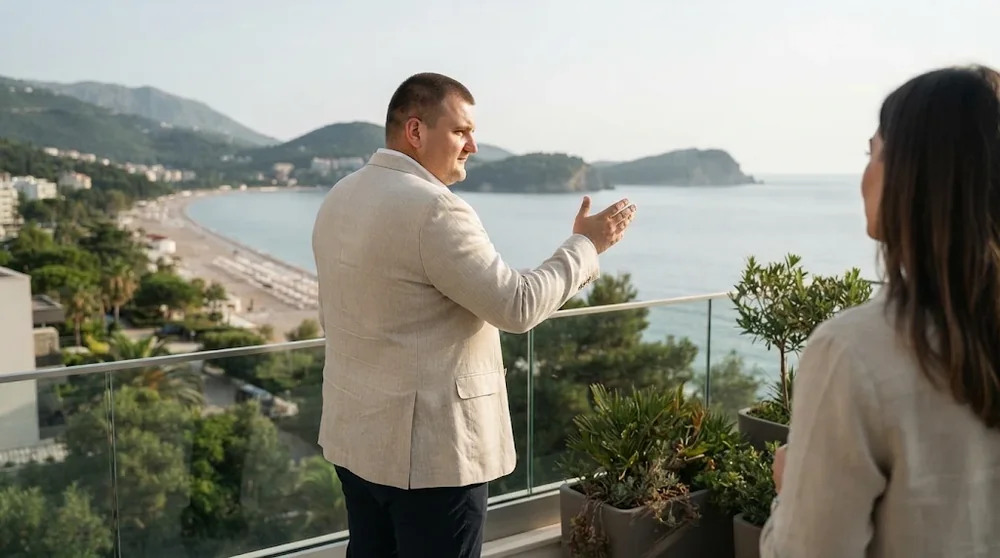
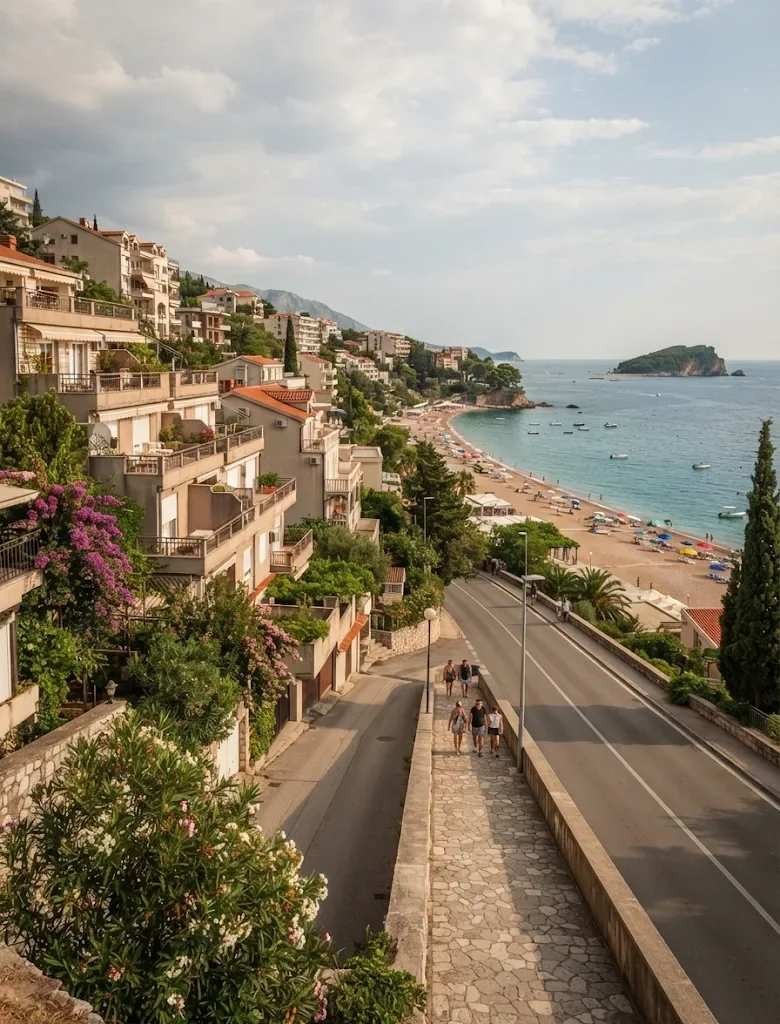
Bečići is a coastal residential and resort area in Budva Municipality, set along a long pebble-and-sand beach on the Budva Riviera. It sits between central Budva and Rafailovići, and the three places run into one another along the coast. I settled in the Bay of Kotor about seven years ago, after restoring a stone house of my own. That taught me to read a building before I read a brochure, and the habit applies just as well to a concrete apartment block above a beach.
A resort is an experience, whereas ownership is a set of obligations. In July, the promenade, cafés and sea suggest an easy life. Ownership means a title, a building budget, a lift that needs servicing, a roof, drainage and a heating plan for January. An attractive holiday apartment is not automatically the strongest investment, and the best rental unit is not necessarily the most comfortable home. That is the central trade-off of this article.
Bečići tends to suit people who like a wide beach, a resort atmosphere and access to Budva without living in its busiest streets. It may disappoint anyone who needs a lively town centre all winter, or who expects a rental to look after itself. Four buyer profiles recur: the full-time resident, the seasonal holiday-home owner, the income-focused landlord and the hybrid owner who wants both. I will use them throughout, because each needs a different apartment.
Lifestyle vs Investment: Which Buyer Are You?
In this article, investment means income from letting, resale appreciation, or both. Appreciation is never assured, and income is never guaranteed. The first question is not “Which apartment is best?” but “How many nights a year will I use it, and what do I need it to earn?” The table below sets the four profiles side by side.
| Profile | Main priority | Desirable features | Key risks | Management load |
|---|---|---|---|---|
| Full-time resident | Comfort and practicality for twelve months | Good insulation, heating, winter sunlight, lift, parking, flat access to services | Damp, quiet winters, thin local services, steep walking routes | Low rental work; full maintenance responsibility |
| Seasonal holiday-home owner | Easy, enjoyable summers | Short route to the sea, balcony, parking, simple upkeep | Empty-flat damp, unused-property costs, building arrears | Closing up, inspections, someone to hold keys |
| Income-focused landlord | Net rental income after costs | Compact layout, durable furnishings, sea view or beach proximity, clear letting rights | Seasonal occupancy, regulation, competing listings, weak winter demand | High: pricing, cleaning, guest reporting, repairs |
| Hybrid owner | Personal use plus partial income | Flexible one- or two-bedroom flat, good shoulder-season comfort | Personal use displaces the best rental dates | Medium to high: calendar control and a reliable local manager |
The practical consequence is that promotional “investment” claims should never choose your apartment for you. Match the property to your real usage pattern, and test the numbers afterwards.
Where to Buy in Becici: Beach, Road or Hillside?
Within Bečići, street-level differences matter more than the resort’s name. I avoid fixed neighbourhood borders here because the area has no sharply defined ones. A straight-line distance to the beach can hide a steep climb or a busy road crossing. The sections below describe general patterns that you must verify on foot, at several times of day.
Beach-adjacent apartments
Flats close to the promenade offer the shortest route to the sea and the strongest summer atmosphere. The trade-offs are evening noise, crowds in peak season and pressure on parking. This is where most first-time buyers slip up: they visit on a quiet spring weekday and assume July will feel the same.
The main-road corridor
Buildings near the main road usually give easy vehicle access and nearby shops. Traffic noise, exhaust and crossings can reduce comfort, particularly on lower floors. Check the pedestrian crossing you would use daily, and listen with the windows shut and open.
Hillside developments
Higher complexes can offer wider sea views, more air and often calmer surroundings. They also bring slopes, stairs and longer walks back from the beach. The climb that seems pleasant in April can feel very different in August heat, or with shopping and children. Winter wind, wind-driven rain and sunlight angle also change with elevation, so inspect the terrace walls, render and drainage.
The Rafailovići-facing edge
Towards Rafailovići, the atmosphere generally becomes slightly less urban, though the places blend without a clear line. Compare actual walking routes to the beach, shops and bus stops rather than relying on a district name in a listing.
Future construction can alter a view quickly. A clear horizon today is not protected by the sale contract. Ask what the neighbouring plots are zoned for and which permits have been issued, then check the answers independently.
Living in Becici Year-Round: Beyond Summer
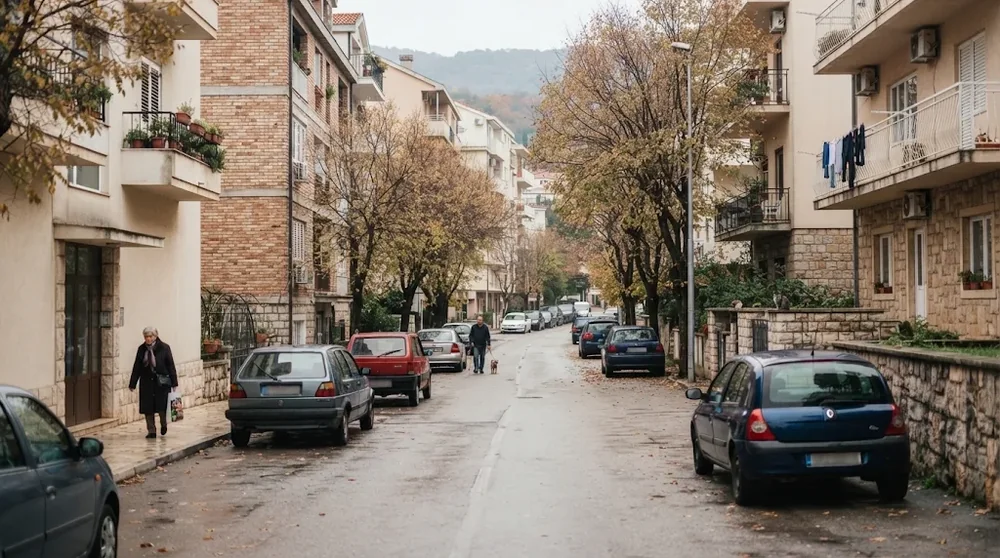
The tourist atmosphere runs roughly from early summer to early autumn. Outside those months, Bečići is much quieter. Many seasonal businesses close or reduce hours, and some buildings sit largely empty. I cannot tell you today’s opening hours or bus timetables, and nobody should assume that every shop, restaurant, clinic or transport link operates in winter as it does in July. Verify the services you depend on at the specific address, in the specific month you would be there.
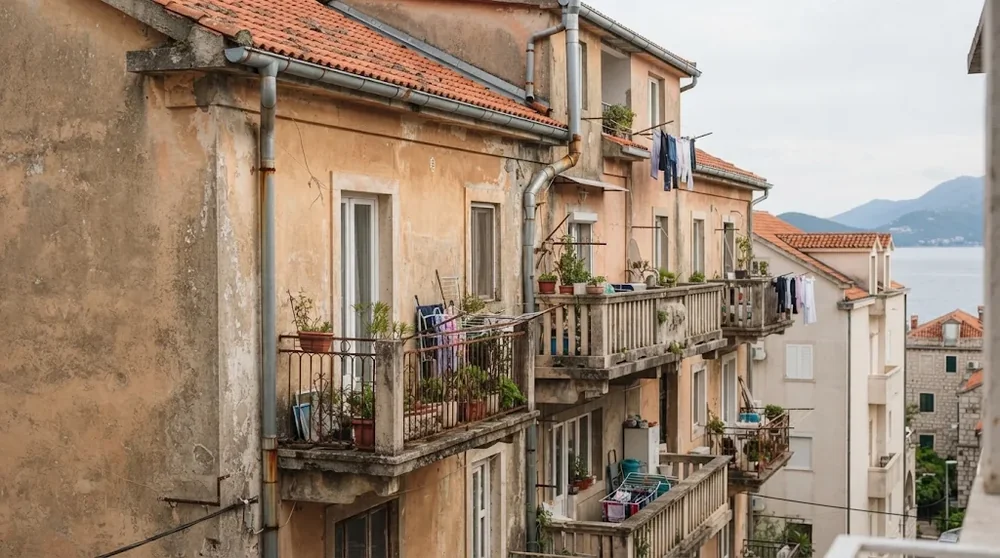
Winter exposes building quality. Damp, condensation and mould are common on the Adriatic coast where insulation is thin, ventilation is poor, or flats are unheated for months. Wind-driven rain tests balcony doors, window seals and external render. A heating system that is cheap to install can be expensive to run, and a flat that was never occupied in winter has no track record of coping with it. A stone house teaches this fast: walls that breathe in one season trap moisture in another, and a concrete apartment frame has its own weaknesses, such as cold bridges at slab edges and balcony junctions.
Use this winter viewing checklist when you can visit between November and March:
- Look for dark patches, blistering paint or a musty smell on external walls, window reveals and behind wardrobes.
- Ask which heating system is installed, how it is billed and what recent winter costs were.
- Note the sun: which rooms receive direct light in midwinter, and for how long.
- Check windows and balcony doors for draughts, seal condition and trickle ventilation.
- Ask whether the lift is serviced regularly and who pays for repairs.
- Count how many neighbouring flats are lived in, and who handles stairwell maintenance.
- Test mobile and internet connectivity, and ask which providers serve the building.
- Try the walk to the nearest supermarket, pharmacy and bus stop in winter conditions.
- Look at parking, drainage and any puddling or water staining in the garage or access road.
- Ask neighbours how the building behaves in a prolonged rain spell.
Nothing here is guesswork on my part. These are the questions I would put to any coastal building, and the answers decide whether a flat is a home or a summer apartment.
Becici Property Prices in 2026: What Do the Numbers Mean?
Three different datasets are often mixed up in conversation, so I keep them apart. MONSTAT, the national statistics office, publishes official data on newly built dwellings sold for the first time. Marketplace asking prices come from listing sites. Illustrative budgets are my own assumptions for planning. See MONSTAT for the published statistics.
| Dataset | Figure | Geography and period | What it does not show |
|---|---|---|---|
| MONSTAT, new dwellings sold for the first time | €2,838/m² (Q2 2026); €2,575/m² (Q1 2026) | Whole coastal region, not Bečići | Resale market, Bečići-specific prices, condition, view or parking |
| MONSTAT, national equivalent | €2,557/m² (Q2 2026) | Montenegro as a whole | Any coastal micro-location |
| Estitor Bečići market page | About €3,242/m² asking price (displayed for Q2 2026) | Bečići listings, marketplace-derived | Final sale prices; the figure should be rechecked before relying on it |
The MONSTAT figures are not the average price of all Bečići properties. They cover new-build dwellings sold for the first time and exclude resales. The Estitor figure reflects what sellers are asking, and sellers often negotiate. A change in asking prices over time is not proof of appreciation either, because the mix of listed flats changes. The gap between €2,838 and €3,242 should therefore not be read as a Bečići premium, since the datasets measure different things.
Price per square metre also moves with floor, view, distance from the beach, parking, completion status and building condition. Two flats on one street can differ more than two district averages. The table below is a hypothetical budget, built on an assumed €3,250/m². It is not an observed sale price.
| Apartment size | Assumed purchase price | Illustrative resale transfer tax (if taxable value equals price) |
|---|---|---|
| 45 m² | €146,250 | €4,387.50 |
| 60 m² | €195,000 | €6,750 |
| 80 m² | €260,000 | €10,000 |
The tax column applies the progressive formula explained in the costs section, and the real taxable value may differ from the price.
Rental Investment in Becici: Revenue, Costs and Seasonality
Rental performance is often described with loose language, so the terms need precise definitions:
- ADR (average daily rate) is the average revenue per booked night.
- Occupancy is booked nights divided by available nights.
- RevPAR (revenue per available room or night) is revenue divided by all available nights, which equals ADR multiplied by occupancy.
- Gross income is total booking revenue before costs.
- Gross rental yield is annual gross income divided by the purchase price.
- Net operating income is gross income minus operating costs, before income tax and finance costs.
- Net rental yield is net income divided by the capital invested, ideally after tax.
For context, MONSTAT reported 10,179,395 overnight stays in individual accommodation nationwide in 2025, with 94.8% in seaside resorts. That tells you the coast dominates Montenegrin tourism. It does not establish Bečići’s occupancy.
For Bečići specifically, AirROI’s data through October 2026 showed roughly 373 active listings, about 39% occupancy of available nights and average annual gross booking revenue of around €8,055 per listing. These are modelled aggregates, not a forecast for any individual flat. Marketplace-derived yield estimates, such as Estitor’s 5.6% gross figure for Bečići, and Global Property Guide’s 4.84% average gross yield across its selected Montenegrin rental markets in Q2 2026, are different measures again. The latter is not specific to Bečići holiday lets.
Demand peaks in the summer and weakens markedly in winter. A flat that earns most of its income in a few months is exposed to a poor season, a new competitor or a regulation change.
The model below is hypothetical. It assumes a 60 m² flat at €3,250/m² (€195,000), illustrative total capital of €210,000, revenue of €110 per booked night, variable costs of 25% of gross income and fixed costs of €3,000 a year. It excludes owner income tax and finance costs.
| Measure | 90 nights | 130 nights | 170 nights |
|---|---|---|---|
| Gross annual income (nights × €110) | €9,900 | €14,300 | €18,700 |
| Gross yield on €195,000 price | 5.08% | 7.33% | 9.59% |
| Variable costs (25%) | €2,475 | €3,575 | €4,675 |
| Fixed costs | €3,000 | €3,000 | €3,000 |
| Operating surplus | €4,425 | €7,725 | €11,025 |
| Return on €210,000 capital (pre-tax, pre-finance) | 2.11% | 3.68% | 5.25% |
The arithmetic is simple: 130 nights at €110 gives €14,300; deducting 25% (€3,575) and €3,000 leaves €7,725; divided by €210,000, that is about 3.68%. The gap between a 5% to 9% headline gross yield and a 2% to 5% net return shows why gross figures flatter. These numbers are not Bečići forecasts. Income tax, a replacement reserve for furniture, appliances and roof or façade works, and mortgage interest all come on top. Check how your own tax residence and Montenegrin rules treat rental income.

Can One Apartment Be Both a Holiday Home and an Investment?
Yes, but with an opportunity cost. Every prime summer night you occupy yourself is a night you cannot let. The hybrid model is a lifestyle choice with financial trade-offs. It is not a superior strategy. The table uses the hypothetical model above, with 130 booked nights as the baseline and €110 per night. It assumes the removed nights would otherwise have been booked at the same rate.
| Calendar | Gross income | Operating surplus | Return on capital |
|---|---|---|---|
| Rental-first (130 nights) | €14,300 | €7,725 | 3.68% |
| Shoulder-season personal use (14 prime nights removed) | €12,760 | €6,570 | 3.13% |
| Mostly private use (28 prime nights removed) | €11,220 | €5,415 | 2.58% |
Fourteen nights cost €1,540 in gross income, or €1,155 after the saved variable costs. Twenty-eight nights cost €3,080 gross, or €2,310 after variable costs. If the removed nights are the dearest of the season, the true cost is higher. Do not combine this hypothetical model with platform observations to produce a “verified” result.
There are practical constraints too: advance bookings you cannot cancel, turnaround cleaning, personal storage, remote management and maintenance windows. A calendar that reserves late May, September or October for the owner can work better than one that blocks August.
The Real Cost of Buying and Owning a Becici Apartment
The purchase price is only the beginning. Costs fall into three groups, and I avoid universal percentages because they depend on the transaction.
| Group | Cost | Notes |
|---|---|---|
| Acquisition | Property transfer tax (porez na promet nepokretnosti) | Progressive on resales; see formula below |
| VAT instead of transfer tax | May apply to some first sales from developers; treatment varies | |
| Notary fees | Contract certification; the notary does not act as your lawyer | |
| Independent legal review | Title, encumbrance and contract checks | |
| Cadastre registration and translation | Registration fees; translation if documents are in another language | |
| Ownership | Annual property tax | Set by the municipality; confirm the current rate |
| Building maintenance and service charges | Ask for the last twelve months’ records | |
| Insurance | Building and contents cover | |
| Utilities and minimum charges | Billed even in an empty flat | |
| Repairs and reserves | Roof, façade, lift, windows, drainage | |
| Rental operations | Furnishing and equipment | One-off, then periodic replacement |
| Management, cleaning and laundry | Per stay or percentage-based | |
| Platform fees and registration costs | Depends on channel and category |
As of November 2026, the progressive transfer-tax formula introduced in January 2024 is described as follows, subject to checking its continuing applicability with the tax administration: 3% on taxable value up to €150,000; €4,500 plus 5% of the amount above €150,000 up to €500,000; and €22,000 plus 6% of the amount above €500,000. For a taxable €195,000 resale, the tax is €4,500 plus 5% of €45,000, which equals €6,750. For a taxable €550,000 resale, it is €22,000 plus 6% of €50,000, which equals €25,000. These are illustrations, not quotations.
Not every purchase is a resale. When a developer sells a new unit and VAT applies, that VAT treatment may replace the transfer tax. It is not universal, so ask in writing which regime applies before you sign. The Real Estate Administration of Montenegro (Uprava za nekretnine) publishes information on registration at its official cadastre website.
Legal Checks Before Buying Coastal Property in Becici
The first document I ask for is a current List nepokretnosti, the property register extract issued by the Real Estate Administration. It shows the registered owner, the cadastral unit, recorded encumbrances such as mortgages, and the registered building and unit details. It does not prove that the building is lawful, that the flat matches the plans, that service charges are paid or that tourist letting is permitted. This house has a story, and so does its paperwork, and an apartment block is no different.
- Obtain a current List nepokretnosti for the apartment and, where relevant, the parking space and storage room, each as its own entry.
- Match the seller to the registered owner. Check names and capacity to sell, including any co-owners.
- Check the unit’s identity: cadastral parcel, floor, area and whether the registered area matches the real flat.
- Look for mortgages, liens and restrictions. Ask how any loan will be cleared at completion.
- Verify the building status: construction permit, use permit and any legalisation. On paper this looks fine, but in reality a flat in an occupied building can still sit in a partly irregular structure.
- Check legalisation status. Montenegro’s 2025 legislation on legalising illegal buildings introduced registration requirements and deadlines. As of November 2026, do not assume any earlier published deadline is still open. Ask the competent authority and your lawyer how it applies to this property.
- Review the building management arrangements: house rules, arrears, planned works and reserve fund.
- Confirm parking and storage rights in writing and in the register, not just in the sales brochure.
- Check for restrictions on tourist letting in the contract, house rules and municipal requirements.
- Hire independent legal representation. A notary certifies the contract and is not your adviser. Before you pay a reservation fee, make sure your lawyer has reviewed the terms for refund conditions.
Foreign Ownership and Holiday Rentals in Becici
Foreign nationals can generally buy ordinary residential apartments in Montenegro, as of November 2026, subject to restrictions affecting certain categories of land and property. Ownership and residence permission are separate legal questions. Buying an apartment does not automatically give you the right to live in Montenegro, so check immigration rules independently. Information for foreign nationals is available through the Ministry of Foreign Affairs of Montenegro.
Holiday letting adds another layer. Depending on current law and municipal rules, you may need to register the accommodation, obtain the correct classification, report guests and pay tourist taxes, and declare the income for tax. The Central Tourism Register is the central register for accommodation providers where it applies, and Budva municipality has its own tourism-registration guidance. Older government guidance should be cross-checked against current laws, because rules and fees change. A listing on a booking platform does not prove that the letting is lawful.
If you plan to let, ask your lawyer to confirm in writing which registrations the specific flat needs, who is responsible for them and whether the building’s rules allow short stays. A short, specific question to a specialist now is cheaper than a correction later.
For questions about your own purchase, such as cadastre checks, residence rules or the registration of a rental, a short one-to-one conversation before you sign can save you a good deal of trouble.
Whatever route you choose for advice, keep every approval and registration confirmation in writing, because the next buyer or the authorities may ask for them.
Becici vs Budva vs Rafailovici: Where Would You Buy?
The honest answer depends on who you are. The table gives general characteristics only, with no price ranking and no claim that any location yields more.
| Factor | Bečići | Central Budva | Rafailovići |
|---|---|---|---|
| Lifestyle | Wide beach, resort feel | Old town, nightlife, concentrated urban services | Smaller-scale, quieter seaside setting |
| Walkability | Varies by street, slope and road crossings | Dense, often walkable near the centre | Varies; check routes to shops and beach |
| Year-round practicality | Quieter in winter; verify services | Generally more year-round activity | Verify services; seasonal character |
| Summer density | High near promenade | Very high near centre | Moderate to high |
| Rental strategy | Beach-led leisure demand | Mixed: leisure and short city stays | Leisure-led, smaller market |
| Parking | Check allocated space and peak access | Often tight; check carefully | Check allocated space and access |
| Main selection risk | Seasonal buildings, noise, future construction | Noise, congestion, older stock | Slopes, limited services, boundary effects |
Two properties inside the same location can differ more than the neighbourhood averages suggest, because of building quality, legal status, noise, parking and view. A buyer wanting a year-round base may find central Budva more practical, while one prioritising a broad beach may prefer Bečići. Both are judgements, not statistics.
To work out which area suits your lifestyle, budget and investment goals, a personal property selection is often more useful than comparing listings alone.
Whichever area you favour, treat the shortlist as provisional until the legal and winter checks are done.
Resale Risks: What Might Make a Becici Apartment Harder to Sell?
An apartment can be desirable and still take time to sell. I have no reliable days-on-market figure for Bečići, so I will not quote one. These are the factors that commonly lengthen a sale:
- Building age and condition. Visible damp, ageing lifts or deferred façade works put buyers off.
- Weak maintenance funds. A thin reserve suggests large bills later.
- Unclear title or legalisation. A buyer’s lawyer will find the same issues you should have found.
- Parking and access. Flats with no allocated space can be harder to sell in a car-dependent resort.
- Oversupply and competing developments. New projects nearby can compete directly with your flat.
- Noise and view obstruction. A new building in front of your sea view can change the buyer pool.
- Poor winter usability. A summer-only apartment appeals to fewer buyers.
The sensible test is a conservative resale scenario. Assume selling fees, holding costs and a price no higher than you paid, then ask whether you could live with that outcome. Extrapolating past appreciation is not a plan.
A Practical Checklist Before Choosing a Becici Property
- Write down your intended use: nights per year in the flat, and the income you need.
- Calculate the full cost, including tax, legal fees, furnishing, service charges and reserves.
- Test the apartment for twelve-month living: heating, damp, winter sun, transport and services.
- Gather rental evidence for your category and building, and discount any advertised figures.
- Walk the slope, the road crossing and the route to the beach, in daylight and in the evening.
- Check parking: allocated space, registered rights, peak-season access.
- Obtain the List nepokretnosti and have a lawyer review title and encumbrances.
- Confirm the building’s permit and legalisation status as of today’s rules.
- Review maintenance records, arrears and house rules, including letting restrictions.
- Ask what could be built nearby and how it would change your view or light.
- Define your exit: a conservative resale price, selling costs and holding period.
- Visit in both summer and winter when feasible, before committing.

The decision principle is simple: buy the apartment that fits your intended way of living and still passes a conservative financial and legal assessment. If it only works under optimistic assumptions, treat that as information.
Frequently Asked Questions About Becici Property
Is Becici a good place to buy property in Montenegro?
Bečići can be a sensible place to buy if beach access, proximity to Budva and a mix of personal use and holiday-rental potential match your priorities. It is less suitable for buyers who need a lively town centre throughout winter or expect assured rental returns. Building quality, parking, legal status and total ownership costs matter more than the resort’s reputation.
Can you live in Becici all year round?
Yes, Bečići has residential apartments used outside the main tourist season, but life there is noticeably quieter in winter. Before choosing a permanent home, check heating, dampness, winter sunlight, parking, transport and which nearby services stay open. A comfortable summer rental is not necessarily a comfortable year-round residence, particularly in a largely seasonal building.
How much does an apartment cost in Becici in 2026?
Bečići asking prices vary by building, size, beach distance, parking and sea views. Estitor’s Q2 2026 market page showed an indicative average of about €3,242 per square metre, derived from marketplace listings. MONSTAT’s €2,838 per square metre for Q2 2026 covers newly sold dwellings across the whole coastal region, not Bečići. Neither figure predicts a particular transaction price.
Can foreigners buy an apartment in Becici?
Foreign nationals can generally buy ordinary residential apartments in Bečići, although restrictions may apply to certain land and property categories. Obtain a current List nepokretnosti, confirm ownership and encumbrances, and have an independent lawyer review the contract. Owning an apartment does not automatically grant residence, nor permission to operate tourist accommodation. Verify current rules as of November 2026.
How much rental income can a Becici apartment generate?
Rental income depends on apartment quality, available nights, pricing, seasonality and management. AirROI’s Bečići data through October 2026 showed average annual gross booking revenue of about €8,055 per active listing, a modelled platform aggregate rather than a forecast for any flat. Gross bookings are not profit: deduct cleaning, commissions, maintenance, utilities, taxes and vacant periods.
Is Becici better than Budva for buying property?
Bečići may suit buyers who prefer a broad beach and a quieter, resort-style setting, while central Budva offers denser urban services and nightlife. Neither is automatically the better investment. Compare individual buildings, legal status, walking routes, parking, year-round demand and the actual costs of each purchase before choosing between them.
My Honest Take on Buying in Becici
Bečići is a good place to own an apartment if you know what you want from it. As a lifestyle purchase it offers a beach, access to Budva and a seasonal rhythm. As an investment it depends on seasonality, costs, regulation and the particular building. My own restoration work taught me that the unglamorous details, such as drainage, damp and paperwork, decide whether ownership is a pleasure or a burden.
If I had to give one piece of advice, it would be to separate the three kinds of evidence. Official statistics describe the market in broad strokes, asking prices describe what sellers hope for, and hypothetical models describe only your assumptions. This is my personal judgement, not a guarantee, and your lawyer and tax adviser should have the last word on your own case.
Disclaimer: This article is general information and personal opinion, dated November 2026, and is not legal, tax or financial advice. Laws, taxes, fees and statistics change, and all figures labelled hypothetical or illustrative are assumptions, not forecasts or guarantees of income, occupancy or capital growth. Verify current rules with the competent authorities and consult an independent lawyer and tax adviser before buying.