

The old walled town of Budva sits on a small rocky peninsula, yet most investor apartments stand in modern blocks beyond its walls. In those blocks, service charges, lift contracts and facade repairs rarely appear in a listing. These recurring costs, together with transfer tax and furnishing, decide what an investor actually earns. I build the numbers below from the purchase price upward, using dated sources where they exist and clearly labelled hypothetical inputs where they do not. All figures are stated as of November 2026.
Budva property investment ROI depends on purchase costs, achievable rent, occupancy and operating expenses. Commercial listing-based research indicates gross residential rental yields of approximately 4–5% in 2026, before tax and maintenance. Investors must also budget for transfer tax on resales, legal fees, annual property tax, management and vacancies. Net returns require a property-specific cash-flow calculation.

What ROI Can Budva Property Investors Expect?
Budva property investment ROI is not one percentage. It is a family of measures, and each answers a different question about the same apartment. As of November 2026, the two public gross-yield indications I rely on for Budva come from commercial listing research, about 5.01% and about 3.7–4.4%, and neither is a realised return or an official statistic.
Global Property Guide reports an approximate gross residential rental yield of 5.01% for Budva for the first half of 2026. Fijaka’s listing snapshot of 9 November 2026 gives roughly 3.7% to 4.4%, depending on apartment size. The datasets differ in period (a half-year against a single day), in sampling method and in apartment mix, so I do not average them. Both are built from advertised prices and advertised rents, and I could not authenticate the underlying samples. An asking rent is not collected rent, and an asking price is not a completed sale price. Montenegro’s official statistics do not establish a comparable realised Budva rental-yield average, so treat 4–5% as an illustrative sensitivity range, not a benchmark.
On paper this looks fine, but in reality the denominator of the investor’s own calculation is larger than the purchase price. The table below separates the measures I use throughout this guide.
| Metric | Formula | Costs included | What it excludes and how to read it |
|---|---|---|---|
| Scheduled gross rental yield | Annual scheduled rent (all twelve months) ÷ purchase price × 100 | None | Assumes no vacancy and excludes taxes, fees and running costs. A marketing figure, not a return. |
| Effective gross yield (occupancy-adjusted) | Annual rent actually collected ÷ purchase price × 100 | Vacancy only | Still excludes taxes, fees, furnishing and running costs. |
| Net operating yield (NOI-based) | Net operating income ÷ total acquisition and setup cost × 100 | Operating costs, all-in capital | Excludes income tax, financing and capital improvements. Best for comparing properties. |
| After-tax rental yield | (NOI − rental income tax and any municipal surtax) ÷ total acquisition and setup cost × 100 | Operating costs and income taxes | Excludes financing. Depends on the taxpayer’s status. |
| Cash-on-cash return (pre-tax) | Annual cash flow after debt service, before income tax ÷ investor cash invested × 100 | Debt service, cash equity only | Shows the effect of borrowing; can be negative. An after-tax version deducts rental taxes first and is shown separately. |
| Total return | (Net sale proceeds + cumulative net cash flow − capital invested) ÷ capital invested | Exit costs, holding period | Includes resale value, which is never assured. Reported separately from annual yield. |
A hypothetical example shows the gap. Rent of €950 for twelve months is €11,400, a 5.70% scheduled gross yield on a €200,000 price. Eleven paid months give €10,450, a 5.23% effective gross yield. The calculation section below takes that rent down to a net operating yield of 3.09% on €225,000 of all-in capital.
Budva Property Prices: What Does Entry Cost?
Three kinds of price data circulate, and they answer different questions. Official statistics describe transactions, asking-price portals describe sellers’ hopes, and neither describes what a Budva resale actually fetches. In Q2 2026, MONSTAT’s release on new-build housing prices recorded an average of €2,838 per square metre for first sales of new-build housing in the coastal region, against €2,557 per square metre nationally. That coastal figure covers first sales of new dwellings across several coastal municipalities, not Budva resales, and it is not a Budva average.
Local portals such as Estitor and Stanovina publish live asking prices that change weekly. I do not quote neighbourhood averages from them here, because I have not verified a sample for the reference date, and samples in smaller settlements such as Pržno can be thin enough for a few listings to move any average. Build your own comparison set instead: at least three genuinely similar apartments, recorded with the date and the asking price.
The table below is arithmetic, not a market price list. It multiplies hypothetical floor areas by the two official averages to show the scale of budget involved.
| Apartment type (hypothetical) | Net area (m²) | Area × €2,838 (coastal first-sale average, Q2 2026) | Area × €2,557 (national average, Q2 2026) |
|---|---|---|---|
| Studio | 35 | €99,330 | €89,495 |
| One-bedroom | 45 | €127,710 | €115,065 |
| Two-bedroom | 65 | €184,470 | €166,205 |
Several factors move a real quotation away from these figures. Marketed area may include walls, terrace shares or common areas, so ask for the net internal area and check it against the property title extract and the contract. A terrace, a parking space (sometimes priced separately), a sea view and the state of the fit-out each change the price. A furnished apartment may include items you would replace, while an unfurnished one needs a budget of its own. Older stock may need electrics, plumbing, waterproofing or a facade contribution before it can be let, and that spending belongs in the acquisition budget, not in later maintenance.
Buying Costs in Budva: Taxes, Fees and Setup
The true cost of a Budva apartment is the sum of the agreed price, statutory taxes, professional fees, and the money needed to make the flat lettable. I separate these into verified statutory charges, negotiated fees and estimates, because they carry different levels of certainty.
For a qualifying resale, the progressive transfer tax rules announced by Montenegro’s Tax Administration, effective from 1 January 2024 under the Real Estate Transfer Tax Act of Montenegro, are: 3% up to €150,000; €4,500 plus 5% of the excess from €150,000 to €500,000; and €22,000 plus 6% above €500,000. On a taxable €200,000 resale the tax is €4,500 plus 5% of €50,000, which is €7,000. The 2026 amendment I can identify, from March 2026, concerned the treatment of VAT-taxed construction land. I have not found anything showing that the progressive thresholds themselves changed, but check the consolidated law for your transaction before relying on this.
A first sale by a developer may be treated differently. Where the supply is subject to VAT at the standard 21% rate, the quoted price normally already contains that VAT, and VAT and transfer tax are not applied automatically to the same transaction. Not every purchase described commercially as a “developer sale” is a VAT-taxable first supply, so verify the legal nature of the supply and the seller’s VAT status, and read the contract and invoice, not the marketing description, before you treat transfer tax as inapplicable.
| Cost line (€, as of November 2026) | Resale at €200,000 | First sale subject to 21% VAT (illustrative, price quoted VAT-inclusive) | Status |
|---|---|---|---|
| Purchase price | 200,000 | 200,000 (hypothetical; if taxed at the standard rate, VAT is 21/121, or 34,710.74) | Agreed in contract |
| Transfer tax | 7,000 | 0 (confirm in contract and invoice) | Statutory rule effective January 2024; recheck |
| Professional and transaction budget | 3,000 | 3,000 | Estimate |
| Furnishing and initial repairs | 15,000 | 12,000 | Estimate |
| Total committed capital | 225,000 | 215,000 | Sum of lines above |
The €3,000 professional budget is my hypothetical allocation: legal review €1,200, notary and registration allowance €700, interpreter and translation €300, technical inspection €500, and bank transfers and sundries €300. A government decision of April 2026 concerned a new notary tariff. I have not confirmed the final tariff’s publication and commencement date in the Official Gazette, so I have deliberately not calculated notary fees here. The €700 line is a placeholder, not a tariff result; request an up-to-date written notary quotation. Buyer agency commission is payable only where your contract says so, and I have entered none.
Before you pay a reservation fee, make sure the agreement states that it is credited to the purchase price and under what conditions it is refundable. A credited deposit is part of the price, not an extra expense. A cash reserve, say €5,000 held for the first year, is not spent but should be held; including it in the denominator would lower the net yield in my later example from 3.09% to 3.02%.
Rental Income: Short-Term Versus Long-Term
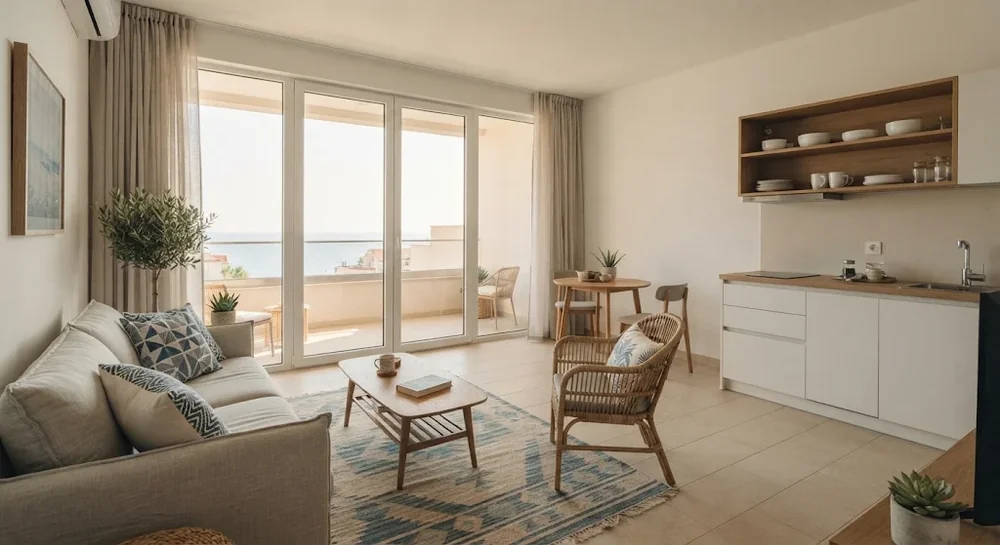
The same apartment can be let in two ways, and the revenue shapes are very different. A long-term letting is driven by monthly rent and paid months, while a holiday letting is driven by occupied nights multiplied by the average daily rate. Gross booking revenue is what guests pay for the stay; owner receipts are what remains after platform commissions, management, cleaning, utilities and tax. I keep these two terms separate throughout.
Seasonality matters. A summer-heavy booking calendar leaves shoulder months thin, and the owner still pays service charges, insurance and property tax all year. MONSTAT’s 2025 tourism release reports 10,179,395 overnight stays in individual accommodation in 2025, of which 94.8% occurred in seaside resorts. That is national tourism context only. It does not establish Budva occupancy, and I do not infer bookable nights from it.
Holiday letting adds compliance and competition. You need to confirm tourist registration, apartment classification and guest-reporting obligations with the local authority, and check that the building’s rules allow short stays. Local competition from other flats in the same block also affects achievable rates. The table uses one hypothetical 45 m² one-bedroom apartment with the €225,000 capital defined earlier. Every input is hypothetical, and the short-term case is fully managed.
| Item (€ per year, hypothetical) | Long-term annual letting | Short-term holiday letting (managed) |
|---|---|---|
| Revenue driver | €950 × 11 paid months | 130 occupied nights × €95 average daily rate |
| Gross revenue (excluding guest cleaning fees) | 10,450 | 12,350 |
| Platform commission (15% assumed) | 0 | 1,852.50 |
| Management (20% assumed) | 0 (owner-managed) | 2,470 |
| Cleaning, linen, utilities (€14 per occupied night) | 0 (tenant pays utilities) | 1,820 |
| Fixed ownership costs | 3,500 | 3,500 |
| Net operating income before income tax and financing | 6,950 | 2,707.50 |
| Income predictability | Higher; fewer turnovers | Lower; depends on bookings |
| Owner labour and key risk | Tenant search, arrears, wear | Guest turnover, reviews, compliance |
On these inputs the managed short-term case earns less than the long-term case, and a self-managed holiday let would add back the €2,470 fee, reaching €5,177.50, before valuing your own time. That is a result of my assumptions, not a market finding. The comparison only has meaning when you replace each input with a written quotation for the apartment you are considering.
Annual Ownership Expenses and Rental Taxes
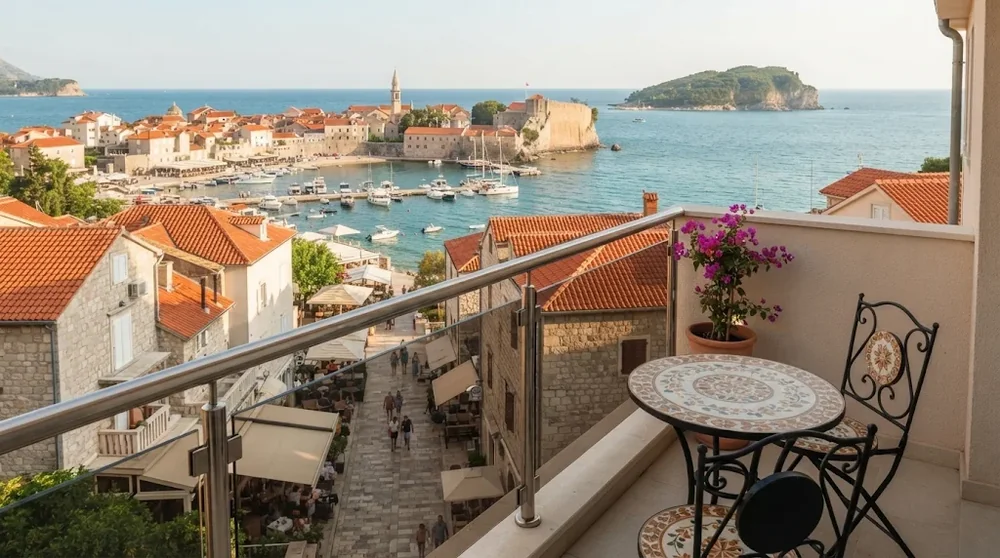
Annual ownership costs are what turn gross rent into net operating income. The table lists the categories I model, with an illustrative amount for the same €200,000 apartment. These amounts are hypothetical and sum to the €3,500 used later.
| Category | Basis | Illustrative amount (€ per year) | Verification |
|---|---|---|---|
| Municipal property tax | General range 0.25–1% of assessed value; separate 0.3–1.5% range for secondary residential property (Articles 9–11 of the Property Tax Act, as of November 2026) | 1,000 (placeholder: 0.5% of €200,000) | Confirm the property’s classification, Budva’s current rate and the assessed value |
| Building service charges | Cleaning, lift, common electricity | 600 | Obtain from the building manager |
| Insurance | Contents and liability | 150 | Written quotation |
| Repairs and maintenance allowance | Ordinary annual wear, set aside each year | 900 | Depends on building age |
| Owner-paid utilities and internet | Voids and common supplies | 400 | Check actual bills |
| Accounting and bank charges | Annual filing, transfers | 250 | Quotation |
| Letting and marketing | Tenant search, listings | 200 | Estimate |
| Total fixed operating costs | 3,500 | Excludes management, income tax, financing |
Property tax is set by the Montenegro Property Tax Act and municipal rules. A government summary describes an ordinary range of 0.25–1% of assessed value, while Articles 10–11 set a separate 0.3–1.5% range for secondary residential property, with specific criteria for that classification. An investment flat that is not your primary home may fall into the second range, so I do not use the 0.25% minimum as a given. I have not established Budva’s actual classification or rate for any specific flat, so the €1,000 above, 0.5% of an assumed €200,000 assessment, is a conditional placeholder. The assessed value can also differ from your price. For sensitivity: at 0.25% the tax is €500 and fixed costs fall to €3,000; at the 0.3% secondary-residence minimum it is €600; at the 1.5% top of that range it is €3,000, and fixed costs rise to €5,500. Each €500 of tax moves the net operating yield by about 0.22 percentage points. I have not verified municipal payment dates for 2026, so ask Budva’s local revenue office for them.
The €900 repairs line is an annual allowance for ordinary wear. If you deposit it in a separate reserve account it is not spent until a repair happens, but the cash-flow tables treat it as spent, which is the cautious choice. The €1,500 repair in the downside scenario later is an extraordinary cost on top of that allowance, not a second count of it.
Rental income tax depends on the taxpayer, and I cannot give one tax model that fits every rental. For an individual, the nominal national rate I model is 15%. Whether a standard percentage deduction for expenses applies depends on the type of letting. Ordinary residential letting and registered tourist accommodation are treated differently, and the latter may carry special conditions. I would start with the expense provisions of the Personal Income Tax Act, beginning with Article 35, and check them against the current consolidated text. So I do not assume the same deduction for both strategies. A municipal surtax on the income-tax liability may also apply, at a rate set by the municipality; I show it as a separate line using a placeholder of 10% of the tax, which is not Budva’s confirmed rate. A company is taxed differently, with profit tax at company level and a further question when profits are paid out. Tourist tax may also apply to holiday lets. Every after-tax figure in this guide is therefore an incomplete national-tax sensitivity, not an actual investor return. A Montenegrin tax adviser should confirm the basis for your status and letting arrangement as of November 2026. Management fees are a quotation item; I do not treat any advertised percentage as a standard.
Restoring my own stone house in Kotor taught me that old structures keep their costs hidden until a wall is opened. I apply the same logic to a twenty-year-old concrete block: budget a contingency for what you cannot yet see.
How to Calculate Net Rental Yield and ROI
Four formulas cover most investment decisions. Scheduled gross yield equals twelve months of contractual rent divided by purchase price, multiplied by 100; effective gross yield uses the rent actually collected instead. Net operating yield equals net operating income divided by total acquisition and setup cost, multiplied by 100. Pre-tax cash-on-cash return equals annual cash flow after debt service, before income tax, divided by the investor’s cash invested, multiplied by 100. Security deposits are not income, capital improvements are not operating costs, and debt service is excluded from NOI.
The example below is a hypothetical teaching tool, not a Budva average. It uses a €200,000 resale and a separately labelled long-term letting at €950 a month over 11 paid months.
| Line | Calculation | Result (€ or %) |
|---|---|---|
| Purchase price | Assumed | 200,000 |
| Transfer tax | 4,500 + 5% × (200,000 − 150,000) | 7,000 |
| Professional and transaction costs | Estimate | 3,000 |
| Furnishing and initial repairs | Estimate | 15,000 |
| Total capital invested, unleveraged | 200,000 + 7,000 + 3,000 + 15,000 | 225,000 |
| Scheduled gross annual rent | 950 × 12 | 11,400 |
| Collected gross annual rent (11 paid months) | 950 × 11 | 10,450 |
| Operating expenses | Itemised below | 3,500 |
| NOI before income tax and financing | 10,450 − 3,500 | 6,950 |
| Scheduled gross yield on price | 11,400 ÷ 200,000 | 5.70% |
| Effective gross yield on price | 10,450 ÷ 200,000 | 5.23% |
| Effective gross yield on all-in capital | 10,450 ÷ 225,000 | 4.64% |
| Net operating yield | 6,950 ÷ 225,000 | 3.09% |
| National income tax, case A (15% on rent less an assumed 30% deduction) | 0.15 × 0.70 × 10,450 | 1,097.25 |
| Municipal surtax, placeholder (10% of the tax) | 0.10 × 1,097.25 | 109.73 |
| After-tax yield, case A | (6,950 − 1,097.25 − 109.73) ÷ 225,000 | 2.55% |
| National income tax, case B (15% on full rent) | 0.15 × 10,450 | 1,567.50 |
| Municipal surtax, placeholder (10% of the tax) | 0.10 × 1,567.50 | 156.75 |
| After-tax yield, case B | (6,950 − 1,567.50 − 156.75) ÷ 225,000 | 2.32% |
The €3,500 of operating expenses is itemised as follows: property tax €1,000 (a conditional placeholder, see the previous section), service charges €600, insurance €150, repairs and maintenance allowance €900, owner-paid utilities and internet €400, accounting and bank charges €250, and letting and marketing €200. These are estimates, not verified averages. Cases A and B are incomplete sensitivities, shown because the correct basis for a given taxpayer must be confirmed by an adviser.
This is where most first-time buyers slip up: they divide advertised rent by advertised price and stop. The first division flatters the result by about 2.1 percentage points in this example, and the tax step takes off roughly another half to three-quarters of a point. Keep total return, which includes resale, as a separate measure and never mix it into annual income.
Budva ROI Scenarios: Conservative to Optimistic
The scenarios below use one defined property: a hypothetical 45 m² one-bedroom resale apartment with €225,000 of all-in capital, let on a short-term, professionally managed basis. Every input is hypothetical; none is sourced or quotation-backed. Revenue equals occupied nights multiplied by the average daily rate, excluding guest cleaning fees. Income tax is shown as a national-only sensitivity: 15% of gross booking revenue with no expense deduction assumed, plus the 10% municipal surtax placeholder on that tax. These are upper-bound sensitivities, not actual after-tax investor returns, and the real burden may be lower if costs are deductible. Figures are before financing.
| Line (€ per year unless stated) | Conservative | Base | Optimistic |
|---|---|---|---|
| Occupied nights | 100 | 130 | 160 |
| Average daily rate (€) | 85 | 95 | 105 |
| Gross booking revenue | 8,500 | 12,350 | 16,800 |
| Gross revenue ÷ €225,000 | 3.78% | 5.49% | 7.47% |
| Platform commission (15%) | 1,275 | 1,852.50 | 2,520 |
| Management (20%) | 1,700 | 2,470 | 3,360 |
| Cleaning, linen, utilities (€14 per night) | 1,400 | 1,820 | 2,240 |
| Fixed ownership costs | 3,500 | 3,500 | 3,500 |
| Extraordinary repair (on top of the ordinary allowance) | 1,500 | 0 | 0 |
| NOI before income tax | −875 | 2,707.50 | 5,180 |
| NOI yield on €225,000 | −0.39% | 1.20% | 2.30% |
| National income-tax sensitivity (15% of gross, no deduction) | 1,275 | 1,852.50 | 2,520 |
| Municipal surtax placeholder (10% of the tax) | 127.50 | 185.25 | 252 |
| After-tax sensitivity result | −2,277.50 | 669.75 | 2,408 |
| After-tax sensitivity yield | −1.01% | 0.30% | 1.07% |
| Pre-income-tax operating break-even nights (NOI = 0) | 122 | 74 | 65 |
| After-tax break-even nights (same sensitivity basis) | 184 | 110 | 95 |
Break-even nights equal fixed costs divided by the contribution per night. In the base case a night contributes €95 × 0.65 − €14 = €47.75, so €3,500 ÷ €47.75 requires 74 nights before any income tax. July and August together contain only 62 nights, so even a full peak summer cannot cover the year’s fixed costs; a profitable year needs bookings in the shoulder months too. That 74 is an NOI break-even, not a profit after tax. Financing, personal income tax, municipal surtax and capital expenditure all raise the number of nights needed, and on the sensitivity basis above the base case needs about 110 nights.
A summer full of bookings is a good season, not a good year. I look at the whole twelve months, including the weeks when the block is quiet and the bills continue.
Stress tests make the point. If base-case nights fall 20% to 104, NOI drops to €1,466. A €1,500 extraordinary repair in the base case leaves €1,207.50. Overpaying by €20,000 raises transfer tax to €8,000 and capital to €246,000, so the base NOI yield falls to 1.10%. For comparison with the €6,950 long-term NOI, a managed holiday let at €95 would need about 219 occupied nights, or about 157 if self-managed, to match it. These are consequences of my inputs and not forecasts.
Where in Budva Do Investment Numbers Work?
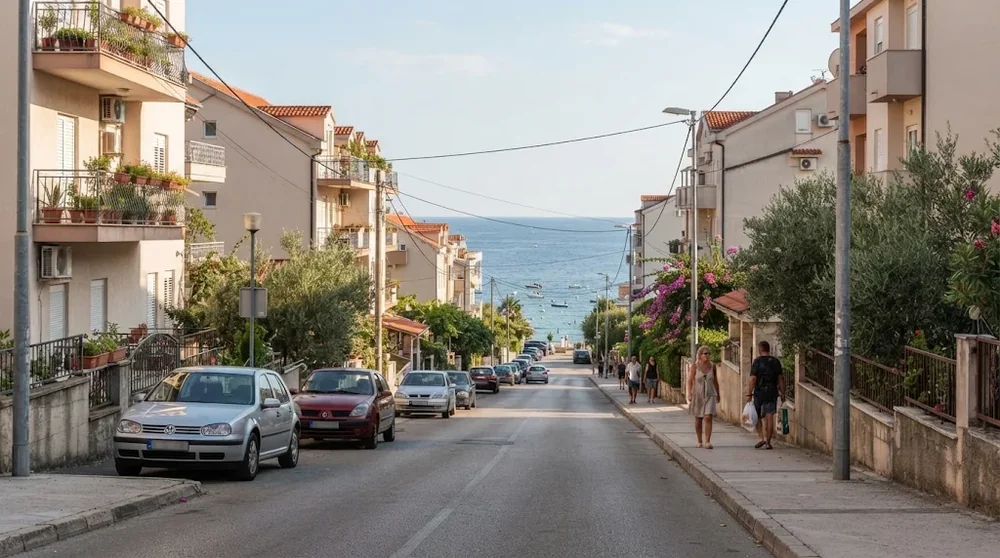
No neighbourhood always delivers a higher net yield, and I do not rank areas by forecast. What differs is the cost and the operational friction that follow from the location. Walkability, the real distance and gradient to the beach, parking, noise, lift reliability and winter demand all change net income, even when the asking price looks similar.
| Area | Expected tenant or guest profile | Principal cost or operational drawback | Due-diligence priority |
|---|---|---|---|
| Old Town and central Budva | Short-stay visitors; some year-round residents | Evening noise, delivery and parking access, older stone buildings, heritage constraints | Building legality, moisture, noise at night |
| Bečići | Beach holidaymakers; some seasonal workers | Resort-style complexes with higher service charges; busy summers, quiet winters | Service charges, management contract, winter demand |
| Rafailovići | Visitors seeking a calmer seafront; some long-stay tenants | Distance to central amenities; reliance on a car or promenade walk | Walking time to services, parking, lift condition |
| Pržno | Quieter visitors and second-home users | Thinner rental market, limited services outside summer | Realistic rent evidence, year-round access |
| Hillside locations | Visitors who value views; some local tenants | Steep access, stairs, parking, longer walk back uphill; lower footfall | Measured gradient, road access, retaining walls |
To see how this works in numbers, compare two hypothetical 45 m² long-term lets. Apartment X is an easy walk from the beach in a simple block. Apartment Y is a discounted flat in a resort-style complex with higher service charges, steep access and weaker off-season demand. The inputs are illustrative, not measured neighbourhood averages. Property tax is the same 0.5% placeholder on each price.
| Line (€, hypothetical) | Apartment X (easy access, low charges) | Apartment Y (discounted, higher charges) |
|---|---|---|
| Purchase price | 200,000 | 185,000 |
| Transfer tax | 7,000 | 6,250 |
| Professional costs, furnishing and repairs | 18,000 | 18,000 |
| Total capital | 225,000 | 209,250 |
| Rent assumption | €950 × 11 paid months | €850 × 10 paid months |
| Collected rent | 10,450 | 8,500 |
| Service charges | 600 | 1,500 |
| Property tax (0.5% placeholder) | 1,000 | 925 |
| Other fixed costs | 1,900 | 1,900 |
| NOI before income tax | 6,950 | 4,175 |
| Effective gross yield on price | 5.23% | 4.59% |
| Net operating yield on total capital | 3.09% | 2.00% |
Apartment Y is €15,000 cheaper, yet it nets about a point less, because higher service charges and a thinner off-season take more than the discount gives back. Panoramic sea views and discounted hillside listings do not automatically improve net returns. A view often raises the purchase price more than the rent, and a discount can reflect gradients, parking shortage or maintenance risk that tenants and guests notice. Winter tenants generally want heating, reliable hot water, nearby shops and easy parking. I judge each building by walking it at different times of day and asking what the next ten years of maintenance look like.
Legal Checks Before Buying a Rental Apartment
This house has a story — and so does its paperwork. In Budva the house is often a concrete block from one of the coast’s periods of rapid construction (a practical observation of mine, not a statistic), and its paperwork can contain gaps that change the investment case. The checklist below is the order I follow. It is general information, and a Montenegrin lawyer should carry out the legal review.
- Current property title extract. The first document I ask for is the current list nepokretnosti from the Uprava za nekretnine (Real Estate Administration), dated within days of signing.
- Title holder and shares. Confirm that the seller is the registered owner, that ownership shares add up, and that all co-owners consent.
- Mortgages and encumbrances. Look for mortgages, liens, pre-emption rights, court annotations and occupancy rights, and agree how they will be cleared at completion.
- Building legality. Ask for the construction permit and the occupation or commissioning documents, and check that the building and the flat match them.
- Alterations and extensions. Compare the flat with the registered plans. Enclosed terraces, added rooms and changed layouts are common legalisation issues.
- Boundaries and area. Check that the registered area and the boundaries match what is sold, including any terrace or storage room.
- Occupation status. Establish whether the flat is vacant or occupied by tenants, and under what contract.
- Right to operate tourist accommodation. Confirm that building rules and permits allow short stays, and that registration, categorisation and guest-reporting duties can be met as of November 2026.
- Management and arrears. Read the management contract, house rules and the last accounts, and obtain written confirmation of unpaid service charges and utility debts.
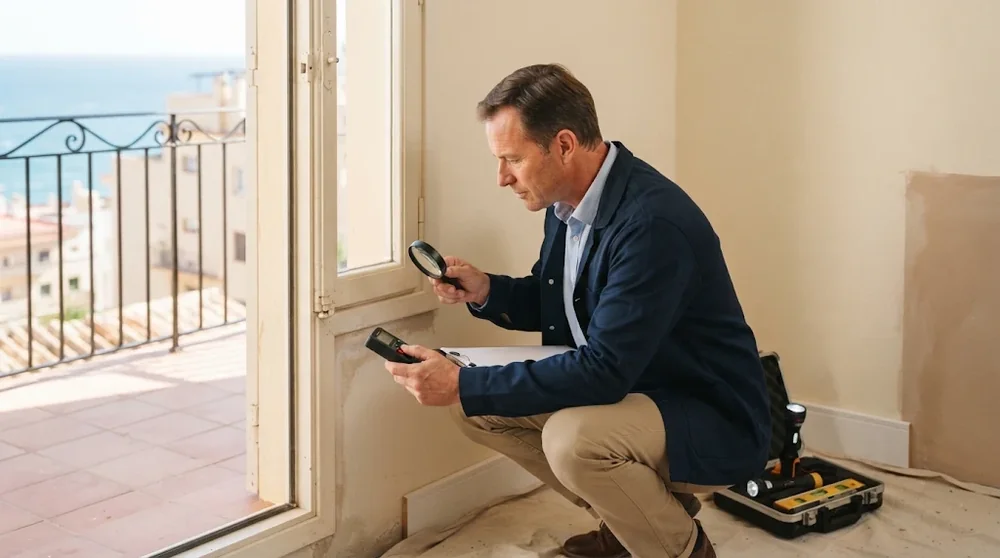
- Independent professionals. Appoint a lawyer for title and contracts and a surveyor or engineer for structure, damp, roofs, facade and shared systems.
This is where most first-time buyers slip up: they assume that notarial certification of the contract is a complete audit. It is not. A notary certifies the transaction, but does not survey the building or replace the lawyer’s review of the title and the technical inspection. Before you pay a reservation fee, make sure the checks above are agreed in writing as conditions of the sale.
Financing, Resale Costs and Investment Exit
Borrowing changes the return in both directions. The key distinction is between the unleveraged property yield and the leveraged equity return. Cash-on-cash return divides annual cash flow after debt service by the cash you actually invested, so a loan can lower the percentage if debt service exceeds NOI. I show it both before and after rental taxes, so that it is never compared with an after-tax unleveraged yield on unequal terms.
Non-resident eligibility for a Montenegrin mortgage is uncertain and depends on the lender, so I do not assume financing is available. I quote no interest rate, because I hold no dated bank offer for November 2026; request written term sheets showing the rate, arrangement fee and repayment schedule. As a hypothetical, suppose a €100,000 loan with annual debt service of €7,500 and a €1,000 arrangement fee. Cash invested is €225,000 − €100,000 + €1,000 = €126,000. With the €6,950 NOI from earlier, annual cash flow before income tax is −€550, a pre-tax cash-on-cash return of −0.44%. Deducting the case A taxes (€1,206.98 including the surtax placeholder) gives about −€1,757 and −1.39%; the case B taxes (€1,724.25) give about −€2,274 and −1.80%. These after-tax figures ignore any deduction for loan interest, which a tax adviser would need to assess.
If you already have a specific flat and a draft price, and want to compare a mortgage against a cash purchase or get a second opinion on the exit costs, it is easier to talk it through than to guess.
Whatever the financing, the exit deserves its own model. The table below uses the original €200,000 purchase, a five-year hold, a hypothetical 3% sales commission, €4,000 for refreshing and legal work, and the long-term letting NOI of €6,950 repeated for five years (€34,750). I assume no appreciation. It is an illustrative five-year pre-tax nominal total return, with no tax on rent or on disposal and no discounting.
| Sale price scenario (year 5, hypothetical) | Sale price (€) | Commission 3% (€) | Repairs and legal (€) | Net proceeds (€) | Net proceeds minus €225,000 (€) | Plus €34,750 cumulative NOI (€) |
|---|---|---|---|---|---|---|
| Below purchase price | 180,000 | 5,400 | 4,000 | 170,600 | −54,400 | −19,650 |
| Equal to purchase price | 200,000 | 6,000 | 4,000 | 190,000 | −35,000 | −250 |
| Above purchase price | 230,000 | 6,900 | 4,000 | 219,100 | −5,900 | 28,850 |
A flat sale price roughly returns your capital before tax and nothing more, because transfer tax, fees and furnishing must be recovered first. Only the higher-price case shows a gain: €28,850 on €225,000, a simple average of about 2.6% a year before tax, without discounting. Do not read the flat-price case as profitable after tax, since rental tax and any disposal tax would reduce it further. Allow for months on the market, during which service charges and property tax continue.
Disposal tax deserves its own paragraph. Official Tax Administration material identifies disposals of real estate as potentially producing a taxable capital gain, generally at 15%, subject to the legal provisions and your circumstances. The tax applies to the gain, not to gross sale proceeds: broadly, the sale price less the documented, properly adjusted acquisition cost. Exemptions may exist depending on the seller’s status and holding period. I rely on none, and I have not applied a flat percentage to the sale price in the table above. Have an adviser compute the gain from your purchase documents before you assume any net result.
Currency matters too. The apartment, rent and costs are in euros. Suppose your reporting currency is sterling and the euro falls 5% against it. An unchanged €225,000 asset would then be worth about 5% less when translated into sterling, before conversion costs; in euro terms its value is unchanged. At the original rate that is a loss of about €11,250, more than one and a half years of long-term NOI. Treat currency as part of the risk.
Budva Investment Checklist and Final Decision
The checklist below is the one I would complete before committing money to any Budva rental apartment.
- Compare at least three genuinely similar properties by net internal area, floor, condition and location.
- Obtain a complete purchase estimate: price, transfer tax or VAT treatment, notary, legal, registration, inspection, furnishing and reserve.
- Verify the title extract, encumbrances, building permits and cadastral match.
- Obtain written confirmation of the intended rental use, the applicable tourist-accommodation permissions and categorisation, guest-registration obligations and any building rules restricting short stays, and make them conditions of your decision to pay a reservation deposit.
- Establish rental comparables from collected rents or signed contracts, not only advertised rents.
- Stress-test occupancy and repairs using the break-even nights method.
- Obtain written management pricing and the building’s service charges.
- Confirm the property-tax classification and rate, and calculate after-tax yield, including any municipal surtax, on the basis confirmed by a tax adviser.
- Review financing offers and compute cash-on-cash return before and after tax.
- Define an exit scenario with sale costs, time on market, capital-gains tax and a flat or lower sale price.
For a property-specific assessment, send the listing details, the asking price, the net internal area, the latest property title extract if you have one, the building’s service charges, your intended letting strategy and your budget. With those I can build a transparent cost and income model for the shortlisted flat, and your lawyer can then verify the legal side. If you have no flat yet and are still comparing areas, budgets and letting strategies, a questionnaire is the better first step, because it narrows the field before you spend days on viewings.
If you are still choosing between locations, budgets and strategies, a short questionnaire can narrow the shortlist before you spend time on viewings.
A shortlist is only a starting point. Each flat on it still needs the title, building and cash-flow checks described above before any money moves.
Frequently Asked Questions About Budva Property ROI
What is the average rental yield in Budva?
Commercial, listing-derived research puts Budva’s gross residential rental yield at about 5.01% (Global Property Guide, first half of 2026) and roughly 3.7–4.4% (Fijaka listing snapshot, 9 November 2026). These rely on asking prices and asking rents and are not official statistics. Gross yield excludes taxes, repairs, management and vacancies, so net return must be calculated for the specific apartment.
Is buying property in Budva a good investment?
Budva can suit investors seeking coastal rental exposure, but profitability depends on the individual building, the purchase price and the rental strategy. Tourist demand does not assure year-round occupancy. A sound decision needs a verified property title, a realistic annual cash-flow forecast, adequate maintenance reserves and an exit plan that does not rely on price growth.
How much does it cost to buy an apartment in Budva?
The budget is the agreed price plus applicable taxes, notary charges, legal checks, registration, translation and any furnishing or repairs. Under the progressive rules effective January 2024, a €200,000 taxable resale incurs €7,000 transfer tax. A first sale subject to VAT follows different treatment, usually already included in the price. Obtain an itemised written quotation before committing funds.
What taxes do property investors pay in Montenegro?
Investors may meet five layers, as of November 2026: transfer tax on qualifying resales (VAT instead on a VAT-taxed first sale); annual municipal property tax, with a general range of 0.25–1% and a separate 0.3–1.5% range for secondary residences; personal income tax on rent, nominally 15%; a possible municipal surtax on that tax; and tax on a later disposal, generally 15% of the taxable gain. Status and use decide each, so confirm with an adviser.
Is short-term or long-term renting more profitable in Budva?
Short-term renting can produce higher revenue in peak months, but commissions, cleaning, utilities, management and empty nights can erase the advantage. Long-term letting generally gives steadier receipts and fewer turnovers. Compare both strategies for the same apartment using annual collected income, all operating costs and applicable taxes, not advertised nightly rates alone.
How do I calculate the net ROI on a rental property in Budva?
Add the purchase price, acquisition taxes, professional fees and setup costs to find total capital invested. Estimate annual rent actually collected, then deduct vacancy losses, operating expenses and applicable income taxes. Divide the annual result by total capital invested and multiply by 100. For financed purchases, calculate debt service and cash-on-cash return separately, before and after tax.
My Verdict on Budva Property Investment Returns
Budva rewards the investor who treats the purchase as a cash-flow project, not a headline yield. Commercial listing-based gross yields of roughly 4–5% as of November 2026 are the starting point of the analysis, not its result. In my worked example, a €200,000 resale becomes €225,000 of capital, and a 5.23% effective gross yield turns into a 3.09% net operating yield before income tax, and into roughly 2.3–2.6% on the incomplete tax sensitivities above.
The decision rests on three things I can check and one I cannot. I can check the title, the building and the annual cost model, and I can stress-test occupancy and exit prices. I cannot know future rents, occupancy or resale values, which is why I prefer apartments that still make sense when the numbers are cautious. I settled in the Bay of Kotor partly for its year-round life, and it has made me wary of any case that depends on a few summer weeks.
If you decide to proceed, let a Montenegrin lawyer, a tax adviser and a surveyor confirm what this guide can only outline. A careful assessment of a real shortlisted flat is worth far more than any average.
Disclaimer: The calculations in this article are illustrative, and the hypothetical figures are teaching tools, not Budva averages or forecasts. After-tax figures are incomplete sensitivities, not actual investor returns. The content is general information as of November 2026 and is not personalised legal, tax or investment advice. Consult a qualified Montenegrin lawyer, tax adviser and surveyor before making any purchase decision. Official sources include the Real Estate Administration for property records and MONSTAT for official statistics.