A reservation fee is due, and all you hold is a brochure, a render and a payment schedule. Before you pay, you need four answers about off-plan developers in Montenegro: which company will sign, what it is permitted to build, who funds construction and who receives your money. This guide shows how to check each one, who should verify it, and when to pause or withdraw.
Evaluate off-plan developers in Montenegro by checking the contracting company, completed projects, land rights, permits and funding. Have an independent local lawyer review mortgages, payment security, deadlines and registration arrangements, while an engineer checks construction evidence. Before paying a reservation fee, establish who receives your money and what happens if delivery fails.
Start with Evidence, Not the Sales Brochure
I restored my own stone house before guiding buyers around the Bay of Kotor, and that work left me one habit: ask what lies behind the finished surface. A sales presentation is a finished surface. The sequence below is my editorial method for how to check a developer in Montenegro and for Montenegro off-plan property due diligence. It is not a statutory procedure, and an independent Montenegrin lawyer must confirm what applies to your project.
What should be checked before reservation?
- Identify the seller that will sign the contract and receive your money.
- Verify delivery history on comparable completed buildings.
- Check financial evidence for that exact company.
- Match land rights and permits to your building and phase.
- Review how each payment is protected.
- Inspect construction against payment milestones.
- Agree completion, defect and registration safeguards in the contract.
| Check | Document | Independent verifier | Decision |
|---|---|---|---|
| Seller identity | Company extract, PIB, signing authority | Lawyer | Continue only if every party is identified consistently and its role is legally explained |
| Delivery history | Handover, use-permit and owner evidence for completed buildings | Lawyer; your own site visits | Pause until delivery is attributed to the signing entity or a documented group link |
| Financial evidence | Filed accounts, funding explanation, dated CBCG search | Accountant; lawyer | Pause if funding is unexplained or unsupported |
| Land and permits | List nepokretnosti; issued permit for your building and phase or, for an eligible legacy project, the recognised notification | Lawyer; engineer | Withdraw if the lawful right to build your unit cannot be shown |
| Payment protection | Draft contract, deposit or guarantee wording | Lawyer | Pause until beneficiary, release and refund route are documented |
| Construction | Dated inspection reports tied to milestones | Your engineer | Negotiate inspection-based release conditions before signing |
| Completion terms | Contract schedules, remedies, registration duties | Lawyer | Negotiate; withdraw if refund and registration terms are refused |
No safety score can compensate for an unresolved legal or payment-security problem. Attractive finishes, a recognisable brand and a sea view do not replace proof of who holds the land or where your money sits. For that reason I do not rate developers numerically: strong results on six checks cannot offset a failure on the seventh.
Check the Developer in CRPS and IRMS
The Central Register of Business Entities, abbreviated CRPS, is the public company register kept by the Montenegrin Tax Administration. The Tax Administration has made CRPS extracts available for public download through its IRMS portal (as of November 2026). Ask your lawyer what the extract for your company actually shows, because unrestricted access to every ownership detail should not be assumed.
The first document I ask for is the extract for the exact entity named in the draft contract, not the name on the hoarding.
Who actually owes you the apartment?
One project can involve six different parties: the marketing brand; the contracting company, often a project company or SPV, meaning a company created to carry a single development; the parent group; the landowner; the building contractor; and the bank beneficiary named for payments. They are frequently separate legal persons, and only the contracting company is clearly bound by your contract.
- Copy the legal name, PIB and registration number from the reservation form and draft contract. The PIB is the Montenegrin tax identification number.
- Download the CRPS extract through IRMS for that name and PIB, and record the search date.
- Compare the directors and signing authority with the person who will actually sign; ask for written authorisation where someone else signs.
- Map brand, SPV, parent, landowner, contractor and bank beneficiary on one page. Every difference needs a written explanation.
- Compare the account holder named for payments with the contracting company. A different holder can be legitimate, for example a lender’s collection account, a notary or a documented payment agent, but it needs a verified legal explanation, because matching names alone do not make a payment safe.
- Ask in writing what the parent or group guarantees, if anything.
A parent’s reputation is not a parent guarantee: a famous group answers for a subsidiary’s promises only where a document says so and your lawyer confirms its effect. If the seller, signatory and payee do not match, treat that as an open legal question, not as proof of wrongdoing.
Verify Completed Projects and Delivery History
A portfolio page shows what a group chooses to display; a delivery history shows what one company actually handed over. As an editorial evidence request, not a statutory minimum, ask for two or three comparable completed projects where available, similar in size, construction type and setting.
- Promised against actual dates: compare the completion date promised in earlier sales contracts with the date keys were really handed over.
- Delivering entity: establish which legal entity built and sold each project. If it was another company in the group, ask for documents showing the link.
- Lawful use: ask whether an upotrebna dozvola, the use permit, was issued, and when.
- Registration: ask owners how long it took before their ownership appeared in the cadastre.
- Site visit: inspect common areas, roofs, drainage, parking and lifts, and compare them with the original specification.
- Owner evidence: request permission to speak to owners you choose, not only those the developer proposes.
- Defects and changes: ask about recurring leaks, maintenance disputes and substituted materials.
- Short history: a new SPV is not automatically unsuitable, but group experience needs documentary attribution to the company that will sign.
I do not quote buyer testimonials in this guide. Reliable owner evidence is gathered by you, with your own questions, and weighed with your lawyer. A refusal to allow visits proves nothing by itself, but it leaves the evidence missing.
Assess Funding and CBCG Warning Signs
Financial checks answer a narrow question: is there evidence that this company can finish what it is selling? Start with filed accounts where they exist. Ask the developer for copies of the financial statements it has filed, and have your lawyer or accountant obtain whatever the company has filed with the official registers, so that you compare what you are given with what is on record. Then ask the accountant to read debt, liquidity and related-party balances, meaning money owed to or by companies under the same control. A project company with little trading history may have no useful accounts at all, which shifts the weight onto funding evidence.
Ask directly how construction is funded: committed bank lending, shareholder equity or future buyer instalments. A project that can only continue if new buyers keep paying carries a different risk from one with funding already committed. Bank finance is also not buyer protection, because a lender’s security protects the lender.
A funding statement is only the developer’s own description; independently supported funding is something you can read in documents. Ask for the following, and let your accountant and lawyer judge whether it is enough:
- Committed facility documents: the signed loan agreement or facility letter, not a statement that the bank is “supportive”.
- Drawdown conditions: what the developer must achieve before each tranche is released, and whether those conditions have been met.
- Equity already contributed: evidence of shareholder money actually paid into the project, not a promise to contribute.
- Cost to complete: an assessment of remaining construction cost, ideally from an independent engineer or quantity surveyor, set against the funding that is committed.
The Central Bank of Montenegro (CBCG) publishes monthly snapshots of blocked accounts and offers a daily debtor search. The page reported for this guide listed data as at 31 October 2026, so confirm the date on the day you search. Search the exact contracting company, and record the entity, the PIB and the search date.
My assessment, not legal advice: a clean CBCG search is a reason to keep checking, never a reason to stop. It shows only that no blocked account appeared in that data on that date, and it does not prove solvency.
Missing accounts, an unexplained account block or a refusal to identify the funding source warrants investigation, not an accusation. Put the question in writing, set a date for the answer, and let your accountant and lawyer judge whether the response is adequate. These are the core risks of buying off-plan property in Montenegro that financial checks can surface early.
Match Land Rights and Building Permits
The katastar nepokretnosti is Montenegro’s real-estate cadastre (the official portal is katastar.me), and the list nepokretnosti is the property sheet drawn from it for a plot, showing rights holders, charges and annotations. Read it in this order:
- Find the cadastral municipality and plot numbers in the contract and design documents.
- Obtain a current list nepokretnosti for each plot and check who holds the right to build.
- Read the encumbrances, such as mortgages and easements.
- Read annotations and pending matters; these need legal interpretation, not self-diagnosis.
- Compare plot numbers and areas with the permit and the location of your unit.
Which permit applies to this phase?
Planning conditions, design approval, a permit application and an issued građevinska dozvola (building permit) are different documents. Under the current permit regime, an issued building permit is what authorises construction; an application or an approved design does not. Some earlier projects, however, acquired their eligibility to build through a construction notification under a previous regime, and the legislation recognises those buildings. Which route lawfully applies depends on the project, so ask your lawyer to identify and verify the authorisation route for your specific building and phase, and do not accept a general assurance that “the permit is in order”.
These Montenegro developer building permit checks sit under the Zakon o izgradnji objekata, the Law on the Construction of Buildings. As of November 2026, the official listing identifies amendments 019/25, 092/25, 160/25 and 114/26, and Official Gazette amendment 114/2026 was published and took effect on 3 August 2026. Do not assume a translation or a pre-2025 guide states the current law. Ask your lawyer to verify the operative provisions and transitional regime for your project. I give no article numbers or deadlines here, because they require inspection of the current primary text.
| Document | Question it answers | Ask the developer |
|---|---|---|
| List nepokretnosti | Who holds the land rights, and what charges exist? | Is the contracting company the right holder for every plot, or is the right held by a landowner whose role is documented? |
| Planning conditions | What may be built on the plot? | Do they cover this phase? |
| Design approval | Was this design approved? | Does it match the unit sold? |
| Permit application | Has permission been requested? | Why is there no issued permit? An application is not a permit. |
| Issued građevinska dozvola | Is this specific building authorised under the current permit regime? | Number, authority, date, phase and permit holder? |
| Construction notification (eligible legacy projects only) | Did the project acquire eligibility to build under an earlier notification regime? | Which notification, when, and on what basis may it still be relied on for this phase? |
| Lender consent | Can individual units be released? | Is it in writing, and does it cover my unit? |
How will the unit be released from a mortgage?
Mortgage release means removing the lender’s charge from your unit, or documenting exactly how it will be removed. A mortgage on development land is neither an automatic rejection nor an approval; it requires a credible, documented release mechanism. Ask:
- Who is the lender, and what debt does the charge secure?
- Has the lender consented in writing to sales of individual units?
- Does your instalment go to the developer or to the lender?
- When, and in what form, is the release delivered?
- Who files the application, and what happens if the developer will not?
Establish How Each Payment Is Protected
This is where most first-time buyers slip up: they treat a notarised contract or an agency receipt as proof that their money is safe. A notarial contract does not itself ring-fence money, and escrow is not mandatory, universal or automatically protective. A notarial deposit means money placed with a notary under written conditions; confirm the current notarial-deposit rules and any Notaries Law amendments with your lawyer before relying on them.
| Arrangement | Who controls the money | Release and refund | Questions for your lawyer |
|---|---|---|---|
| Direct payment to the developer | The developer, once received | The contract and applicable law; practical recovery also depends on enforceability and available assets | Is a refund claim realistically enforceable if the company lacks funds? |
| Documented notarial deposit | A notary, under written conditions | Only the conditions in the deposit document | Who triggers release? What are the costs, expiry date and exclusions? |
| Bank guarantee, if offered | The guarantor bank promises payment on defined events | Claim procedure and expiry set by the guarantee | Which events trigger it, until when, and does it cover refunds only? |
Insolvency is the stress test for Montenegro off-plan payment protection. If the developer fails, your position depends on whether the money was ever the developer’s asset, who else may claim it and how quickly a refund can be enforced. Those are legal questions; I can frame them, but your lawyer must answer them for your file.
Illustrative only: imagine a hypothetical apartment priced at EUR 200,000. A first sum could sit with a notary against a written condition, a second sum could be released after your engineer confirms the structure, and the final sum could be held back until use-permit and registration documents are delivered. The structure is an illustration, and I am not suggesting that any percentages are normal or required.
Whatever structure is proposed, ask for the exact wording in writing, in English if you need it, and have your lawyer review the clauses before any money is transferred.
Inspect Construction Before Releasing Instalments
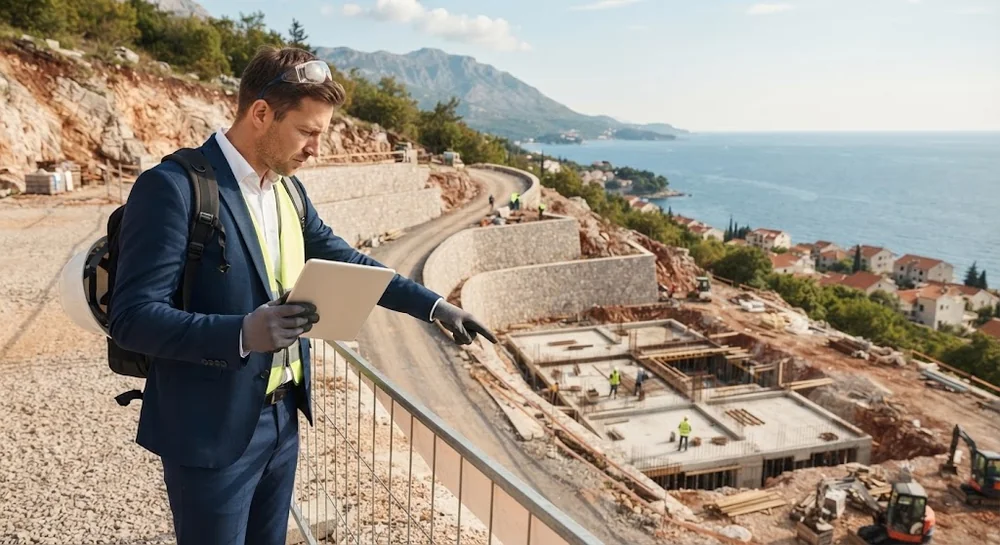
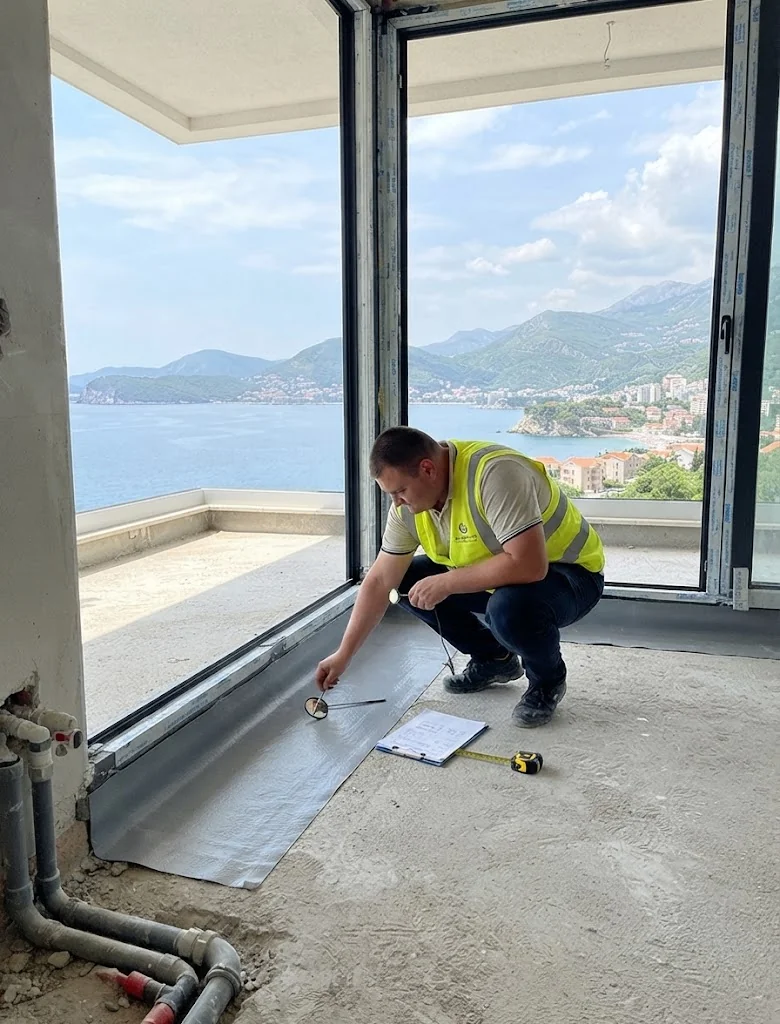
Statutory project supervision is part of the building process, and the legislation sets independence requirements for it, including restrictions on investors, contractors and their employees performing supervision; confirm the current requirements with your lawyer. Independent construction supervision on your behalf is an additional service: an engineer you appoint, who reports directly to you. Require dated inspection evidence tied to each contractual milestone, because photographs alone may not show compliance: they rarely reveal dates, locations or measurements.
- Waterproofing: balcony thresholds, terraces, basement walls and podium decks, inspected before they are covered.
- Drainage and retaining structures: run-off routes, cuttings and walls on slopes, ideally observed after heavy rain.
- Corrosion exposure: reinforcement cover, metalwork and fixings near salt air.
- Glazing and acoustic separation: window specification and party-wall and floor build-ups compared with the contract.
- Utilities: written confirmation of electricity, water, sewerage and road access, rather than a statement that connection is in progress.
- Budva and Bečići: access for deliveries and emergency vehicles, and density around the plot.
- Kotor and Herceg Novi: slope, narrow access and any heritage or protection constraints, where they apply to the plot.
- Tivat and Luštica: where one phase’s roads, water and sewerage end, and who is obliged to finish the rest.
- Bar: drainage and utility capacity for the site.
- Podgorica: an inland comparison, where coastal exposure matters less but permit, utility and milestone evidence still apply.
The location prompts are questions to ask, not findings: they describe no universal defect and no blanket municipal restriction. Construction evidence should release money only where the contract makes release depend on it.
That condition has to be negotiated before you sign. Ask your lawyer to write inspection-based release conditions into the payment schedule, so that each instalment is linked to a milestone and to your engineer’s written confirmation. If you are already bound by a contract without such terms, an adverse engineer’s report does not automatically entitle you to suspend a payment that has fallen due. Take legal advice on notices and lawful withholding before you miss a payment, because a missed instalment can itself put you in breach.
If you are unsure how the payment clauses in your own draft contract would work if delivery failed, a short one-to-one conversation before you sign can help you prepare sharper questions for your lawyer.
Keep every inspection report, notice and reply in one dated file. If a dispute ever reaches a lawyer or a court, a clear paper trail of what you asked, when, and what the developer answered is worth more than any recollection.
Negotiate Completion, Defects and Registration Terms
Three moments are often blurred: handover of keys, lawful occupation and registered ownership. The upotrebna dozvola, the use permit, broadly confirms that a completed building may be used, but how it interacts with cadastral registration depends on the project’s status and on transitional rules, so I do not state one universal sequence. Statutory construction deadlines are administrative; they do not replace the buyer remedies you negotiate.
| Term | What to define | Question to ask |
|---|---|---|
| Unit identification | Number, floor, plan, plot | Does the attached plan match the building permit? |
| Area and variation | Net and gross area, tolerance | What happens to the price if the area differs? |
| Parking and storage | Right, location, registration | Is the right sold, registered and transferable? |
| Specification and substitutions | Finishes, fittings, glazing | Who approves equivalent substitutes? |
| Completion date | What counts as complete | Keys, use permit or finished snagging? |
| Long-stop date | Final date after which you may exit | Which events can extend it? |
| Extensions and notices | Permitted reasons, written notice | Is evidence required for each extension? |
| Delay remedies | Compensation, interest | Who pays, and how is it enforced? |
| Termination and refund | Triggers, timing, source of funds | Which account refunds, and by when? |
| Snagging | Inspection right, repair period | Is a retention held until repairs finish? |
| Defects | Warranty period, procedure | Which entity answers, and is anything secured? |
| Utilities | Connections included in the price | Who pays connection fees and deposits? |
| Use permit | Developer’s obligation and deadline | What are my rights if it is delayed? |
| Registration cooperation | Documents and signatories | Who files, and what is the remedy for non-cooperation? |
| Dispute procedure | Governing law, forum, language | Where and how would a claim be heard? |
Receiving keys establishes physical handover; it does not by itself establish lawful occupation or registered ownership. Registered ownership is a separate legal event, and your lawyer should map it out for your unit rather than rely on a general rule.

Compare Developers and Decide Your Next Step
Use one copy of this worksheet per developer, and add no scores. It consolidates the contracting-company, delivery, funding, land, payment, construction and contract checks above. The wording in the cells is only an example of what to record; it is not a completed check, and you fill in your own findings.
| Check | Evidence received | Independently verified | Unresolved issue | Responsible specialist | Next action |
|---|---|---|---|---|---|
| Contracting company | Record: extract, PIB, signatory | Record: roles of brand, landowner and payee explained and verified? | Example: brand or payee differs | Lawyer | Example: request written explanation |
| Delivery history | Record: handover and use-permit records | Record: sites visited, owners spoken to | Example: entity attribution unclear | Lawyer | Example: request group-link documents |
| Funding | Record: accounts, facility documents, equity, cost to complete | Record: accountant review, dated CBCG search | Example: reliance on buyer instalments | Accountant | Example: ask for funding evidence |
| Land and permits | Record: list nepokretnosti, permit or legacy notification | Record: plots, phase and authorisation route matched | Example: mortgage release undocumented | Lawyer | Example: request lender consent |
| Payment protection | Record: deposit or guarantee wording | Record: control and refund route read | Example: release trigger unclear | Lawyer | Example: redraft clause |
| Construction | Record: dated inspection reports | Record: engineer site visit | Example: evidence not tied to milestone | Engineer | Example: negotiate release conditions; take legal advice before withholding any instalment |
| Contract and registration | Record: draft contract | Record: clause review | Example: registration duties vague | Lawyer | Example: negotiate wording |
Treat the decision as three separate stages: your own initial screening, specialist review, and the final decision to sign or pay.
- Initial screening: proceed to specialist review when every row has evidence or a documented explanation, and no rights, permit or payment issue remains obviously open.
- Pause pending evidence when documents are missing or unexplained, and set a written deadline for answers.
- Withdraw when an unacceptable issue survives reasonable requests, such as no demonstrable lawful right to build, a payment arrangement whose purpose cannot be explained or verified, or refusal of refund and registration terms.
Specialist review is the lawyer’s, engineer’s and accountant’s work, each giving a written opinion on their own area. The final decision to sign or pay is yours, and it should follow those opinions, not precede them.
Hypothetical scenario A. A well-known brand markets a seafront block, but the draft contract names an unfamiliar company and offers no parent guarantee. The brand is not the debtor, so the sensible decision is to pause until contracting liability, funding and the payee are explained in writing.
Hypothetical scenario B. A smaller developer has two documented completed buildings with registered owners but cannot show how the next phase will be funded. Moving to specialist review makes sense only with a funding explanation and a payment structure that does not rest on buyer instalments alone.
Before spending time on checking every project, it helps to narrow the field by budget, location and investment goals, so your lawyer and engineer review only developments that deserve the effort.
If you would like a project-document checklist or a coordinated review, I can request the documents, introduce independent lawyers, engineers and accountants, and keep the process organised. I am a property expert in Montenegro, and I do not certify title or legality; each specialist is responsible for their own opinion.
Questions About Off-Plan Developers in Montenegro
How can I check a property developer in Montenegro?
Start with the exact company named in the proposed contract and use its PIB and registration details to obtain registry evidence. Compare directors, signing authority and project rights with the sales documents, then verify completed developments independently. Review available financial information and CBCG account-blocking records for that entity. A familiar sales brand does not establish the contracting company’s financial strength.
Which documents should I see before paying an off-plan reservation fee?
Request the contracting company’s registry extract, current land-registry evidence, the approvals that apply to your building and phase, the reservation terms and a draft purchase agreement. Identify the precise unit, the payment recipient, refund conditions and any mortgage-release arrangements. Ask an independent Montenegrin lawyer to assess missing documents and their legal effect before money moves, especially at an early project stage.
Are off-plan payments automatically protected by escrow in Montenegro?
Not automatically. Do not assume a payment is protected because a notary, agent or bank is involved. Ask your lawyer to identify the current legal requirements as of November 2026 and examine the actual deposit arrangement. Protection depends on who controls the account, when funds are released, which refunds are enforceable and how the arrangement operates if the developer fails.
Can I buy an off-plan apartment if the development land is mortgaged?
A development mortgage does not by itself decide whether a purchase is acceptable; it is neither automatic approval nor automatic rejection. Your lawyer should establish the lender’s rights and the precise process for releasing your unit from the charge. Request documented release conditions, payment instructions and registration arrangements in writing, and do not rely on a verbal promise that the mortgage will disappear.
What happens if the developer misses the completion date?
Your options depend on the contract, applicable law and the developer’s ability to perform. Before signing, review the completion definition, extension rights, notice requirements, long-stop date, delay remedies and refund procedure. An administrative construction deadline does not automatically compensate a buyer. Have a lawyer explain how any proposed remedy would be enforced if the developer disputes it or lacks funds.
When do I become the registered owner of an off-plan apartment?
Signing a contract, paying the price and receiving keys are separate from registration of ownership in the cadastre (see katastar.me for the official portal). Ask your lawyer to explain the route for your unit, including the building’s cadastral status, applicable use-permit requirements, release of mortgages and the documents needed for registration. Confirm who must submit each document and what happens if the developer does not cooperate.
My Practical Takeaway for Buyers
Checking off-plan developers in Montenegro comes down to one discipline: match every promise to a document, and every document to someone qualified to read it. Establish the contracting company, its delivery record, its funding, its land rights and permits, and the route your money takes. Then let an engineer confirm what has actually been built.
Before you pay a reservation fee, make sure you know who receives the money, what happens if delivery fails and who will file your registration. Restoring my stone house taught me that sound structure comes before finishes, and the same order serves a buyer of a new apartment. Withdrawing from a project with an unresolved issue is a sound outcome of due diligence, not a failed one.
Disclaimer: this guide is general information as of November 2026 and is not legal, tax, financial or engineering advice. Laws, registers and procedures change, and individual projects differ. Seek independent Montenegrin legal advice and suitable technical and accounting input before signing or paying anything. It guarantees no outcome and recommends no developer.